SpaceX IPO: The Full Story Behind the Losses, the Ambitions, and the $1.75 Trillion Bet
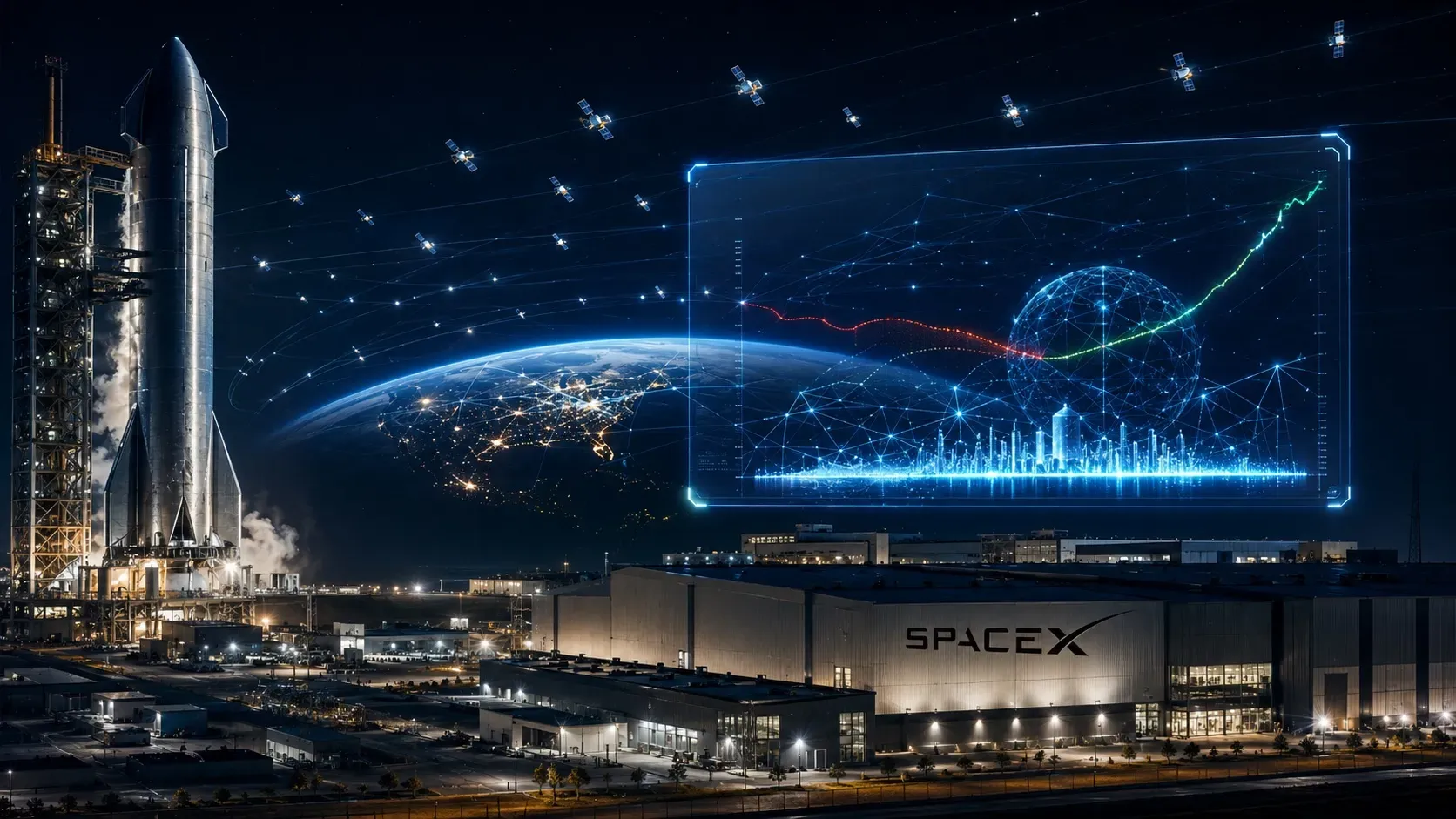
SpaceX is expected to qualify rapidly for inclusion in the Nasdaq-100 under updated fast-track eligibility rules

Dubai | EcoPulse24
SpaceX is preparing to enter public markets with one of the most ambitious and controversial offerings in modern financial history - a deal that is not simply testing investor appetite for a space company, but challenging how markets value artificial intelligence, orbital infrastructure, sovereign connectivity, and founder-controlled corporate power under a single balance sheet.
The company confidentially filed for an initial public offering with the US Securities and Exchange Commission on April 1, 2026, before publicly releasing its S-1 filing on May 20. Trading is expected to begin on Nasdaq under the ticker SPCX on June 12, following pricing on June 11 and an institutional roadshow scheduled for early June. Elon Musk has stated publicly that he does not intend to sell any shares during the offering.
Once listed, SpaceX is expected to qualify rapidly for inclusion in the Nasdaq-100 under updated fast-track eligibility rules, potentially triggering large passive inflows from index-tracking funds within just two weeks of trading.
The offering is being led by five major Wall Street banks - Bank of America, Citigroup, Goldman Sachs, JPMorgan Chase, and Morgan Stanley - alongside 16 additional underwriters.
But beneath the excitement surrounding the IPO lies a far more complicated reality: SpaceX is not a single business. It is effectively three radically different companies - a profitable satellite-connectivity platform, a heavily subsidized launch infrastructure division, and an AI operation burning capital at a historic rate - all wrapped into one valuation approaching $1.75 trillion.
The numbers behind the filing
For full-year 2025, SpaceX generated $18.674 billion in revenue while reporting a $2.589 billion operating loss and adjusted EBITDA of $6.584 billion. In the first quarter of 2026 alone, revenue reached $4.694 billion, while operating losses widened sharply to $1.943 billion. Adjusted EBITDA for the quarter totaled $1.127 billion.
The company posted a net loss of $4.94 billion for 2025. During Q1 2026 alone, net losses reached $4.28 billion - compared with just $528 million during the same quarter a year earlier.
Yet one critical point is often misunderstood in surface-level commentary: SpaceX remains strongly profitable on an adjusted EBITDA basis. The deterioration in net income is being driven primarily by stock-based compensation, depreciation linked to the Starlink satellite constellation, and massive AI infrastructure spending tied to xAI and Grok. Some of these costs are non-cash, but all represent real economic expenditures.
Before the integration of xAI, SpaceX had actually reported a net profit of $791 million in 2024. The merger transformed the company from profitable into deeply loss-making almost overnight - a strategic decision rather than a sign of operational collapse.
Starlink is carrying the company
The clearest engine supporting the SpaceX investment case is Starlink.
The company’s connectivity segment generated $11.387 billion in revenue during 2025, representing annual growth of nearly 50%. Operating income surged 120.4% to $4.423 billion, while adjusted EBITDA climbed to $7.168 billion. During the first quarter of 2026 alone, the division produced $3.257 billion in revenue and $1.188 billion in operating income.
Starlink ended the quarter with 10.3 million subscribers across 164 countries and more than 9,600 satellites in orbit.
However, the filing also reveals an important warning sign that many bullish analyses have ignored: average monthly revenue per user declined from $81 at the end of 2025 to $66 during Q1 2026 - a 19% drop in a single quarter.
The decline reflects Starlink’s expansion into lower-income international markets and broader consumer penetration. Subscriber growth is still offsetting pricing pressure for now, but the ARPU trend may become increasingly important if expansion slows.
The launch business is still losing money
SpaceX’s launch division remains deeply unprofitable.
The segment generated just $619 million in revenue during Q1 2026 while posting a $662 million operating loss, meaning the division is currently losing more money than it generates in sales. For full-year 2025, the launch segment recorded an operating loss of $657 million.
The losses appear intentional.
SpaceX continues investing aggressively into Starship, which the company believes could fundamentally reshape launch economics once development stabilizes and large-scale deployment becomes commercially viable.
For now, however, the launch business functions more like a strategic infrastructure investment than a profitable operating segment.
The AI division is consuming capital at extraordinary speed
The most aggressive spending inside SpaceX is now concentrated in AI.
The company’s AI segment - referred to internally as SpaceXAI - recorded a $2.469 billion operating loss during Q1 2026 on revenue of just $818 million. For full-year 2025, operating losses in the AI division totaled $6.355 billion.
The filing reveals plans to scale the Grok AI model toward “multi-trillion parameter” systems, requiring enormous additional compute infrastructure spending. Capital expenditures tied to AI alone reached $7.72 billion during the first quarter of 2026 - implying an annualized pace exceeding $30 billion.
One positive development emerged from the xAI integration itself. After xAI borrowed approximately $16 billion during 2025 to finance its compute infrastructure, SpaceX secured a cheaper $20 billion bridge loan in March 2026 that was used to refinance and restructure xAI’s debt under the consolidated entity.
The balance sheet most investors are missing
SpaceX’s cash position declined sharply from $24.75 billion at the end of 2025 to $15.85 billion by the end of Q1 2026. Total debt climbed to $29.1 billion.
Total capital expenditures during Q1 alone reached $10.10 billion, compared with $4.14 billion during the same quarter a year earlier.
Cumulative losses since the company’s founding reached approximately $41.3 billion as of March 31, 2026.
Meanwhile, revenue from the US government - including NASA, the Pentagon, and intelligence agencies - totaled $5.9 billion during 2025, accounting for 31.6% of total company revenue.
That figure sits at the center of one of the IPO’s most politically sensitive debates: the extent to which SpaceX’s business model is intertwined with US national-security and government spending priorities.
The valuation question
At a targeted valuation of $1.75 trillion against 2025 revenue of $18.674 billion, SpaceX is asking investors to pay roughly 95 times annual sales - a multiple virtually unprecedented at this scale.
Prediction markets currently imply a 98% probability that SpaceX surpasses a $1 trillion market capitalization and a 72% probability that it exceeds $2 trillion. The synthetic SPCX-USD contract on Hyperliquid suggests an implied valuation closer to $2.4 trillion.
The honest answer is that this is not one IPO. It is three radically different businesses being sold under one ticker.
Starlink is profitable and scalable.
The launch business is deliberately reinvesting.
The AI division is consuming capital at a pace rarely seen in public markets.
Investors are not valuing what SpaceX is today. They are valuing what it could become if orbital infrastructure, artificial intelligence, sovereign connectivity, and launch systems converge successfully inside one corporate structure.
Musk’s control package may become the largest in history
The filing also reveals one of the most controversial governance structures ever proposed in a major public offering.
In January 2026, SpaceX’s board granted Musk one billion restricted Class B shares worth approximately $700 billion at the target valuation.
Two additional compensation packages remain outstanding:
-
200 million super-voting Class B shares triggered only if SpaceX reaches a $7.5 trillion valuation and establishes a permanent Martian settlement of one million inhabitants
-
an additional 60.4 million shares tied to valuation thresholds and deployment of orbital data centers with 100 terawatts of compute capacity
Most notably, the filing indicates Musk may vote these shares before vesting and may also pledge them as collateral for loans.
Institutional backlash grows
Criticism surrounding the IPO is already intensifying.
On May 14, leaders from CalPERS and New York pension systems managing roughly $1 trillion in retirement assets jointly described the proposed governance structure as “the most management-favoring governance framework in the history of US public markets.”
Musk controls roughly 85% of voting power through Class B shares despite owning approximately 42% of the company economically.
Critics point to:
-
permanent super-voting structures
-
veto power over removal decisions
-
mandatory arbitration clauses limiting shareholder lawsuits
-
Texas legal provisions raising thresholds for shareholder proposals
-
extensive related-party transactions involving Tesla and affiliated entities
Labor unions have also demanded enhanced SEC scrutiny, arguing that rapid Nasdaq inclusion could force pension funds and retail retirement savers into automatic exposure to the stock before governance risks are fully understood.
The deeper question behind the IPO
The SpaceX offering arrives at a moment when global markets are increasingly rewarding scale, founder control, AI infrastructure dominance, and strategic national importance over traditional valuation discipline.
The company sits at the intersection of:
-
artificial intelligence
-
defense infrastructure
-
satellite connectivity
-
launch systems
-
sovereign communications
-
cloud computing
-
government contracts
-
industrial-scale data infrastructure
That combination is almost impossible to compare using conventional public-market frameworks.
EcoPulse24 Analysis
The SpaceX IPO ultimately represents one of the clearest examples of how capital markets are changing in the AI era.
This is no longer a market that prices companies solely on current profitability. Investors are increasingly allocating capital toward infrastructure dominance, compute capacity, network scale, and strategic technological positioning decades into the future.
Starlink alone already resembles a globally scaled telecommunications and sovereign-connectivity platform. The launch business operates more like strategic industrial infrastructure. Meanwhile, xAI is behaving like a wartime AI spending machine competing directly against OpenAI, Anthropic, and the broader hyperscale ecosystem.
The valuation may appear irrational under traditional metrics. Yet the market is not pricing today’s earnings. It is pricing the possibility that one company could simultaneously control:
-
orbital internet infrastructure
-
launch logistics
-
AI compute deployment
-
sovereign communications
-
planetary-scale data systems
That future may never fully materialize.
But investors buying into SpaceX are not purchasing a conventional aerospace company.
They are making a concentrated long-duration bet on whether Elon Musk can merge space infrastructure, artificial intelligence, and global connectivity into one dominant technological platform.
Explore Related Coverage
Sources & References
SpaceX S-1 Registration Statement — SEC EDGAR (filed May 20, 2026)
https://www.sec.gov/Archi…rationtechnologi.htm
NYC Comptroller — Joint Letter to SpaceX re: IPO Governance (CalPERS, NY State, NYC)
https://comptroller.nyc.g…d-calpers-ceo-frost/
American Federation of Teachers — AFT demands extraordinary scrutiny of SpaceX IPO
https://www.aft.org/press…-workers-retirements
Editorial Note
Disclaimer
© 2025 EcoPulse24. All rights reserved.