Trump Announces Oil Deal: India to Buy Venezuelan Crude Instead of Iranian
Trump says India will buy Venezuelan, not Iranian oil, as US controls Venezuela's oil. India's reliance on Russian oil complicates the shift.

Washington - EcoPulse24
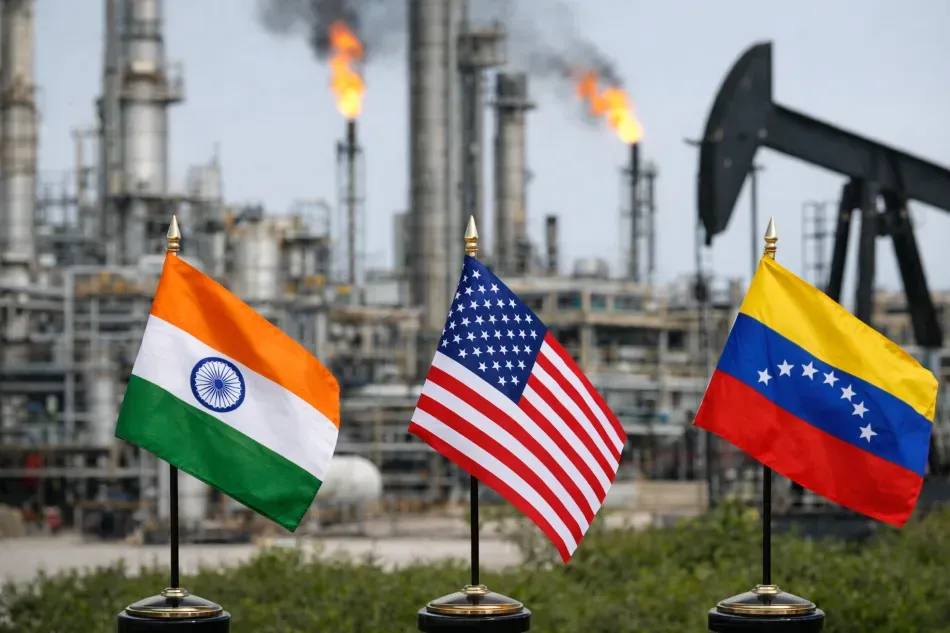
US President Donald Trump announced that India will purchase Venezuelan oil instead of Iranian, marking a radical reshaping of global energy flows under American influence. Speaking to reporters aboard Air Force One, Trump stated, "We've already made this deal, the concept of the deal," adding that China is also welcome to buy Venezuelan oil.
The announcement followed the US taking full control of Venezuelan oil sales and revenues after the arrest of former President Nicolás Maduro in January 2026. Trump clarified that Washington intends to maintain control over Venezuelan oil indefinitely, an unprecedented move placing one of the world's largest oil reserves under direct US management.
The deal comes amid heightened US-India tensions in 2025 over India's imports of Russian oil. In August, Trump imposed an additional 25% tariff on Indian goods, raising total duties to 50%, aiming to compel New Delhi to halt Russian oil purchases that Moscow uses to fund its war in Ukraine. Previously, in March 2025, Trump had imposed a 25% tariff on all countries buying Venezuelan oil, including India.
Official data highlights the challenge for Washington in shifting India's import behavior. In November 2025, India imported $3.7 billion of Russian oil, accounting for 35% of its total oil imports, with a volume of 7.7 million tons. Notably, Russia's share of India's oil imports surged from just 2.5% in 2021 (before the Ukraine war) to around 50% in 2025, making Russia India's largest single oil supplier.
Nevertheless, India has shown some response to US pressure. By October 2025, India's imports of US oil rose to 10.7% from just 3% in 2024, part of efforts to improve relations and reach the "Mission 500" goal of $500 billion in bilateral trade by 2030. US Treasury Secretary Scott Bessent indicated in January that the extra 25% tariffs could be lifted due to India's sharp reduction in Russian oil imports.
However, significant technical and economic challenges hinder the deal's implementation. Venezuela produced 896,000 barrels per day in December 2025 - a fraction of its 1970s peak of 3.5 million bpd. This is less than 1% of global output, despite Venezuela holding 303 billion barrels of proven reserves (17% of the global total), surpassing even Saudi Arabia.
Analysts say restoring production to 3 million bpd would take at least a decade and require hundreds of billions in investment. Venezuela's infrastructure needs an estimated $58 billion just to recover historic capacity, with pipelines largely unchanged for 50 years. At best, an additional 500,000 bpd could be added in two years with $10 – 20 billion in investment - still limited compared to India's demand.
The nature of Venezuelan oil complicates matters further. Its crude is extremely heavy, with an API gravity below 10 and sulfur content over 3%, requiring extensive processing and blending with lighter oil before export. Most reserves need oil prices around $100 per barrel to be economically viable, while Brent is currently at just $60.
India also faces a real economic dilemma. Its total imports from Russia reached $68.24 billion in 2024, growing at 53.6% annually since 2017, mostly discounted oil. Russian oil offers India significant advantages: lower prices, long-term stable contracts, and better compatibility with Indian refineries compared to heavy Venezuelan crude.
Global oil markets have shown limited reaction to Venezuelan political developments. Brent dropped to about $60 per barrel and WTI below $58, mainly due to a global supply glut rather than geopolitical concerns. The IEA estimates a supply surplus of about 2 million bpd in 2026, reducing the impact of potential Venezuelan supply disruptions.
This week, the US government eased some sanctions on Venezuela's oil sector to enable American companies to sell Venezuelan crude. A White House official said the move "will help move existing product" from Venezuela, with more announcements on sanctions relief expected. These steps aim to redirect Venezuelan exports from China - whose shipments fell to zero in January 2026 - toward the US and its allies.
The deal carries broader geopolitical implications. Washington aims to achieve three strategic goals: cut off Russia's oil revenues funding the Ukraine war, isolate Iran by replacing its oil with US-controlled Venezuelan supply, and turn Venezuela from a supplier to China and Russia into a tool for US policy. However, analysts warn that past US interventions in Iraq and Libya led to prolonged instability, and Venezuela, with its 30 million people, could face a similar fate.
For the Middle East, these developments could open opportunities for Gulf producers. The Gulf's share of India's oil imports fell from 63% to 46% between 2017 and 2024, mainly due to discounted Russian oil. If India reduces Russian imports under US pressure, it may increase purchases from Saudi Arabia, the UAE, and Iraq, which have spare capacity and lighter, easier-to-refine crude than Venezuela.
Meanwhile, Indian Prime Minister Narendra Modi held talks with Venezuela's acting president Delcy Rodríguez on Friday - the first leadership-level contact since the US military operation in Caracas. Both sides agreed to strengthen bilateral cooperation in energy, trade, investment, and digital technology.
India now faces three possible scenarios: gradual compliance by reducing Russian imports and increasing purchases from the Gulf, US, and Venezuela - but at higher costs and inflationary pressure; economic resistance by continuing Russian purchases via intermediaries and "shadow fleets," with an expected 600,000 bpd in January 2026 but risking escalation with Washington; or diplomatic balancing by making a symbolic Venezuelan purchase while maintaining discounted Russian imports, satisfying Washington without major economic loss.
Despite Trump's confidence, the deal faces major hurdles: Venezuela's limited current output, high economic costs for India, structural reliance on discounted Russian oil, and the incompatibility of Venezuelan heavy crude with some Indian refineries. Nonetheless, the move reflects Washington's intent to redraw the global energy map and exert unprecedented pressure on traditional partners, seeking to restore US dominance in energy markets amid an emerging multipolar world.
Explore Related Coverage
Sources & References
Editorial Note
Disclaimer
© 2025 EcoPulse24. All rights reserved.