U.S. Tariff Cuts to Offset India's Shift from Russian Oil
US tariff cuts may follow India's reduced Russian oil imports, aiding Indian exports, but energy costs and supply risks will rise.
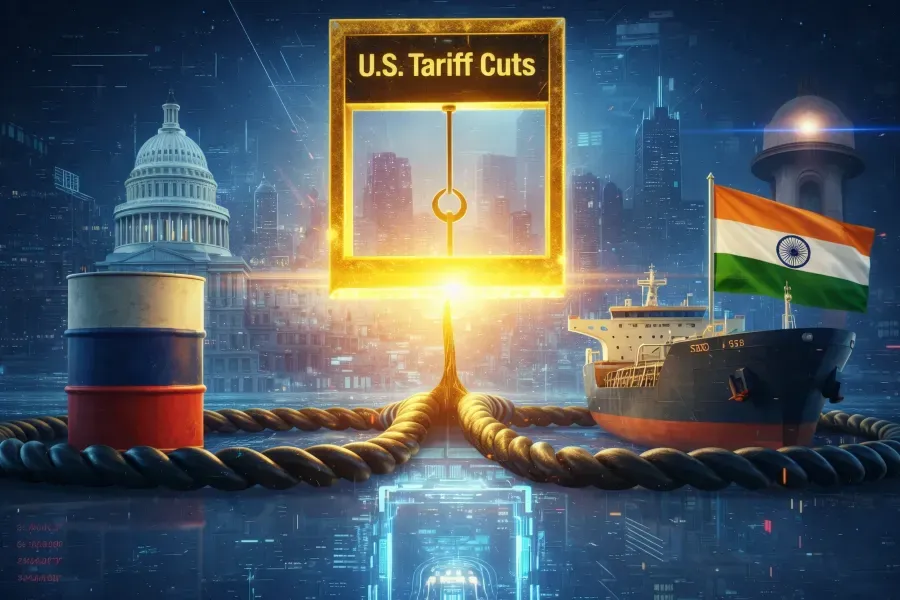
The agency reported that U.S. President Donald Trump has repeatedly urged India to end its oil purchases from Russia. Nomura experts, Sunal Varma and Aurodeep Nandi, believe that responding to this pressure could pave the way for a new trade agreement with Washington that includes tariff reductions on Indian goods.
They argue that lowering tariffs below the ASEAN average of 19-20% would help restore the competitiveness of labor-intensive Indian exports, such as textiles, leather, and light industrial products. India's imports of Russian oil account for 36% of its total crude imports (Irene), and the firm expects the 25% punitive tariff on Russian oil imports to be lifted after November, while the corresponding tariff on U.S. exports will remain until the end of the fiscal year in March.
According to Nomura estimates, the narrowing gap between Russian and global oil prices to about $1.8-2.2 per barrel makes the direct impact of this shift minimal, equivalent to just 0.04% of GDP, while the greater risk lies in 'indirect effects resulting from rising global oil prices.' Energy Implications and Supply Challenges Data from Kpler indicates that Russia has been India's top supplier since 2023, with New Delhi importing about 1.8 million barrels per day, accounting for 36% of its total oil imports.
Following recent U.S. sanctions on Rosneft and Lukoil, major Indian refineries are preparing to reduce their Russian oil imports to nearly zero, forcing them to turn back to the Middle East and the U.S. as alternative sources. Bloomberg noted that this shift will increase global energy costs, as Gulf producers are expected to raise prices to compensate for the Russian gap.
According to Gaurav Kapoor, chief economist at IndusInd Bank, 'Importing oil from America will be costly due to high transportation costs,' emphasizing that India faces a real challenge in securing its energy needs after years of reliance on cheap Russian crude. Kapoor added that this issue pertains to national energy security, noting that New Delhi is required to find quick and stable supply alternatives amid current geopolitical shifts. Trump has affirmed Modi's commitment to a gradual halt of Russian crude imports (Reuters).
Limited Impact on Inflation and Growth Despite concerns over rising prices, Bloomberg quoted analysts stating that the impact of this shift on inflation will be limited, as the consumer price index remains below 2%, at the bottom of the Reserve Bank of India's (RBI) target range of 2-6%. According to RBI estimates, a 10% increase in the oil bill could raise inflation by about 0.3 percentage points and reduce growth by 0.15 percentage points, assuming full cost transfer to local prices. The report noted that last week, President Trump mentioned that Indian Prime Minister Narendra Modi informed him that India would gradually stop purchasing oil from Russia, but clarified that the shift would be a gradual and complex process, while the Indian government has yet to issue an official comment on this matter. Source: Bloomberg
Sources & References
Editorial Note
Disclaimer
All rights reserved
Please review the Terms & Conditions.
© 2025 EcoPulse24.