UAE and India Cement Strategic Energy Partnership Amid Asian Transformations
UAE and India strengthen energy ties, focusing on reliable, long-term, and clean energy partnerships amid global economic shifts.

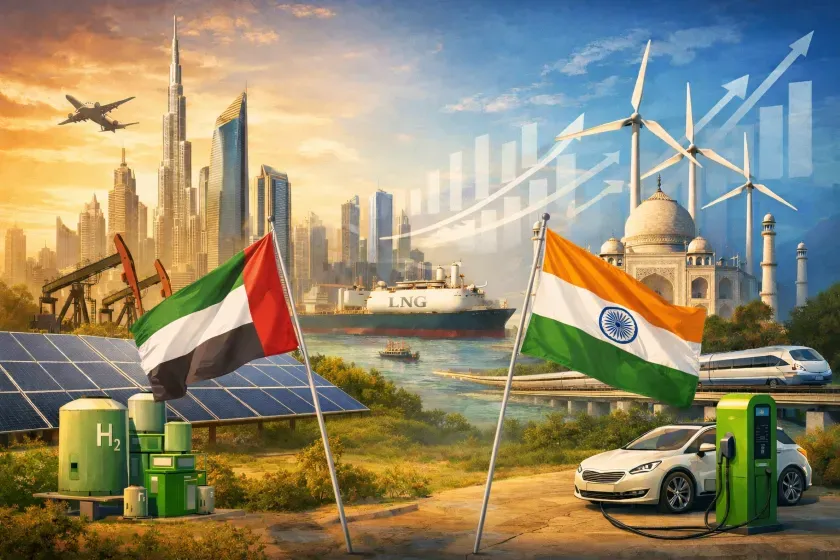
In a global environment marked by rapid geopolitical shifts and declining confidence in traditional supply chains, the UAE and India have reiterated the strength of their strategic energy partnership, laying the groundwork for long-term collaboration focused on sustainable economic security.
During his keynote address at India Energy Week 2026 in Goa, Dr. Sultan Ahmed Al Jaber, UAE Minister of Industry and Advanced Technology and CEO of ADNOC, outlined a clear vision for the future of energy markets: reliable partnerships are now more crucial than reserves alone in a world rife with political and economic uncertainty.
Al Jaber placed India at the forefront of ADNOC’s long-term vision, noting that the relationship has evolved beyond that of supplier and consumer to become a comprehensive partnership based on intertwined economic interests and forward-looking growth. As the world’s third-largest energy consumer and one of the fastest-growing economies, India is set to become a major driver of global energy demand in the coming decades.
The UAE is already India’s top partner for LNG imports from ADNOC and the largest supplier of LPG, as well as a key crude oil provider for Indian refineries. These positions are the result of long-term investments and years of accumulated trust and stability.
Al Jaber also highlighted India’s structural economic transformations, predicting unprecedented growth in sectors such as aviation, urbanization, data centers, electricity, and cooling - areas with high energy demand. With India’s urban population nearing one billion, electricity demand is expected to double due to digitalization, AI, and industrial expansion. Thus, ensuring stable and reliable energy supplies is essential for India’s sustained growth, a need the UAE aims to fulfill with a balanced mix of oil, gas, and clean energy.
The UAE’s message extended beyond fossil fuels to emphasize the growing role of renewables in the bilateral relationship. Through the Altira fund for clean technology, the UAE is supporting large-scale solar, wind, and energy storage projects to help India achieve an orderly energy transition without compromising economic security. Additionally, the international investment arm XRG is expanding the UAE’s global presence not only in gas but also in chemicals and digital infrastructure, integrating energy, industry, and technology.
Al Jaber noted that AI is now a core component of ADNOC’s operations, with hundreds of digital and robotic tools monitoring wells and facilities, reducing unplanned outages and improving efficiency - a model the company seeks to replicate in international markets, including India.
Politically and economically, Al Jaber’s address conveyed that while some countries are building trade barriers, the UAE has chosen openness, bridge-building, and deepening partnerships. This strategy has materialized in dozens of comprehensive economic partnership agreements, with India at the forefront, resulting in significant investment flows and reinforcing the UAE’s status as a trusted global business and energy hub.
Strategically, the UAE-India partnership reflects a rare convergence of necessity and opportunity. India seeks reliable suppliers in a turbulent world, while the UAE diversifies its markets and deepens its presence in fast-growing economies. The partnership is founded on complementarity and long-term investment, rather than short-term fixes. Despite global competition, energy price volatility, and the accelerating shift to clean sources, India’s demand, strong political ties, and the UAE’s flexible model make this a calculated strategic bet.
Ultimately, the UAE-India relationship is more than trade or energy contracts; it is a shared vision for a more balanced and stable economic future, built on trust, technology investment, and a forward-looking approach to growth as the world redefines economic security, energy, and development.
Explore Related Coverage
Sources & References
Editorial Note
Disclaimer
© 2025 EcoPulse24. All rights reserved.