US Defense Stocks Shed $8 Billion in One Session as Airline Shares Stage Powerful Rebound
Defense sector stocks shed $8B after Trump delayed Iran strikes, while airline shares rebounded strongly on lower oil prices.

EcoPulse24 | New York
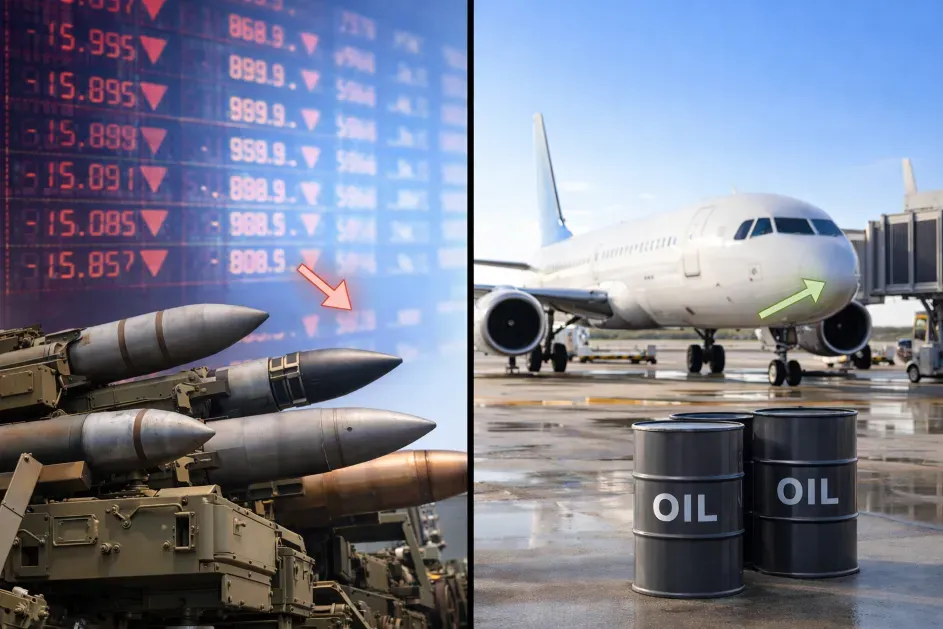
US defense sector stocks suffered a combined market capitalization loss of approximately $8 billion in a single trading session on Monday, as President Donald Trump's announcement of a five-day delay in planned strikes against Iranian energy infrastructure triggered a sharp rotation away from defense plays and into beaten-down airline shares. The move illustrated how deeply geopolitical risk had been priced into defense stocks during the height of the Hormuz crisis.
Defense Sector Takes a Sharp Hit
The sell-off struck across the major US defense contractors. Shares in companies spanning Lockheed Martin, RTX Corporation, Northrop Grumman, General Dynamics, and L3Harris Technologies all declined sharply as markets priced out the near-term probability of an escalation scenario that had been underpinning defense valuations in recent weeks. Aerospace and defense ETFs registered significant single-day percentage declines as investors recalibrated their exposure to the conflict narrative. The sector had been one of the strongest performers during the preceding weeks of Hormuz-driven uncertainty, making it vulnerable to any perceived shift toward de-escalation.
Airlines Stage a Powerful Rebound
In a clear mirror-image reaction, US airline stocks staged a powerful intraday recovery. Carriers including Delta Air Lines, United Airlines, Southwest Airlines, and American Airlines all climbed notably, as the decline in crude oil prices-which dropped over 10 percent at settlement-directly reduced the projected fuel cost burden for the aviation sector. Jet fuel typically accounts for 20 to 30 percent of airline operating costs, making the airline sector one of the biggest direct beneficiaries of any easing in oil market tensions. The divergence between defense and airline sectors on Monday was among the sharpest sector-level splits seen in a single session this year.
A Classic Geopolitical Trade Unwind
The simultaneous move in defense and airline stocks illustrated a textbook geopolitical trade unwind. Over the preceding weeks, as tensions in the Strait of Hormuz escalated and military rhetoric intensified, investors had steadily added to defense positions while avoiding cyclically sensitive sectors like aviation. Monday's reversal compressed weeks of positioning into a single session, resulting in outsized price swings in both directions.
However, the move may prove short-lived. Iran's deputy parliament speaker Ali Nikzad flatly denied any talks with the United States in early Tuesday trading and stated that the Strait of Hormuz would not return to normal. Tehran described Trump's claims of productive discussions as an attempt to manipulate financial markets. Those comments triggered a partial recovery in crude oil prices and renewed uncertainty about whether Monday's de-escalation narrative would hold.
Broader Market Context
The rotation played out against a backdrop of strong overall market gains on Monday, with major US indices closing higher after weeks of elevated volatility. The S&P 500, Dow Jones Industrial Average, and Nasdaq Composite all posted solid advances, though the gains masked a sharp divergence at the sector level. Defense was sharply lower while consumer discretionary and transportation-linked stocks outperformed. Market participants are now watching whether the partial recovery in oil prices in Tuesday's early session will trigger a reversal of Monday's sector rotation, with defense stocks partially recovering in pre-market trading.
EcoPulse24 Analysis
EcoPulse24 Analysis: The $8 billion wipeout in defense market capitalization reflects how heavily geopolitical risk had been priced into those stocks during the height of the Hormuz crisis. The sharp reversal suggests that positioning in the defense sector was stretched and vulnerable to any hint of diplomatic progress. With Iran pushing back against Trump's claims and uncertainty returning to the market, investors face a testing environment where a single headline can swing sector values by billions. Airlines remain a useful barometer: their fortunes track oil prices, which in turn track the perceived probability of a supply disruption through Hormuz. The coming days will determine whether Monday's defense sell-off deepens or fully reverses.
Explore Related Coverage
Sources & References
Editorial Note
Disclaimer
© 2025 EcoPulse24. All rights reserved.