Australia Cannot Save the World's LNG Market But Tokyo Is Asking Anyway
Japan urged Australia to boost LNG output amid Gulf supply shocks, but Australia can't quickly expand capacity to meet urgent Asian demand.

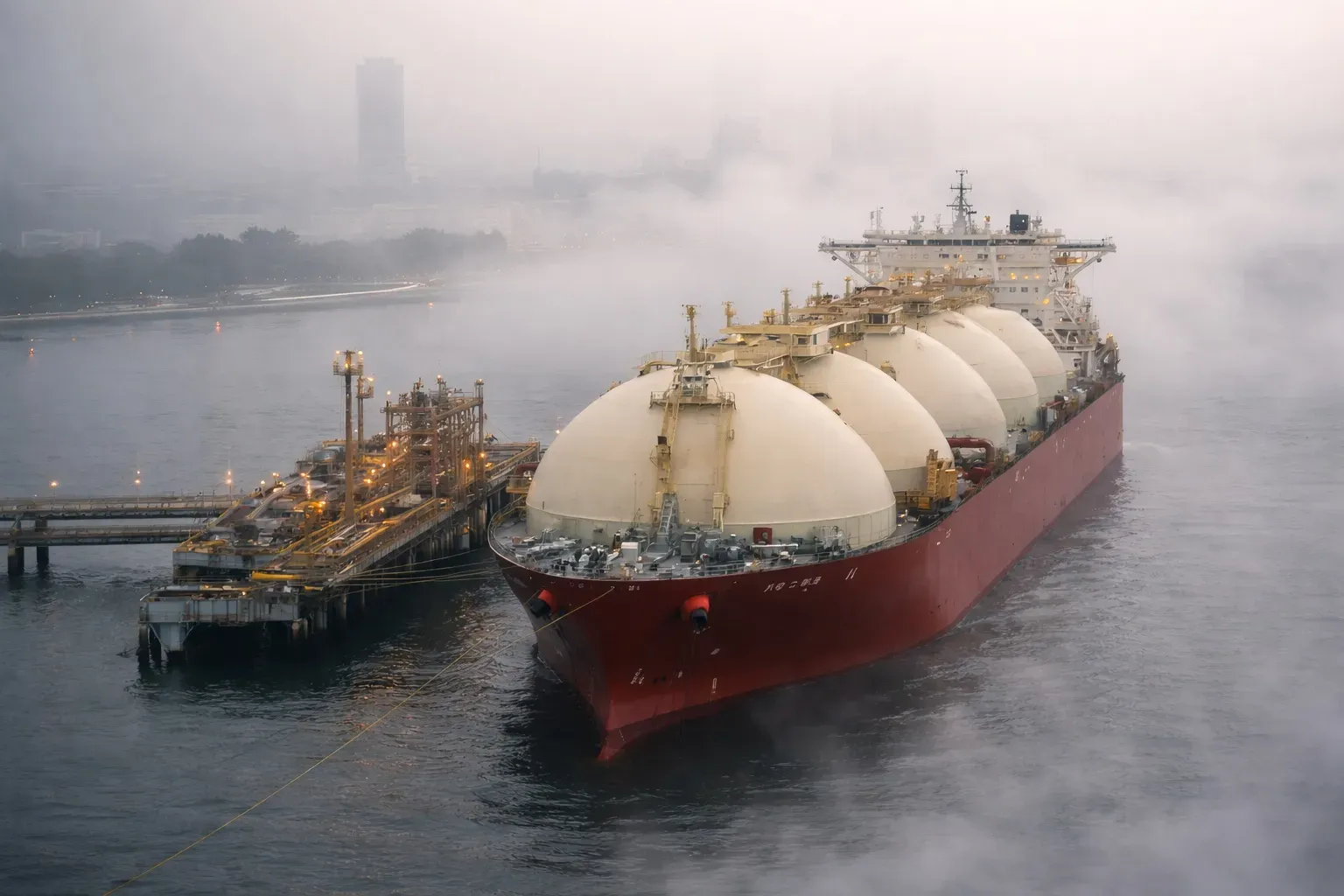
EcoPulse24 | Energy & Markets Analysis
Japan's industry minister did not mince words. When Ryosei Akazawa sat across from Australian Resources Minister Madeleine King on Saturday, he delivered a message that rarely surfaces so plainly in the carefully choreographed language of energy diplomacy: produce more, as fast as you can, because we are running out of options.
The request tells a story that goes far beyond the bilateral relationship between Tokyo and Canberra. It is, in essence, a confession - that the architecture of Asian energy security, built painstakingly over decades of diversification policy since the 1973 oil shock, has a ceiling. And the Iran conflict has found it.
The Numbers Behind the Plea
The arithmetic of Japan's vulnerability is stark. The Middle East supplies roughly 11% of Japan's LNG imports, with 6% of that transiting the Strait of Hormuz a waterway that has effectively ceased to function as a commercial corridor since the outbreak of the U.S.-Israeli war on Iran. For crude oil, the exposure is existential: approximately 95% of Japan's supplies originate from the same region. Australia, by contrast, accounts for 40% of Japan's LNG imports, making it not merely a preferred partner but an irreplaceable one in the current environment.
The crisis at the source is severe. On March 2, Iranian drone strikes hit QatarEnergy facilities at Ras Laffan Industrial City and Mesaieed, triggering a complete halt in LNG production and a formal force majeure declaration that has since cascaded through the supply chain with Shell, TotalEnergies and multiple Asian buyers receiving notices suspending contractual delivery obligations. Qatar supplies roughly 20% of global LNG, and its Ras Laffan complex is the single largest liquefaction facility on earth. Energy Minister Saad al-Kaabi has warned that even if hostilities ceased today, a return to normal deliveries would take weeks to months.
The Honest Limits of Australia's Answer
Canberra's response was measured but revealing. King pointed to the Scarborough and Barossa fields as evidence of Australia's commitment to expanded supply. What she did not say and what the market already knows is that these additions operate on engineering timelines, not diplomatic ones.
Woodside's Scarborough Energy Project, a $12.5 billion development in Western Australia's Carnarvon Basin, is 94% complete and targeting its first LNG cargo in the fourth quarter of 2026, with a nameplate capacity of 8 million tonnes per year. Santos' Barossa field, which feeds the Darwin LNG plant at 3.7 million tonnes per year, loaded its first cargo only in January 2026 and sent it directly to Japan. Both are genuine contributions to Australia's export capacity, but neither can be accelerated by ministerial request.
The deeper constraint is structural. According to Kpler's market analysis, the total realistic supplementary supply available from all alternative exporters combined the United States, Australia, Nigeria, Algeria, Trinidad amounts to under 2 million tonnes per month, against a monthly shortfall of 5.8 million tonnes created by Qatar's shutdown. Australia already operates its existing facilities at high utilisation rates. There is no reserve capacity sitting idle, waiting to be unlocked by a bilateral meeting.
A Market Transformed, Not Temporarily Disrupted
What distinguishes this crisis from previous LNG supply shocks is its scope. Asian spot LNG prices surged to $25.40 per million British thermal units on March 4, more than doubling in days. European gas prices jumped 52% following the Ras Laffan strikes the largest single move since Russia's invasion of Ukraine in 2022. At least eleven LNG tankers linked to Qatar have suspended operations to avoid Hormuz transit, and Japan's three major shipping operators Nippon Yusen, Mitsui OSK Lines and Kawasaki Kisen Kaisha have ordered their fleets out of the Persian Gulf entirely.
The rerouting option is not commercially neutral. An LNG carrier avoiding the Strait of Hormuz and diverting via the Cape of Good Hope adds 14 to 16 days to voyage time, fundamentally repricing delivery economics and tightening an already stretched global tanker fleet.
Japan, for its part, is not without buffers. By early March, major Japanese utilities had increased LNG stocks by 10%, reaching approximately 2.19 million metric tonnes sufficient for around 44 weeks of consumption even under a complete Hormuz closure, according to Kpler data. Emergency oil reserves stand at 254 days of consumption. These are not trivial cushions. But they are finite, and the deeper question how Japan restructures its supply relationships if the Gulf remains unstable - has no short-term answer that Australia alone can provide.
What Tokyo's Request Reveals
The significance of Saturday's meeting lies less in its immediate outcomes than in what it signals about the shifting geometry of energy security in the Indo-Pacific. Japan's request to Australia was not merely about LNG volumes. It was a public acknowledgment that the post-Cold War assumption of stable, affordable Gulf energy the assumption that underwrote three decades of Asian industrial growth is no longer reliable.
Australia, for its part, now finds itself in an unexpected position: a nation that was until recently managing domestic gas affordability concerns and export reservation debates is suddenly the cornerstone of regional energy security for the world's third-largest economy. The Scarborough and Barossa fields were designed to serve long-term commercial contracts, not geopolitical emergencies. The distinction matters.
In 2024, Australia exported 3.9 trillion cubic feet of LNG roughly 20% of global export volumes with Japan taking 32% of that output, China 33%, and South Korea 14%. Any meaningful increase in Australian production will not simply flow to Tokyo; it will enter a market where Beijing, Seoul, and New Delhi are competing for the same incremental tonnes with equal urgency.
What Japan asked for on Saturday was reasonable. What it will receive is rather less than it needs and rather more than anyone else can offer.
Sources & References
Editorial Note
Disclaimer
© 2025 EcoPulse24. All rights reserved.