China’s Factory Activity Weakens as Growth Momentum Slows Despite AI Export Boom
Purchasing Managers' Index (PMI) slipped to 50.0 in May from 50.3 in April, indicating factory activity stagnated after months of expansion.

Beijing | EcoPulse24
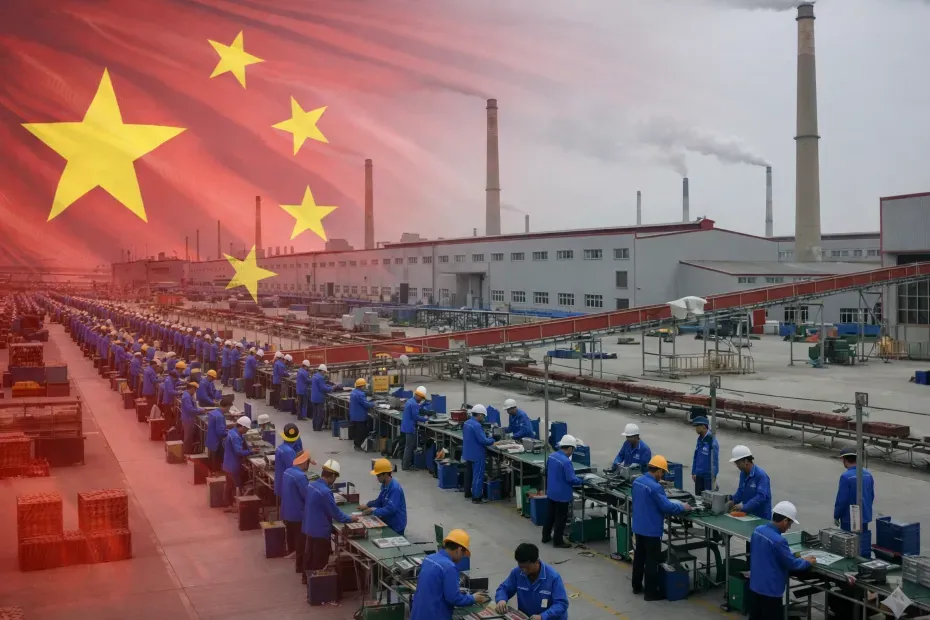
China's manufacturing sector lost momentum in May, adding to signs that the world's second-largest economy is struggling to sustain the strong growth recorded earlier this year despite continued strength in exports linked to artificial intelligence and advanced technology products.
Official data released by China's National Bureau of Statistics showed the manufacturing Purchasing Managers' Index (PMI) slipped to 50.0 in May from 50.3 in April, indicating factory activity stagnated after months of expansion.
While the reading remains above the contraction threshold, it highlights growing pressure from softer global demand, rising input costs, and disruptions linked to the ongoing conflict in the Middle East.
Manufacturing Loses Momentum
The latest figures suggest China's industrial sector is facing a more challenging environment than earlier in the year.
At the same time, the non-manufacturing PMI, which measures activity across services and construction, improved to 50.1 from 49.4, returning to expansion territory and providing some support to the broader economy.
China's May PMI Snapshot
| Indicator | May 2026 | April 2026 |
|---|---|---|
| Manufacturing PMI | 50.0 | 50.3 |
| Non-Manufacturing PMI | 50.1 | 49.4 |
A reading above 50 indicates expansion, while a reading below 50 signals contraction.
The data follows a weaker April performance in which industrial production and retail sales recorded some of their slowest growth rates in years, prompting economists to call for additional policy support.
Beijing Responds With More Support
Chinese policymakers have already begun responding to the slowdown.
During May, the People's Bank of China lowered the rate on its one-year policy lending facility to a record low, while authorities introduced new measures aimed at expanding access to public services such as education and healthcare in urban areas.
The reforms are designed to improve living standards, support domestic consumption, and strengthen household spending - an area Beijing has been trying to boost as it seeks to reduce reliance on investment-led growth.
AI Exports Continue to Power Trade
Despite signs of slower domestic activity, China's export machine remains remarkably resilient.
The country recorded a record $1.2 trillion trade surplus in 2025, while export volumes in 2026 have largely remained above last year's levels, supported by surging global demand for AI infrastructure, data-center equipment, semiconductors, and power technologies.
According to estimates from Goldman Sachs and Nomura, exports of semiconductors, computers, and other AI-related products accounted for roughly half of China's export growth in April.
Key China Trade Indicators
| Indicator | Value |
|---|---|
| 2025 Trade Surplus | $1.2 Trillion |
| Manufacturing PMI | 50.0 |
| Non-Manufacturing PMI | 50.1 |
| AI-Related Share of Export Growth (April) | ~50% |
The strength of AI-related exports has helped offset some of the pressure created by slowing domestic demand and geopolitical uncertainty.
Currency Strength Creates New Pressure
One emerging challenge for Chinese manufacturers is the appreciation of the yuan.
A stronger currency reduces export competitiveness and increases financial pressures on businesses selling abroad.
Bloomberg data compiled from first-quarter earnings reports showed that nearly one-quarter of approximately 5,500 listed Chinese companies reported foreign-exchange losses or cited currency fluctuations as a significant factor affecting profitability.
That represents the highest proportion recorded in at least a decade.
Trade Relations Remain a Wild Card
Meanwhile, investors continue to monitor developments in US-China trade relations.
A recent summit between US President Donald Trump and Chinese President Xi Jinping produced limited breakthroughs, but both countries agreed to establish new trade and investment committees aimed at improving commercial cooperation.
Chinese officials indicated that discussions could eventually lead to lower tariffs on at least $30 billion worth of goods flowing between the two economies.
EcoPulse24 Analysis
China's latest PMI report reveals a growing divide inside the economy.
On one side, traditional manufacturing and domestic demand are showing signs of fatigue, with factory activity stagnating and policymakers increasingly relying on monetary and fiscal support to maintain growth.
On the other side, China's role in the global AI supply chain continues to strengthen.
Demand for semiconductors, data-center equipment, power infrastructure, and AI-related technologies is providing a powerful export tailwind that is helping offset weakness elsewhere in the economy.
This creates a two-speed economy.
Domestic growth is slowing, while externally driven technology exports remain robust.
For global markets, the most important takeaway is that China's growth story is becoming increasingly tied to artificial intelligence infrastructure and advanced manufacturing rather than traditional property-led expansion.
If AI investment remains strong worldwide, it could provide an important buffer for Chinese exports throughout 2026.
However, if global demand weakens further or geopolitical tensions intensify, the slowdown now emerging in factory activity could become a more significant challenge for Beijing's economic growth objectives.
Sources & References
Editorial Note
Disclaimer
© 2025 EcoPulse24. All rights reserved.