UAE and Jordan Sign $2.3 Billion Rail Deal to Boost Mining Exports
UAE and Jordan signed a $2.3B deal for a 360km rail line to boost mining exports, linking mines to Aqaba Port with 16M tonnes annual capacity.

Abu Dhabi | April 15, 2026
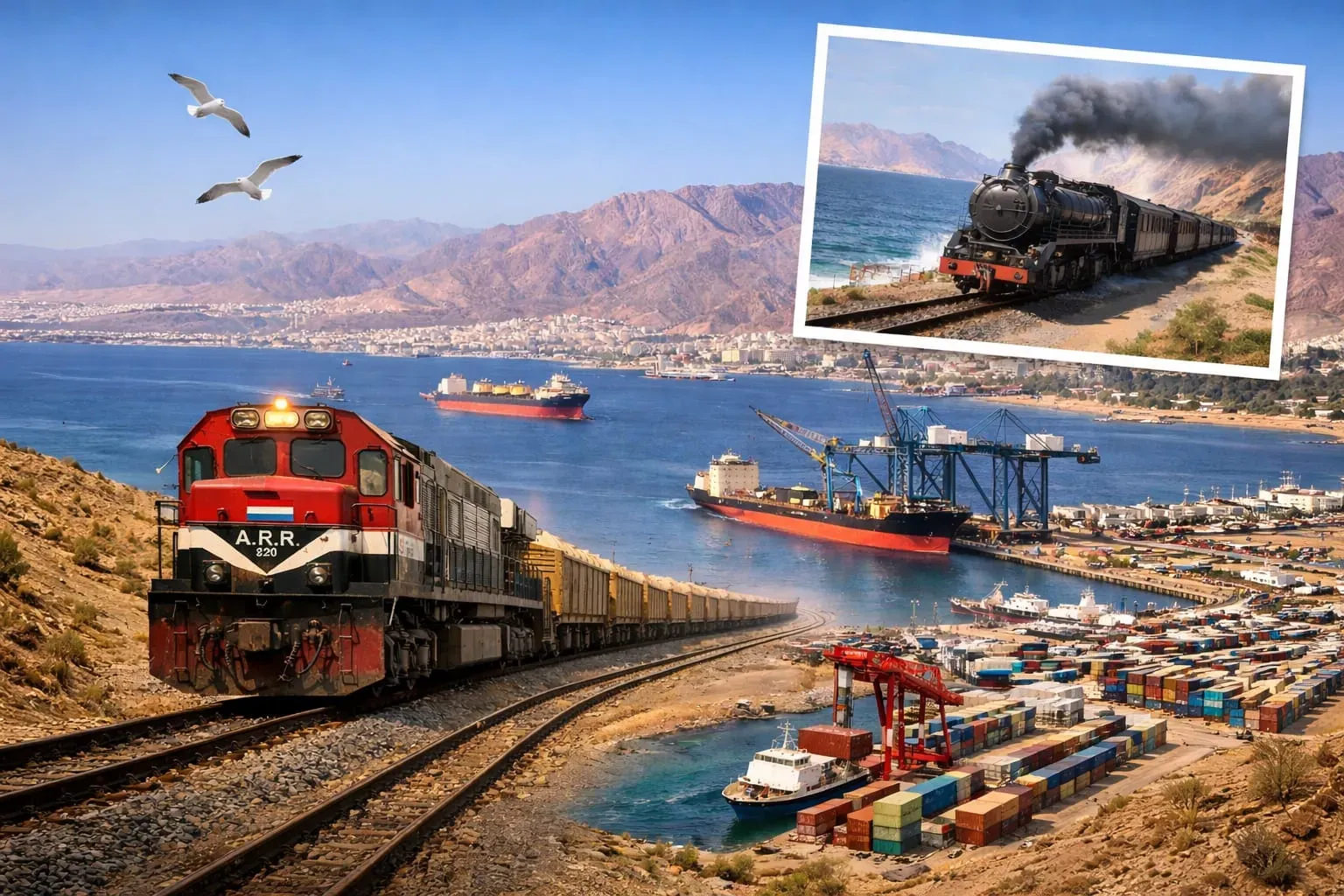
The United Arab Emirates and the Hashemite Kingdom of Jordan signed a strategic agreement Wednesday to develop a 360-kilometer railway network across Jordanian territory at a total cost of $2.3 billion, reflecting a deepening economic partnership between the two countries in infrastructure and mining.
The agreement was signed at Qasr Al Watan in Abu Dhabi in the presence of Sheikh Mansour bin Zayed Al Nahyan, Deputy Ruler of the UAE, and Jordanian Prime Minister Dr. Jaafar Hassan. UAE Minister of Energy and Infrastructure Suhail Al Mazrouei and his Jordanian counterpart Dr. Nidal Al-Qatamin signed on behalf of their respective governments.
Connecting the Mines to the Sea
The planned network will link the Al-Shidiya and Ghor Al-Safi mining regions - home to Jordan's phosphate and potash operations - to the Port of Aqaba on the Red Sea, with an annual transport capacity of 16 million tonnes of both minerals.
This export capacity carries significant weight. Jordan produced 11.5 million tonnes of phosphate in 2024 according to Jordan Phosphate Mines Company's official figures, while the country ranks seventh globally in potash production at 1.7 million tonnes annually - the sole potash producer in the Arab world. Yet prohibitive overland transport costs have long constrained Jordan's price competitiveness in international markets. This project directly addresses that structural gap.
Partnership Structure
The UAE-Jordan Railway Company has been established as the joint venture to execute the project, bringing together Abu Dhabi's L'IMAD Holding and key Jordanian stakeholders including Jordan Phosphate Mines Company, Arab Potash Company, the Social Security Investment Fund, and the Government Investments Management Corporation.
Etihad Rail - the developer and operator of the UAE's national railway network, which completed its 1,200-kilometer domestic network in February 2023 with a freight capacity of 50 million tonnes annually - will serve as the operational arm responsible for construction, operation, and maintenance.
Notably, L'IMAD Holding represents the UAE's new-generation sovereign investment vehicle, into which Abu Dhabi's ADQ development fund has been consolidated as part of a broader restructuring of Abu Dhabi's state investment architecture.
Extension of the 2023 Framework
This deal does not stand alone. It extends the comprehensive $5.5 billion investment agreement signed between the two countries in late 2023 under the patronage of President Sheikh Mohamed bin Zayed Al Nahyan and King Abdullah II. Combined, the two commitments bring total Emirati pledges to Jordan to approximately $7.8 billion over just three years.
Analysis: What Does This Really Mean?
I. Jordan's Competitiveness Equation Shifts
Jordan's mining sector challenge has never been about reserves - they are substantial. The problem has been the cost of getting the mineral to the ship. Overland transport from Al-Shidiya mines to Aqaba adds significant logistical burden to the final product cost. Central bank data shows that Jordan's phosphate exports reached 426.8 million dinars in the first nine months of 2025 (+12.5%), while potash exports hit 412.4 million dinars (+13.4%) - yet 93.2% of phosphoric acid exports flow to India alone. This extreme concentration in a single market reflects limited price competitiveness elsewhere. The railway directly widens that margin, unlocking markets previously closed on price.
II. Strategic Timing in a Disrupted Market
The project arrives as global fertilizer trade maps redraw themselves. Sanctions on Russia and Belarus - two of the world's largest potash producers - have created sustained supply pressure, elevating demand for geopolitically reliable alternatives. In this context, Jordan transitions from a secondary supplier to a strategic option actively sought by markets across India, Indonesia, and sub-Saharan Africa. The new railway gives Jordan the logistics to respond at scale.
III. Aqaba: From Transit Point to Export Hub
An additional 16 million tonnes annually creates significant new operational pressure on the Port of Aqaba - but equally, a sharp rise in throughput revenues and logistics value-add. The question now before the Jordanian government: does Aqaba's current infrastructure absorb this volume, or does the project necessitate parallel port expansion? That is the logical thread of the partnership's next phase.
IV. L'IMAD and the Emirati Regional Expansion Agenda
The broader framework here is that the UAE - through L'IMAD and Etihad Rail - is establishing a replicable model: exporting railway construction and operational expertise to regional countries while retaining investment stakes in their critical infrastructure. Etihad Rail has already signed a memorandum of understanding with Paraguay to build a 44-kilometer line in 2026. Jordan is not the first destination, but it is the most strategically significant given the weight of mining in its national budget.
Bottom Line
This project is not merely a railway. It is a structural overhaul of Jordan's logistics model at its roots.
The $2.3 billion price tag becomes rational when measured against the returns of reducing transport costs for 16 million tonnes annually over decades. The equation is straightforward: every dollar saved per tonne translates into hundreds of millions in aggregate margin - opening markets that were previously priced out.
The ultimate long-term beneficiary extends beyond Jordan and the UAE. In an era of declining reliability among traditional large exporters, a stable Jordan - connected by a modern transport network - becomes an indispensable partner in global food security.
EcoPulse24 - Covering Gulf Markets, Energy & Macroeconomics
Fact Table: UAE-Jordan Railway Agreement - Key Data
| Fact | Detail |
|---|---|
| Core Project Data | |
| Total project cost | $2.3 billion |
| Railway network length | 360 kilometers |
| Annual transport capacity | 16 million tonnes |
| Minerals transported | Phosphate & Potash |
| Origin point | Al-Shidiya & Ghor Al-Safi |
| Destination | Port of Aqaba |
| Partnership Structure | |
| Joint venture entity | UAE-Jordan Railway Company |
| Emirati party | L'IMAD Holding |
| Operational arm | Etihad Rail |
| Jordanian stakeholders | Jordan Phosphate Mines Co., Arab Potash Co., Social Security Investment Fund, Government Investments Management Corp. |
| Investment Context | |
| Parent agreement (2023) | $5.5 billion |
| Total Emirati commitments to Jordan | ~$7.8 billion |
| Jordan Mining Sector | |
| Phosphate production 2024 | 11.5 million tonnes |
| Jordan's global potash ranking | 7th |
| Annual potash production | 1.7 million tonnes |
| Phosphate exports (9M 2025) | JD 426.8M (+12.5%) |
| Potash exports (9M 2025) | JD 412.4M (+13.4%) |
| Phosphoric acid export concentration to India | 93.2% |
| Etihad Rail | |
| UAE network completion | February 2023 |
| Freight capacity | 50 million tonnes/year |
| International expansion (Paraguay) | 44 km line - MoU 2026 |
EcoPulse24 - ecopulse24.com
Sources & References
Editorial Note
Disclaimer
© 2025 EcoPulse24. All rights reserved.