Tesla Bets $28 Billion on an AI, Robotics, and Chip Manufacturing Empire
Tesla will invest $28B in 2026 to expand AI, robotics, and chipmaking, signaling a shift from EVs to tech infrastructure.

London | EcoPulse24
From humanoid robots to homegrown silicon, Musk's spending surge signals a full corporate reinvention
Tesla Inc. is embarking on its most ambitious capital deployment in company history, committing more than $25 billion in total capital expenditure for 2026 - roughly three times last year's outlay - while simultaneously announcing a separate $3 billion plan to build a research-grade chip fabrication facility in Texas, bringing its combined strategic investment footprint to approximately $28 billion this year alone. this is an editorial calculation.
The dual announcements, made Wednesday during Tesla's first-quarter earnings call, mark a decisive pivot away from the company's origins as an electric-vehicle manufacturer toward what CEO Elon Musk envisions as an integrated AI, robotics, and semiconductor platform.
A Spending Plan That Rewrites the Playbook
Capital expenditures for 2026 will exceed $25 billion, up from a prior forecast of $20 billion, directed at factory expansion, Optimus humanoid robot production, the Cybercab autonomous vehicle, and artificial intelligence infrastructure. The scale of commitment drew measured reactions from analysts. Dec Mullarkey, managing director at SLC Management, called the revised plan "sobering" for free cash flow projections, while Ivan Feinseth of Tigress Financial Partners acknowledged the near-term execution risk but argued investors may increasingly price Tesla as "an AI compute and robotics infrastructure platform rather than just an automaker."
Tesla shares were little changed in after-hours trading, having already declined roughly 21% from their mid-December record high.
The Research Fab: Tesla's First Step Into Silicon
Embedded within the broader spending plan is a $3 billion allocation to construct what Musk described as a "research fab" - a pilot-scale chip fabrication facility on the existing Giga Texas campus. Capable of producing only a few thousand wafers per month, the facility is designed as a controlled testing environment for advanced manufacturing processes rather than mass production.
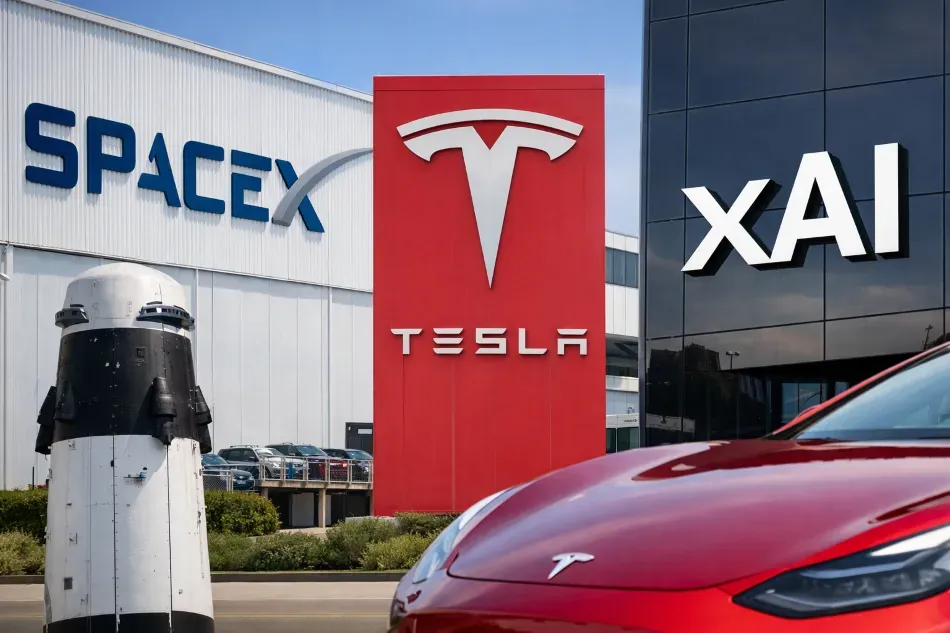
The initiative is part of a larger ambition Musk calls Terafab - a long-term effort spanning Tesla, SpaceX, and his xAI artificial intelligence company to establish domestic chip manufacturing capacity at scale. SpaceX will lead the early phases of Terafab, with Intel Corp. signed on as a key technical partner, contributing expertise across chip design, fabrication, and advanced packaging.
Crucially, Musk indicated Tesla plans to build on Intel's 14A process node - the chipmaker's most advanced production technology, which has yet to secure a single external customer. The disclosure sent Intel shares up approximately 3% in late trading. Musk was clear-eyed about the timeline: "By the time Terafab scales up, 14A will be probably fairly mature or ready for prime time."
The proposed $3 billion budget represents roughly one-tenth of what a leading-tier semiconductor company would spend on a comparable state-of-the-art facility - a single ASML lithography machine alone can carry a price tag in the hundreds of millions - underscoring that this phase remains experimental by industry standards.
Core Business: Stabilized, Not Recovered
First-quarter adjusted earnings came in at $0.41 per share, ahead of the $0.34 analyst consensus, marking the second consecutive quarter of beats. Free cash flow reached $1.4 billion, sharply outperforming expectations of nearly negative $1.9 billion, partly because Tesla spent less than $2.5 billion in capex during Q1 - well below the quarterly run rate it must sustain to reach its full-year target.
Vehicle deliveries remained under pressure. Q1 2026 was the second-worst quarter for deliveries since mid-2022. The company, however, reported demand recovery in parts of Asia, South America, and a rebound across North America and the Europe-Middle East region, with rising fuel prices cited as a tailwind for EV interest.
The energy and storage division posted $2.4 billion in revenue, a 12% year-on-year decline. CFO Vaibhav Taneja described the unit's performance as "inherently lumpy" while reaffirming that full-year energy deployments are expected to exceed 2025 levels.
On Robotaxi, Tesla said the service remains on track to expand to Phoenix, Miami, Orlando, Tampa, and Las Vegas in the first half of 2026, following recent launches in Houston and Dallas. Musk acknowledged that material revenue from the service is unlikely before 2027.
The Structural Bet
Andrew Rocco of Zacks Investment Research captured the underlying dynamic concisely: the legacy EV business is "stable enough to fund Tesla's heavy investments in robotics and self-driving technology." Whether the semiconductor ambitions achieve similar footing - or remain a research exercise - depends on execution timelines that stretch well beyond this fiscal year.
Any intercompany arrangements between Tesla and SpaceX on Terafab will require board approval from both entities, Musk noted, flagging a governance layer that could complicate the timeline. What is clear is that Tesla is no longer primarily betting on selling cars. It is betting on owning the infrastructure - physical, computational, and silicon - that powers the next generation of autonomous systems.
Explore Related Coverage
Sources & References
Editorial Note
Disclaimer
© 2025 EcoPulse24. All rights reserved.