Is Warsh Caught Between Trump’s Demands and Market Constraints - or Facing a Redefinition of the Fed Itself?
Warsh's Fed nomination faces political pressure, inflation risks, and market doubts about independence, risking global financial instability.

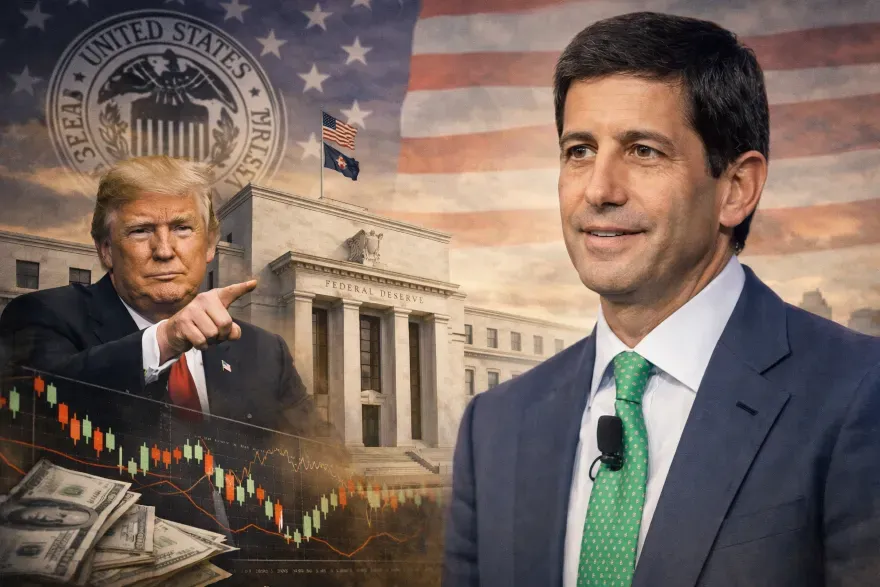
Washington | EcoPulse24
What is unfolding around Kevin Warsh’s nomination is not a routine confirmation process - it is a structural stress test for the Federal Reserve’s role in the global financial system.
This is no longer a simple debate between hawks and doves. It is a collision between explicit political pressure and binding market realities - inflation risks driven by energy shocks, elevated yields, and fragile confidence in central bank independence.
Political Pressure Sets the Frame
Calls for the United States to maintain “the lowest interest rates in the world” are not policy preferences - they are political benchmarks imposed on monetary decision-making.
For any incoming Fed chair, this creates a predefined expectation:
policy success is no longer measured purely by economic outcomes, but by alignment with political objectives.
Signal: When targets are politically defined, policy tools lose neutrality.
Warsh’s Shift: Flexibility or Fragility?
Warsh built his reputation as an inflation hawk, often warning of the long-term risks of loose monetary policy. His recent tilt toward rate cuts marks a notable shift.
The critical question is not whether he supports easing - but why now.
-
Alignment with political pressure risks undermining credibility
-
Resistance risks weakening his institutional backing
Signal: Rapid repositioning is interpreted by markets not as adaptability, but as a governance risk.
The Core Contradiction: Easing vs. Liquidity Withdrawal
At the center of Warsh’s policy stance lies a fundamental inconsistency.
On one hand, support for lower interest rates implies easing financial conditions.
On the other, his intention to shrink the Fed’s $6.7 trillion balance sheet implies liquidity withdrawal.
This duality sends conflicting signals:
-
Rate cuts → stimulate demand
-
Balance sheet reduction → tighten liquidity
Signal: Markets reprice aggressively when policy direction becomes internally inconsistent.
Geopolitics as a Hard Constraint
The Iran-linked conflict has reintroduced a key variable: energy-driven inflation.
Higher oil prices are not just a commodity story - they feed directly into broader price pressures, complicating any attempt to ease monetary policy.
In this environment, rate cuts risk amplifying inflation rather than supporting growth.
Signal: Policy intent is secondary - inflation dynamics dictate the feasible path.
Beyond Rates: The Independence Question
Perhaps the most consequential element lies beneath the surface - discussions around revisiting the Fed – Treasury relationship.
Any move to redefine that balance would represent a structural shift in how monetary authority is exercised in the United States.
Historically, central bank independence has anchored:
-
Inflation expectations
-
Bond market stability
-
Currency credibility
Signal: Even the perception of reduced independence triggers repricing across assets.
What Markets Are Actually Pricing
Markets are not evaluating Warsh as an individual - they are interpreting the broader institutional signal.
That signal currently suggests:
-
Political influence over rate direction is rising
-
Economic constraints are tightening
-
Policy coherence is increasingly uncertain
The Bottom Line
Warsh is not merely caught between Trump and traditional monetary orthodoxy.
He stands at the intersection of three competing forces:
-
Direct political pressure for rapid rate cuts
-
Inflation constraints driven by energy and geopolitics
-
Market demand for credibility and policy consistency
Any imbalance between these forces will not remain contained within the Federal Reserve -
it will be transmitted immediately into bond yields, the dollar, and global risk assets.
The Key Signal
If interest rate decisions shift from data-driven frameworks to pressure-driven outcomes,
markets will not wait.They will reprice - broadly, and decisively.
Sources & References
Editorial Note
Disclaimer
© 2025 EcoPulse24. All rights reserved.