2025: The Great Green Pivot - When Transition Blueprints Became Steel and Concrete
In 2025, global renewables surged by 793 GW, led by China and Gulf states, as investments soared and green transition became industrial reality.

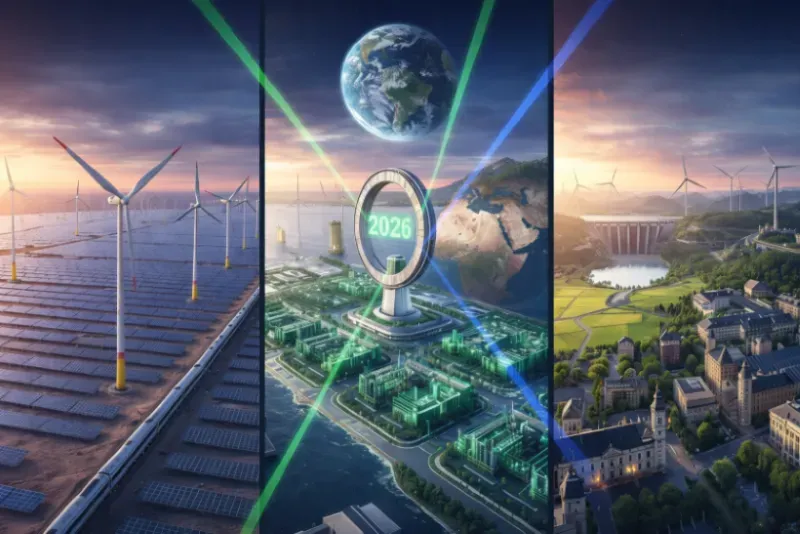
Global renewable capacity surges by 793 GW in 2025 as China and the Gulf redefine energy leadership; Europe dominates offshore wind while U.S. momentum stumbles under policy shifts.
The year 2025 has etched itself into history as the definitive moment when the global energy transition moved from symbolic pledges to industrial reality. While financial markets grappled with volatility and crude oil prices retreated by 17%, renewable energy projects advanced at an unprecedented cadence.
In the first half of the year alone, $386 billion was deployed into new renewable ventures, contributing to a global addition of 793 GW. From Saudi Arabia’s near-completion of the world’s largest green hydrogen plant to Europe’s commissioning of record-breaking offshore wind farms, 2025 was not a year of incremental growth, but a civilizational leap toward a decarbonized economy.
China: Redefining the Possible
China has transcended mere market leadership to fundamentally redefine global energy capacity. In H1 2025, the nation added 212 GW of solar and 51 GW of wind. To put this in perspective: China’s six-month addition nearly equals Europe’s total renewable installations over two full years.
Beijing now commands 66% of global solar additions and 69% of new wind capacity. Most significantly, Chinese carbon emissions fell by approximately 1% in the first half of the year, providing the first concrete evidence that high economic growth and emissions decoupling can coexist. The flagship 3.5 GW Xinjiang desert solar project, a $2.13 billion investment, now powers 3 million homes, offsetting 6.07 million tons of $CO_2$ annually.
Saudi Arabia & NEOM: Green Hydrogen’s Ground Zero
The skepticism that once met Crown Prince Mohammed bin Salman’s $8.4 billion green hydrogen vision has been replaced by industrial silence. The NEOM Green Hydrogen Company (NGHC) facility is now 90% complete, sprawling across an area 1.7 times the size of Washington, D.C.
Powered by 4 GW of dedicated solar and wind energy, the plant will produce 600 tons of carbon-free hydrogen daily. Saudi Arabia has already secured "green corridors" to Europe through agreements with TotalEnergies, EnBW, and Zhero, aiming to export 1.2 million tons of green ammonia annually. With production costs as low as $2.16/kg, the Kingdom is positioned to dominate a global market projected to hit $72 billion by 2030.
The UAE: Solving the ‘Lunar Challenge’ of Intermittency
On January 14, 2025, UAE President Sheikh Mohamed bin Zayed Al Nahyan inaugurated a gigawatt-scale project that addresses the "holy grail" of renewables: intermittency. Developed by Masdar and EWEC, the Al Azizah project in Abu Dhabi combines 5.2 GW of solar PV with a staggering 19 GWh Battery Energy Storage System (BESS) - the world’s largest.
"For decades, intermittency was the lunar challenge of our era," stated Dr. Sultan Al Jaber, Chairman of Masdar. "With this project, we have transformed renewables into a true baseload power source." Masdar’s global capacity has surged 150% in two years, reaching 50 GW as it tracks toward its 100 GW goal for 2030.
Europe: An Offshore Industrial Empire
Europe’s North Sea has become the continent’s new engine room. The Dogger Bank Wind Farm, a joint venture between SSE, Equinor, and Vårgrønn, began commercial operations for its first phase in 2025. Once its three phases (A, B, and C) are complete, the 3.6 GW array will power 6 million homes.
In Germany, the 960 MW He Dreiht project entered service, notable for being one of the first offshore farms built without government subsidies, relying instead on corporate Power Purchase Agreements (PPAs). European offshore wind investment hit $40 billion in H1 2025, a 63% year-over-year increase.
United States: Policy Headwinds vs. Market Demand
In stark contrast to the global trend, U.S. renewable investment fell 36% ($20.5 billion) in H1 2025. The industry’s retreat followed the enactment of the "One Big Beautiful Bill Act," which curtailed several clean energy tax credits.
President Trump’s executive order to halt the 80% complete Revolution Wind project signaled a federal pivot away from offshore wind. However, domestic demand remains resilient; renewables accounted for 93% of new U.S. power capacity through September 2025, driven by a 67 GW pipeline of planned battery storage through 2030.
Global Reference Data: Renewable Contributions 2025
| Country/Region | Key Projects | Capacity Added (2025) | Investment Value | Key Players |
| China | Xinjiang Desert Solar (3.5 GW) | 212 GW Solar / 51 GW Wind (H1) | $2.13B (Xinjiang) | State Grid, PowerChina |
| Saudi Arabia | NEOM Green Hydrogen, Yanbu | 4 GW (NEOM), 15 GW Planned | $8.4B (NEOM) | ACWA Power, Air Products |
| UAE | 24/7 Solar + BESS Project | 5.2 GW Solar / 19 GWh BESS | $6B (Al Azizah) | Masdar, EWEC |
| UK | Dogger Bank (A, B, C) | 3.6 GW Total | £ Billions | SSE, Equinor, GE |
| Germany | He Dreiht, Nordseecluster | 2.5 GW+ Offshore | €2.4B (He Dreiht) | EnBW, RWE, Vestas |
| USA | Solar + BESS focus | 30.2 GW (thru Sept) | $115B (Manufacturing) | NextEra, Air Products |
| India | Solar/Wind/Storage Auctions | Surge in hybrid projects | $11.8B (H1) | Adani, ReNew |
| Indonesia | National Power Dev. Plan | 5x growth vs 2024 | $96B (10-year opp) | PLN, International Funds |
Global Investment Summary 2025
| Metric | Value / Impact |
| Total Global Renewable Investment (H1 2025) | $386 Billion (+10% YoY) |
| Total Global Investment 2024 (Baseline) | $622.5 Billion (Record) |
| Global Capacity Addition (2025 Proj.) | 793 GW (+11% YoY) |
| Solar Capacity Growth (2025 Proj.) | ~520 GW (+9%) |
| Wind Capacity Growth (2025 Proj.) | ~270 GW (+21%) |
| China’s Share of Global Solar/Wind | 66% / 69% |
| EU Offshore Wind Investment (H1 2025) | $40 Billion (+63%) |
| U.S. Planned Battery Storage (2025-2030) | 67 GW |
| COP30 Climate Finance Target (by 2035) | $1.3 Trillion Annually |
| Saudi Green Hydrogen Production Cost | $2.16 / kg |
The Bottom Line
2025 marked the end of the "PowerPoint era" for the energy transition. With $386 billion committed in just six months, the momentum is now governed by physics and economics rather than just policy. While U.S. political shifts have introduced friction, the massive scaling in China and the Gulf suggests that the global decarbonization engine has reached a point of no return. The window for $1.5^\circ\text{C}$ remains narrow, but 2025 has finally provided the industrial scale required to keep the target within reach.
© 2025 EcoPulse24. All Rights Reserved.
Sources & References
Editorial Note
Disclaimer
Please review the Terms & Conditions.
© 2025 EcoPulse24. All rights reserved.