Canada and India Sign $1.9 Billion Uranium Deal, Resetting Nuclear Partnership and Targeting Doubled Trade by 2030
Canada and India sign a $1.9B uranium deal, reset ties, and aim to double trade by 2030 amid India's nuclear expansion plans.

New Delhi | EcoPulse24
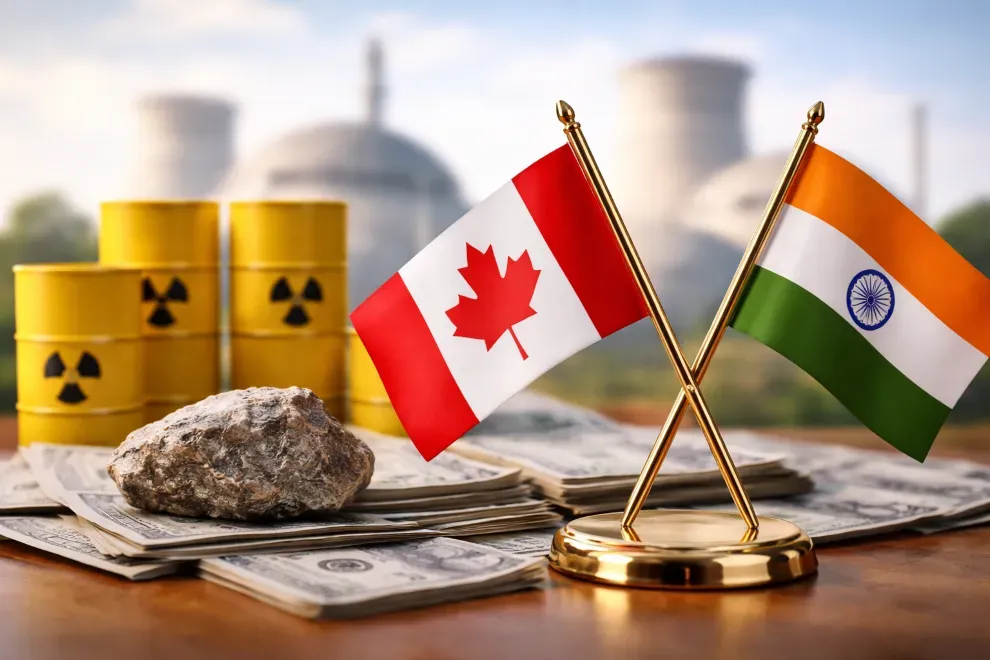
Canadian company Cameco has entered a uranium supply agreement with India valued at CAD 2.6 billion (USD 1.9 billion), committing to supply 22 million pounds of reactor fuel from 2027 to 2035. This step signals a strategic repositioning in bilateral ties following years of political tension.
The agreement was signed during Canadian Prime Minister Mark Carney’s first official visit to New Delhi. The announcement included plans to expand cooperation to liquefied natural gas, critical minerals, solar energy, and hydrogen, reflecting a broader drive to deepen economic and technological partnerships.
The CAD 2.6 billion deal grants Saskatchewan-based Cameco a long-term commitment to supply uranium over eight years, strengthening its operational outlook amid rising global demand for nuclear fuel. This agreement succeeds a previous contract signed in 2015, following the two countries’ 2010 nuclear cooperation accord.
India’s move to boost uranium imports coincides with domestic reforms, including ending the state monopoly on nuclear power generation and relaxing controversial liability rules to attract private investment. These reforms align with India’s plan to raise nuclear capacity to 100 GW by 2047, up from the current 8.8 GW, which accounts for less than 2% of the nation’s total electricity capacity.
On the market front, Cameco shares traded at $161.38, up 0.16%. HCL Technologies’ shares in India rose 1.68% to 1,365.70 rupees, as the company announced expansion in Canada and may increase its Canadian workforce by 75% by 2030.
The deal ensures stable uranium supply flows through the next decade, supporting India's rapidly expanding nuclear sector beyond the limits of local resources. It also signals a gradual restoration of trust between Ottawa and New Delhi after tensions peaked in 2023 following Canadian allegations of Indian government-linked involvement in violence within Canada.
Strategically, the agreement goes beyond commercial value, forming part of a broader economic realignment. Both sides announced intentions to sign a new comprehensive economic partnership agreement this year, aiming to double bilateral trade by 2030. Additional cooperation was agreed in the space sector, and a preliminary memorandum was signed for joint development and deployment of artificial intelligence technologies in a trilateral partnership with Australia.
EcoPulse24 Analysis:
The deal reflects a dual shift: India is securing long-term fuel for its nuclear ambitions, while Canada strengthens its presence in a high-growth market. The political reset has opened new economic opportunities, and as India seeks to significantly expand its nuclear capacity, the uranium market is poised for structurally higher demand, bolstering the negotiating position of international suppliers in the years ahead.
Explore Related Coverage
Sources & References
Editorial Note
Disclaimer
© 2025 EcoPulse24. All rights reserved.