Oil shock ripples through Canada’s economy as energy surge drives lasting inflation risks
Oil shock from Middle East tensions drives lasting inflation in Canada, raising fuel, food, and supply costs, complicating central bank policy.

Toronto | EcoPulse24
Energy-driven price shock spreads beyond fuel into broader consumer costs
The global oil shock triggered by Middle East tensions is now feeding directly into Canada’s economy, raising concerns that inflationary pressures will persist even if crude prices stabilize in the coming months.
While oil prices have shown volatility following ceasefire headlines, the structural impact of higher energy costs is already being felt across households and industries, with economists warning that the effects are both immediate and potentially long-lasting.
Fuel prices surge as supply disruption reshapes markets
The disruption of oil flows - particularly with a significant portion of global supply constrained around the Strait of Hormuz - has pushed crude prices sharply higher compared to pre-war levels, driving a rapid increase in gasoline costs for consumers.
Economists describe the price dynamic through the classic “rockets and feathers” effect, where fuel prices rise quickly when crude surges but adjust more slowly when oil declines. However, recent analysis suggests that the persistence of high prices may be less about delayed adjustment and more about sustained supply-side pressure.
Canada energy shock impact snapshot
| Indicator | Impact |
|---|---|
| Oil price level | Elevated vs pre-war |
| Gasoline prices | Sharp increase |
| Consumer monthly cost impact | ~C$100 increase |
| Global oil flow disruption | ~20% affected |
Inflation pressure extends into food and supply chains
The energy shock is not limited to fuel costs. Rising energy prices are feeding into broader supply chains, particularly in agriculture and food production, where energy-intensive inputs such as fertilizers are becoming more expensive.
Food prices are already approximately 20% higher than pre-pandemic levels, and additional cost pressures are expected to pass through to consumers as producers adjust to higher input costs.
At the same time, sectors such as aviation are facing increased costs due to tighter fuel availability, with airlines introducing surcharges to offset higher jet fuel expenses.
Central banks face tightening dilemma amid energy-driven inflation
The persistence of elevated oil prices is complicating the outlook for monetary policy. Economists suggest that if crude stabilizes at moderate levels, central banks may maintain current policy settings. However, sustained prices above higher thresholds could force a shift toward renewed tightening.
This creates a policy dilemma: inflation driven by supply-side shocks limits the effectiveness of traditional monetary tools while increasing the risk of slower economic growth.
EcoPulse24 Analysis
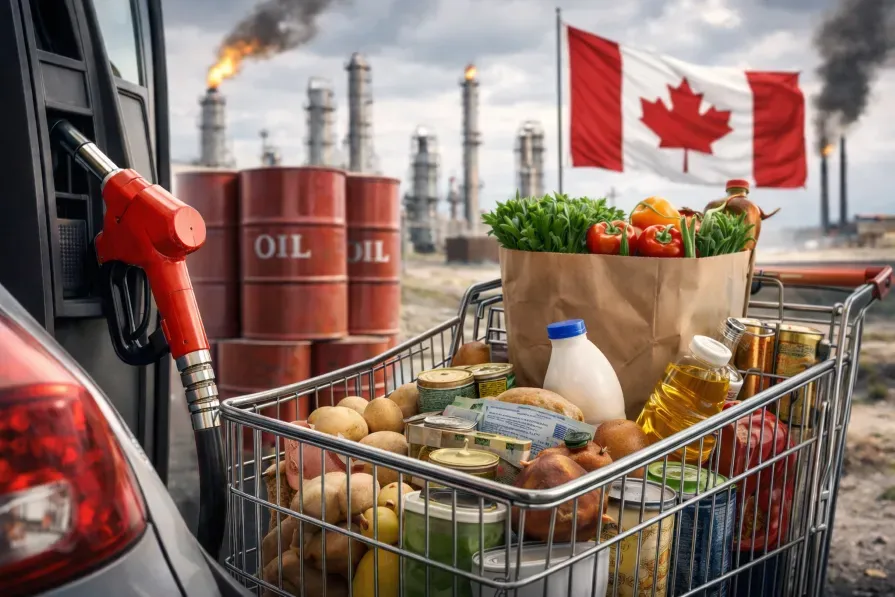
What is unfolding is not a temporary price spike, but a structural energy shock feeding into the real economy. The transmission mechanism is already visible: from crude oil → to fuel → to food → to broader inflation.
The key shift lies in persistence. Even if oil prices retreat, the embedded costs across supply chains are unlikely to reverse quickly, creating what can be described as sticky inflation driven by energy risk premiums.
This dynamic challenges the assumption that inflation will normalize smoothly. Instead, markets are entering a phase where energy becomes the dominant macro driver once again, reshaping consumer behavior, corporate costs, and policy decisions.
For Canada, the impact is amplified by household sensitivity to energy and food prices, making the shock both economically and politically significant.
At a global level, the situation reinforces a broader transition:
inflation is no longer purely cyclical - it is increasingly tied to geopolitics and supply security.
Sources & References
Editorial Note
Disclaimer
© 2025 EcoPulse24. All rights reserved.