Dollar Holds Firm Amid Diverging Currencies, Reflecting Fed Policy Shift and Japanese Political Pressures
The US dollar stays strong on Fed policy signals and data, while the yen weakens due to local politics; commodity currencies outperform.

Washington | EcoPulse24
Global currency markets are undergoing a repositioning as the US dollar holds steady at relatively high levels. This strength is underpinned by a shift in investor outlook regarding US monetary policy and recent strong economic data. This environment has reshaped the balance of major currencies against the dollar, with clear divergence between the performance of European and commodity currencies on one hand, and the Japanese yen on the other.
The dollar index traded near 97.5 after a two-day rally, supported by unexpected expansion in US manufacturing activity, reinforcing the view that the US economy retains momentum favorable for corporate earnings. Investors are now focused on the upcoming monthly jobs report, though it could be delayed by a potential partial government shutdown.
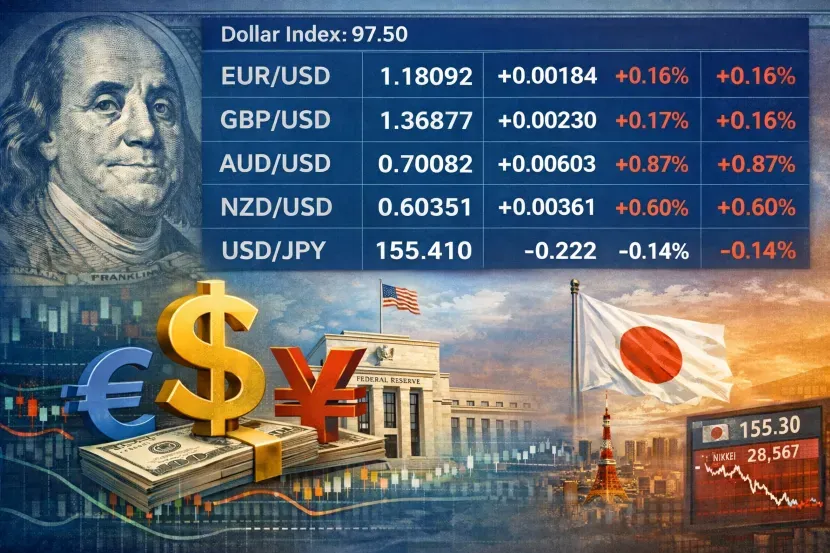
Among major currency pairs, daily movements reflected a delicate balance between dollar strength and local factors:
| Currency | Rate vs USD | Change | Change % |
|---|---|---|---|
| EUR/USD | 1.18092 | 0.00184 | 0.16% |
| GBP/USD | 1.36877 | 0.00230 | 0.17% |
| AUD/USD | 0.70082 | 0.00603 | 0.87% |
| NZD/USD | 0.60351 | 0.00361 | 0.60% |
| USD/JPY | 155.410 | 0.222 | -0.14% |
European currencies showed limited improvement against the dollar, lacking strong domestic catalysts and thus remaining primarily influenced by US developments. In contrast, commodity currencies - particularly the Australian and New Zealand dollars - performed better, driven by expectations of tighter monetary policy in Australia, which partially offset dollar strength during the session.
The dollar’s rally accelerated after President Donald Trump nominated Kevin Warsh to succeed Federal Reserve Chair Jerome Powell. Markets interpreted this as signaling a relatively hawkish approach to monetary policy, with a preference for slower rate cuts compared to other candidates, boosting the dollar’s short-term appeal.
Additionally, US-India trade developments provided further support for the greenback, following an agreement to reduce mutual tariffs and for New Delhi to halt Russian oil purchases. This move reshuffled trade and energy flows, reinforcing demand for the dollar as a primary settlement currency.
The Japanese yen remained under clear pressure, trading near 155.5 yen per dollar after two consecutive sessions of losses. While dollar strength played a key role, local Japanese factors intensified the pressure. Prime Minister Sanai Takaichi's comments describing yen weakness as a potential opportunity for exports were interpreted as a political signal favoring a weaker currency, despite later clarifications emphasizing economic flexibility amid exchange rate volatility.
Yen weakness also coincided with the approach of early lower house elections on February 8, where the government is expected to pursue expansionary fiscal policies. Ongoing discussions over tax cuts have heightened concerns about Japan’s public finances, negatively impacting both government bonds and the yen.
EcoPulse24 Analysis:
Currency movements reflect a transitional phase in global monetary policy expectations. The dollar is benefiting from a rare mix of strong economic data and signals of relative hawkishness at the Fed’s helm, giving it a clear short-term advantage. Conversely, the yen faces dual pressures from both external dollar strength and domestic political messaging that appears tolerant of a weaker currency. The outperformance of commodity currencies highlights that monetary policy differentials have become pivotal, making markets more selective in currency trading. Overall, the FX market is likely to remain highly sensitive to any shifts in US interest rate direction or major economies’ fiscal policies, with divergence persisting over broad-based moves.
Explore Related Coverage
Sources & References
Editorial Note
Disclaimer
© 2025 EcoPulse24. All rights reserved.