Dubai Financial Market Rises Despite Regional Conflict as Investors Return to DIFC
Dubai's stock market rose 1% this week, showing investor confidence despite regional tensions as activity and foreign investment rebound in DIFC.

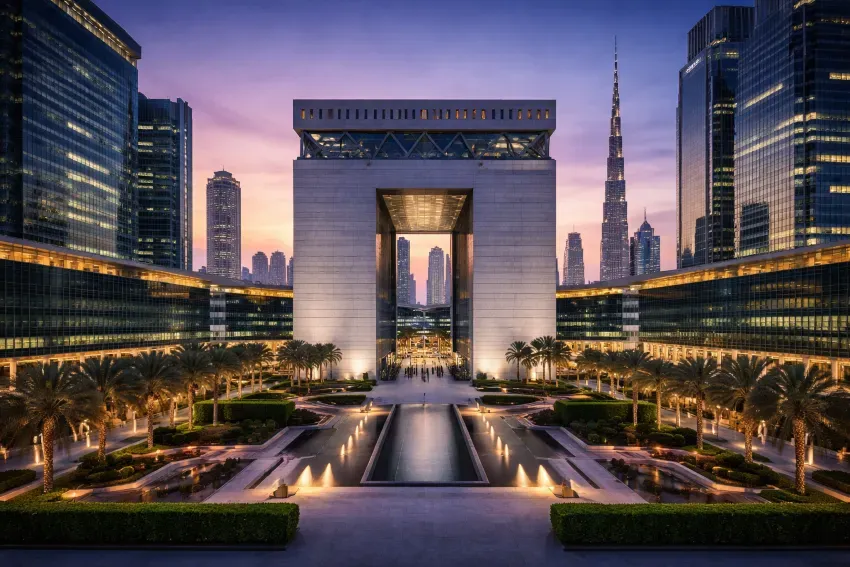
Dubai | EcoPulse24
Dubai Financial Market, DIFC, UAE stocks
Dubai’s stock market extended its gains this week despite ongoing regional military tensions, signaling continued investor confidence in the emirate’s financial system even as geopolitical risks remain elevated across the Middle East.
The Dubai Financial Market General Index closed at 5,902.21 points, gaining 59.61 points or 1.02% over the past week, according to Masadir Market History data. The advance came as several major financial and operating stocks maintained positive momentum alongside a gradual return of bankers, traders and executives to the Dubai International Financial Centre.
A Bloomberg report published Thursday highlighted how traffic and business activity have started recovering in Dubai’s financial district after many financial professionals temporarily relocated during recent regional attacks. Major international firms including Citigroup and Standard Chartered have resumed normal office operations in the UAE, reinforcing confidence in Dubai’s role as a regional financial hub.
The latest market performance suggests investors are increasingly separating short-term geopolitical volatility from the UAE’s longer-term economic fundamentals. Unlike previous regional crises that triggered broader selloffs across Gulf markets, current trading patterns indicate stronger confidence in Dubai’s institutional resilience and operational continuity.
Market participants also appear to be pricing in Dubai’s growing role as a global capital platform rather than a purely regional financial center. Long-term residency programs, sustained foreign investment inflows and continued hiring by international financial firms have helped stabilize sentiment despite the uncertain geopolitical backdrop.
Bloomberg reported that several global asset managers and financial institutions continue to expand operations in the emirate, with firms such as Brookfield Asset Management pursuing new real estate investments in Dubai even during the current regional tensions.
Top Gainers on Dubai Financial Market
| Symbol | Company | Price | Change % | Traded Value |
|---|---|---|---|---|
| DNIR | DNIR | AED 3.35 | 9.83% | AED 1,675 |
| DU | du | AED 11.20 | 3.13% | AED 28.49 million |
| CBD | Commercial Bank of Dubai | AED 9.33 | 1.96% | AED 15,416 |
| MASQ | MASQ | AED 242.4 | 1.00% | AED 19.74 million |
| AMCREIT | AMCREIT | AED 1.10 | 0.91% | AED 998 |
The gains in telecommunications and banking shares point to continued confidence in domestic economic activity and consumer demand, while ongoing trading activity in real estate-linked stocks reflects expectations that Dubai’s property and investment sectors remain structurally supported despite regional uncertainty.
EcoPulse24 Analysis
Dubai’s market behavior during the current geopolitical cycle reflects a broader structural transition in how Gulf financial centers are perceived by international investors. The emirate is increasingly being treated as a long-duration financial and capital allocation platform rather than a temporary emerging market destination vulnerable to every regional escalation.
That distinction matters because global capital typically reacts not only to conflict itself, but to operational disruption, institutional continuity and liquidity stability. Dubai’s ability to maintain trading activity, reopen financial offices and preserve investor participation during a volatile regional period sends a strong signal about the maturity of its financial ecosystem.
The return of bankers, hedge funds and international firms to DIFC also carries symbolic weight. In previous regional crises, capital flight and operational pauses were often immediate. Today, the response appears more measured, suggesting investors believe the UAE possesses stronger crisis-management capabilities and infrastructure resilience than in past cycles.
Equally important is the fact that major global firms continue expanding recruitment and investment activity in Dubai instead of freezing operations entirely. That behavior reflects confidence in the emirate’s long-term strategic positioning between Asia, Europe and Africa, especially as global firms continue searching for politically stable and tax-efficient regional headquarters.
The resilience of Dubai Financial Market during the week also reinforces the growing decoupling between Gulf market performance and headline-driven geopolitical panic. Investors appear increasingly focused on liquidity conditions, earnings visibility and macroeconomic durability rather than reacting purely to military developments.
If current market stability continues alongside sustained capital inflows and recovering business activity, Dubai could emerge from the present geopolitical period with a stronger reputation as one of the Middle East’s most resilient financial centers.
Sources & References
Editorial Note
Disclaimer
© 2025 EcoPulse24. All rights reserved.