EU and Mercosur Sign Largest Free Trade Agreement in EU History After 25 Years of Negotiations, Valued at €111 Billion
EU and Mercosur signed a €111B free trade deal after 25 years, cutting tariffs and boosting trade, pending ratification amid key challenges.

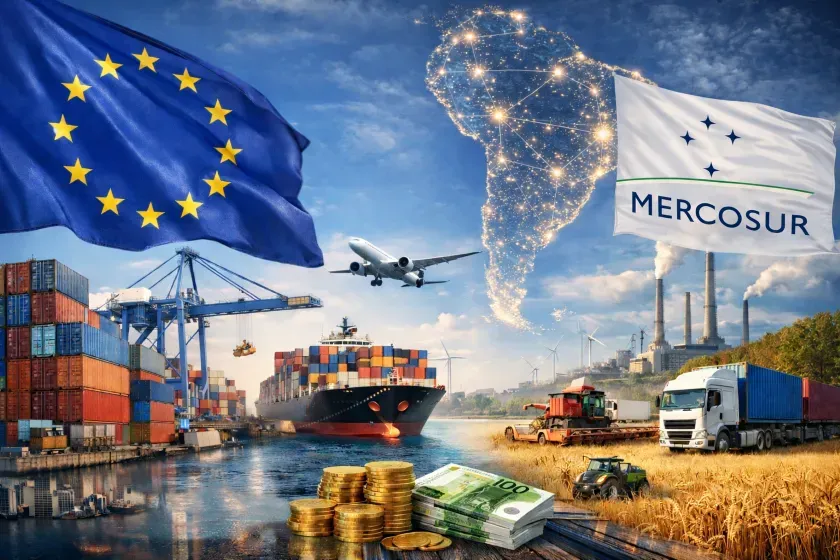
Asunción, Paraguay – January 17, 2026
In a landmark moment for global trade, the European Union and South America's Mercosur bloc officially signed a comprehensive partnership and free trade agreement in Paraguay's capital, Asunción, ending 25 years of difficult negotiations. The deal redraws the map of international trade amid rising global protectionism and tariffs.
The signing ceremony - held at the Gran Teatro José Asunción Flores, where Mercosur's founding treaty was signed in 1991 - was attended by European Commission President Ursula von der Leyen, European Council President António Costa, and leaders from Paraguay, Argentina, and Uruguay. Notably absent was Brazilian President Luiz Inácio Lula da Silva, who sent his foreign minister instead, reflecting internal tensions within Mercosur despite Brazil's leadership role.
The agreement establishes a free trade area covering over 700 million consumers and 30% of global GDP, encompassing 27 EU countries and four Mercosur states (Argentina, Brazil, Paraguay, Uruguay). Bilateral trade reached €111 billion in 2024, with EU exports of €55.2 billion and imports of €56 billion, a 36% increase since 2014.
The deal eliminates over 90% of tariffs on bilateral trade, with gradual reductions over 10-15 years. The European Commission estimates EU companies will save over €4 billion annually in tariffs.
Geopolitically, the deal is seen as a response to US protectionism, as it was signed hours before new US tariffs on Europe. Von der Leyen stated the agreement sends a “very strong message to the world” favoring fair trade and long-term partnership over isolation. The EU aims to lessen dependence on the US and China, diversify supply sources, and reinforce its status as a global trading power.
Securing access to critical raw materials is central to the agreement, ensuring EU supplies for green transition technologies and reducing reliance on China. Tariffs on key raw materials will be reduced, stimulating Mercosur exports and lowering costs for European industry.
Agriculture remains the most contentious issue. France led EU opposition, fearing an influx of cheap South American meat. Brazil is the world’s largest beef exporter, accounting for 23% of global exports. To address concerns, strict quotas were set: 99,000 tons of beef and 180,000 tons of poultry annually at reduced tariffs, along with a €6.3 billion EU fund to support affected farmers and safeguard clauses for sensitive sectors.
European industry, especially German automakers, strongly supported the deal, as auto tariffs in Brazil and Argentina (35%) will be phased out over 15 years. EU exports to Mercosur are expected to rise 39% by 2040, while imports from Latin America will increase by 16.9%.
Middle East and Gulf states, though not parties to the agreement, will feel its impact. The Gulf relies heavily on South American food imports; competition for these supplies may intensify, affecting prices and availability. For example, the UAE imported 95,000 tons of Brazilian beef in H1 2024, up 238% year-on-year.
The deal also offers Gulf states opportunities for trilateral cooperation in renewable energy, increased investment in South America, and reinforcement of their role as global trade hubs. However, competition in petrochemicals may intensify, requiring strategic responses.
Environmental concerns, particularly Amazon deforestation, remain a major challenge. The agreement includes binding commitments to the Paris Climate Accord and biodiversity, with the EU barring imports linked to deforestation from late 2026.
Despite the official signing, the deal still requires ratification by the European Parliament, all 27 EU member states, and the four Mercosur parliaments. The process is expected to be contentious, especially among French, Polish, Austrian, Irish, and Hungarian lawmakers, while Germany, Spain, and Italy are supportive.
The direct economic impact is expected to be modest, with EU GDP rising by 0.1% and Mercosur by 0.3% by 2032. However, the geopolitical significance is substantial, signaling to the US and China that the EU is determined to reduce dependency and achieve strategic autonomy.
The agreement is expected to enter into force by the end of 2026, pending ratification. Its provisional application will begin immediately after approval by the European Parliament.
In conclusion, the EU-Mercosur agreement marks a pivotal moment in global trade, opening vast opportunities for business and investment while facing significant challenges regarding agriculture, the environment, and parliamentary approval.
Disclaimer: This analysis reflects the independent assessment of EcoPulse24 and does not necessarily represent the views of any parties involved in the agreement.
Explore Related Coverage
Sources & References
Editorial Note
Disclaimer
© 2025 EcoPulse24. All rights reserved.