Blast at Qatar's Ras Laffan Gas Complex Raises Questions Over LNG Restart
An explosion at Qatar's Barzan gas facility in Ras Laffan injured dozens and left 18 missing, raising fresh questions about the pace of LNG production

Doha | EcoPulse24
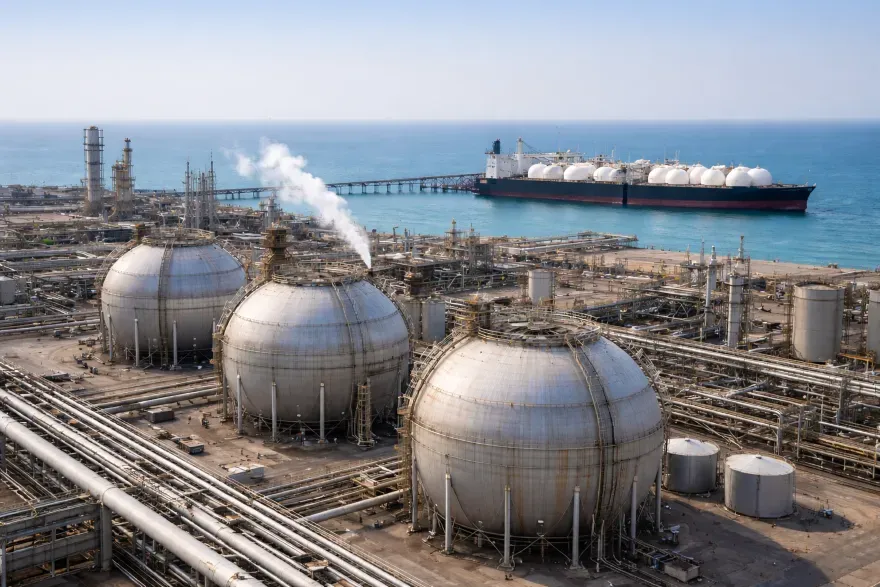
An explosion and fire struck Qatar's Barzan local gas supply facility at the Ras Laffan Industrial City on Sunday, injuring dozens and leaving multiple people missing, in an incident that has raised fresh questions about the pace of the country's liquefied natural gas (LNG) production recovery following the recent US-Iran ceasefire.
According to QatarEnergy, the incident occurred during the startup of the Ras Laffan industrial complex. Qatar's Ministry of Interior said in an online statement that 54 people were injured and 18 remain missing.
The Barzan facility supplies gas to domestic industries and power generation, and it remains unclear whether the incident will affect Qatar's LNG production and export operations.
Incident Hits Strategic Energy Hub
The explosion occurred at one of the world's most strategically important energy complexes.
Spanning approximately 300 square kilometers, Ras Laffan Industrial City is among the world's largest integrated energy hubs, housing LNG export plants, refineries, gas-to-liquids facilities, desalination units and power stations.
The industrial complex forms the backbone of Qatar's natural gas industry and plays a critical role in supplying global LNG markets.
Before the recent conflict between the United States and Iran, Qatar was the world's second-largest LNG exporter. The country suspended production of the super-chilled fuel earlier in the conflict following attacks on major energy facilities and the closure of the Strait of Hormuz.
LNG Restart Faces New Questions
The incident comes at a particularly sensitive moment for energy markets.
Qatar has been working to restore operations at Ras Laffan after the reopening of the Strait of Hormuz, with authorities aiming to resume approximately 80% of LNG production within two months of the waterway safely reopening.
The pace of Qatar's production recovery has been closely monitored by global energy markets because a rapid return of LNG supplies could ease international gas prices and help normalize supply conditions following weeks of disruptions.
However, the latest explosion has introduced fresh uncertainty over the operational challenges involved in restarting one of the world's largest LNG facilities.
Markets Closely Monitoring Supply Risks
Bloomberg reported that US-Iran tensions had already pushed Dutch natural gas prices, an international benchmark, higher early on Monday.
The uncertainty surrounding the Barzan incident has increased market attention on Qatar's recovery timeline, particularly given the country's central role in global LNG trade.
Despite the explosion, available shipping data suggest Qatar has not yet slowed its export restart plans.
According to ship-tracking data compiled by Bloomberg, four tankers owned by Qatar's state shipping company or operating under long-term charter arrangements were traveling through the Strait of Hormuz toward Ras Laffan on Monday.
EcoPulse24 Analysis | Why the Ras Laffan Incident Matters to Global Energy Markets
The explosion at Barzan is not merely an industrial accident.
It occurred at a time when energy traders were increasingly optimistic that the reopening of the Strait of Hormuz would allow Qatar to rapidly restore LNG production and exports, helping stabilize global gas markets.
Instead, the incident highlights the technical complexity and operational risks associated with restarting large-scale energy infrastructure after major disruptions.
Restarting LNG facilities requires carefully balancing system pressures, coordinating interconnected processing units and ensuring equipment integrity to avoid leaks or mechanical failures. Any malfunction during this process can create operational delays and raise questions about production schedules.
The incident also underscores the broader vulnerabilities facing Middle Eastern energy infrastructure. Even after geopolitical tensions ease, the process of restoring operations can itself become a source of uncertainty for markets.
At this stage, the most important unanswered question is whether the Barzan explosion will remain an isolated event or evolve into a wider challenge for Qatar's LNG recovery plans.
For global energy markets, the issue is no longer simply how quickly Qatar can resume exports.
The question now is whether one of the world's most important LNG suppliers can restore operations as rapidly as expected without further disruptions.
Sources & References
Editorial Note
Disclaimer
© 2025 EcoPulse24. All rights reserved.