Gold Slides Toward Multi-Month Lows as Stronger Dollar and Easing Geopolitical Risks Pressure Safe-Haven Demand
Gold fell to around $4,025 an ounce, losing nearly 12% in a month as a stronger US dollar and easing geopolitical risks weighed on safe-haven demand.

Precious Metal Falls Nearly 12% in a Month as Markets Reprice Fed Expectations and Reduce Defensive Positions
Dubai | EcoPulse24
Gold fell to around $4,025 per ounce on Wednesday, extending one of its steepest declines in recent months as a strengthening US dollar, expectations of tighter Federal Reserve policy and easing geopolitical tensions combined to pressure demand for the precious metal.
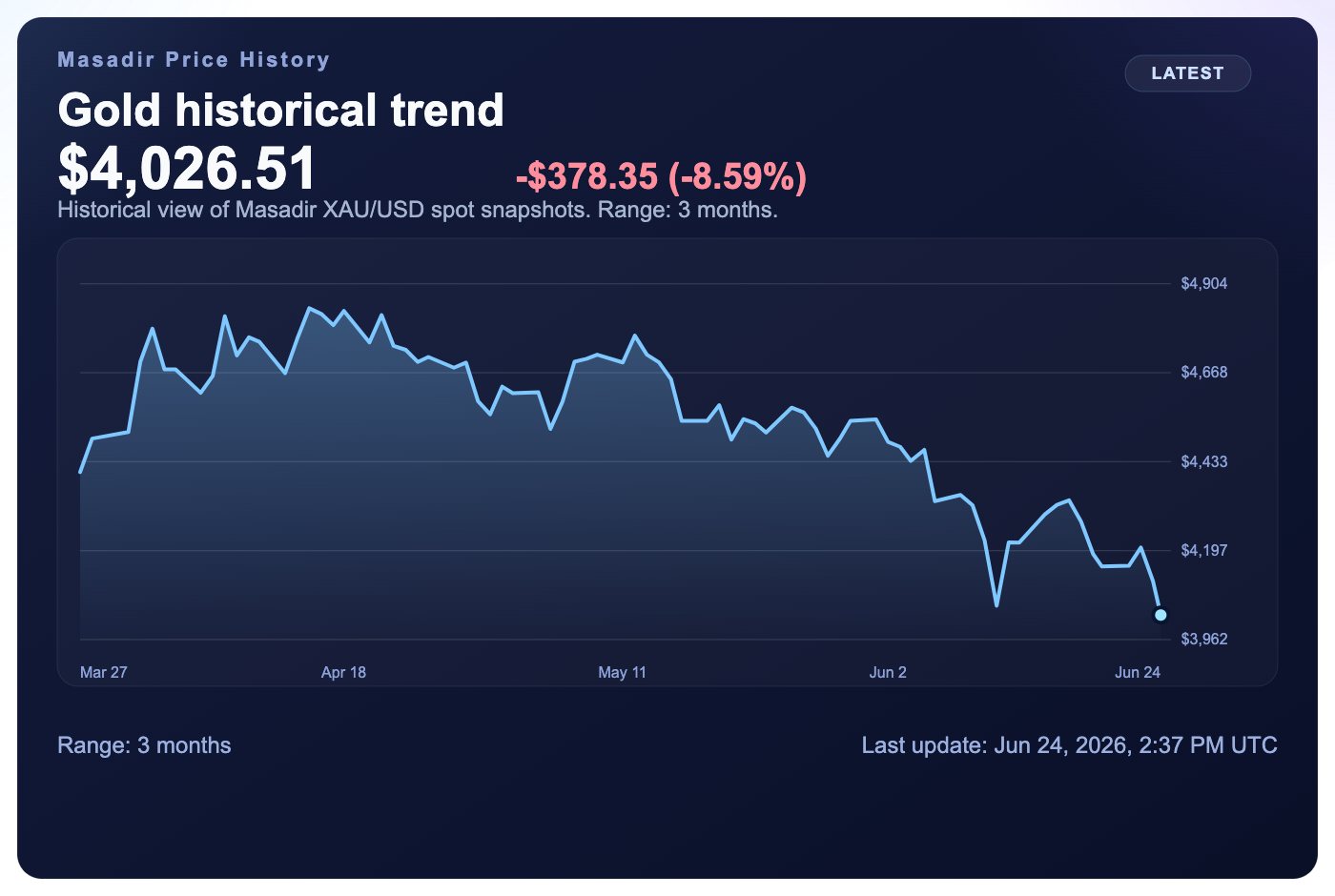
According to Masadir Economics data, gold was down approximately 2.0% on the day, or $83.23 per ounce, while cumulative losses widened to 7.38% over the past week, 11.76% over the past month, and roughly 8.6% over the past three months.
The latest reading leaves gold near some of its weakest levels in several months and suggests that investors are undergoing a broader reassessment of defensive assets.
Charts Signal a Sustained Downtrend
Masadir charts show a persistent pattern of lower highs and lower lows over the past three months, indicating that selling pressure has become increasingly entrenched.
The decline accelerated during the second half of June, with losses extending across daily, weekly and monthly timeframes.
The scale of the retreat suggests the move is not merely short-term volatility but rather a sustained repricing process in which investors have continued to reduce exposure to the precious metal.
Stronger Dollar Raises Pressure on Gold
The decline in gold has coincided with a notable rebound in the US dollar.
The US Dollar Index (DXY) climbed above 101.7 on Wednesday, reaching its highest level since March 2025 and moving toward its longest winning streak in more than a month.
The greenback has gained approximately 3.5% since the start of the year, supported by expectations that the Federal Reserve will maintain restrictive monetary policy.
Traders currently assign roughly a 68% probability of an interest-rate increase in September, up sharply from 29% just one week ago.
A stronger dollar typically weighs on gold by making the metal more expensive for holders of other currencies and increasing the relative attractiveness of dollar-denominated assets.
Easing Geopolitical Risks Reduce Safe-Haven Demand
At the same time, geopolitical risk premiums that previously supported gold prices have continued to unwind.
Progress in US-Iran negotiations and improving traffic through the Strait of Hormuz have eased concerns over global energy supplies and reduced immediate fears of supply disruptions.
As tensions have moderated, investors appear increasingly willing to reduce defensive positions accumulated during earlier periods of uncertainty.
The unwinding of these safe-haven flows has added further downward pressure to the precious metal.
Equity Market Volatility Has Not Revived Gold Demand
Recent volatility in global equity markets has boosted demand for traditional safe-haven currencies such as the US dollar.
However, that support has not meaningfully extended to gold.
Instead, the precious metal has continued to weaken, suggesting investors are currently favoring cash and dollar-denominated assets over bullion as their preferred defensive positioning.
EcoPulse24 Analysis
Gold Is Being Hit by Multiple Macro Forces Simultaneously
Gold's latest decline is not the result of a single catalyst.
Instead, several macro forces have aligned against the precious metal simultaneously:
-
A stronger US dollar;
-
Increasing expectations of tighter Federal Reserve policy;
-
Easing geopolitical tensions in the Middle East;
-
The continued unwinding of safe-haven positioning.
The market structure also remains technically weak.
Nearly 12% of value has been erased in just one month, and the persistent sequence of lower highs and lower lows indicates that buyers have yet to regain control of momentum.
The latest price action suggests that gold is increasingly trading as a casualty of rising dollar strength and changing investor expectations, rather than as a beneficiary of broader market uncertainty.
For now, the metal remains caught between fading geopolitical premiums and a resurgent dollar, leaving it under pressure despite heightened volatility elsewhere in global markets.
Sources & References
Editorial Note
Disclaimer
© 2025 EcoPulse24. All rights reserved.