Gold Falls to Lowest Level of 2026 as Strong U.S. Jobs Data Reinforces Higher-for-Longer Rate Expectations
Masadir Economics platform's 90-day historical analysis, gold has declined approximately 15.8% over the past three months,

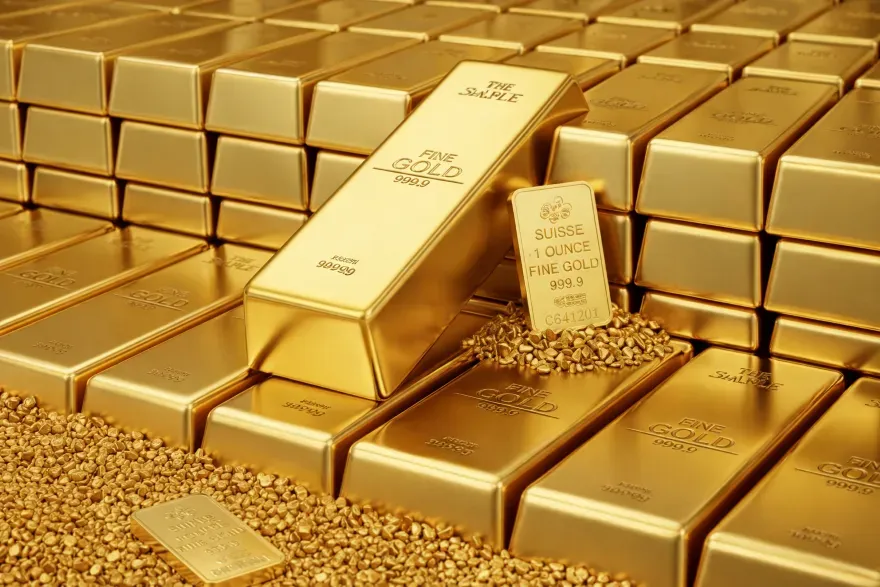
Dubai | EcoPulse24
Gold prices dropped below $4,370 per ounce on Friday, hitting their lowest level of 2026 and heading for a weekly loss of nearly 4%, as stronger-than-expected U.S. employment data boosted expectations that the Federal Reserve may keep interest rates elevated for longer.
The decline came after the latest U.S. labor market report showed the economy added 172,000 nonfarm jobs in May, significantly exceeding market expectations of 85,000 jobs. Meanwhile, the unemployment rate remained unchanged at 4.3%, while annual wage growth eased to 3.4%, matching analyst forecasts.
The data reinforced confidence in the resilience of the U.S. economy and prompted investors to reassess expectations for monetary policy through the remainder of 2026.
Strong Labor Market Reshapes Interest Rate Expectations
Markets reacted quickly to the jobs report, increasing bets that the Federal Reserve could implement another quarter-point rate increase before year-end.
Higher interest rates generally weigh on gold because the precious metal does not generate income, making yield-bearing assets such as government bonds relatively more attractive.
The stronger labor market data also supported the U.S. dollar and Treasury yields, adding further pressure on bullion prices.
Key Economic Data
| Indicator | Value |
|---|---|
| May Nonfarm Payrolls | 172,000 |
| Market Forecast | 85,000 |
| U.S. Unemployment Rate | 4.3% |
| Annual Wage Growth | 3.4% |
| Expected Fed Move | +0.25% by year-end |
Geopolitical Risks Fail to Offset Selling Pressure
Despite ongoing tensions in the Middle East, gold was unable to attract sufficient safe-haven demand to counter the impact of rising rate expectations.
U.S. President Donald Trump stated that peace negotiations in the region were approaching their final stages. However, Iranian officials disputed claims of meaningful progress, while Iran-backed Hezbollah rejected a U.S.-supported ceasefire proposal.
Although geopolitical uncertainty typically supports gold prices, investors appeared more focused on monetary policy and economic fundamentals during the latest trading sessions.
Gold's Role as an Inflation Hedge Weakens
The recent decline suggests investors are becoming less reliant on gold as an inflation hedge compared with earlier periods.
As expectations for tighter monetary policy increase, investors often reduce exposure to precious metals and shift toward assets that benefit from higher interest rates.
This dynamic has become increasingly visible across global markets as economic data remains stronger than expected.
Masadir Economics: Gold Down Nearly 16% in 90 Days
Additional data from Masadir Economics highlights the broader trend behind the recent weakness in gold prices.
According to the platform's 90-day historical analysis, gold has declined approximately 15.8% over the past three months, falling to $4,327.89 per ounce and approaching the lower end of its recent trading range.
The decline reflects a significant shift in investor sentiment away from traditional inflation hedges as markets increasingly focus on economic growth prospects, monetary policy expectations, and interest-rate dynamics.
Masadir's data suggests that investors are placing greater weight on Federal Reserve policy and U.S. economic performance than on geopolitical risks, which had previously provided strong support for precious metals.
Masadir Economics Gold Snapshot
| Indicator | Value |
|---|---|
| Current Gold Price | $4,327.89 |
| 90-Day Change | -15.81% |
| 90-Day High | $4,475.29 |
| 90-Day Low | $4,313.18 |
EcoPulse24 Analysis
The latest decline in gold illustrates the growing influence of monetary policy expectations on global markets.
While geopolitical tensions remain elevated, investors are increasingly focused on the trajectory of U.S. interest rates and the resilience of the American economy. The stronger-than-expected jobs report reinforces the view that inflation risks have not fully disappeared and that policymakers may need to maintain a restrictive stance for longer than previously anticipated.
The broader trend identified by Masadir Economics further supports this interpretation. A nearly 16% decline over 90 days signals that investors are steadily reducing exposure to inflation-protection assets as confidence in economic growth and higher interest rates grows.
For gold, the coming weeks may be defined by a tug-of-war between two powerful forces: persistent geopolitical uncertainty supporting safe-haven demand, and stronger economic data encouraging investors to favor yield-generating assets.
At present, the latter appears to be exerting greater influence on market positioning.
Explore Related Coverage
Sources & References
Trading Economics - tradingeconomics.com
Editorial Note
Disclaimer
© 2025 EcoPulse24. All rights reserved.