Gold Loses Nearly 27% From Record High Despite War, Inflation and Energy Shock
Investors Shift Away From Traditional Safe Havens as Higher Real Yields and Dollar Strength Reshape Market Dynamics

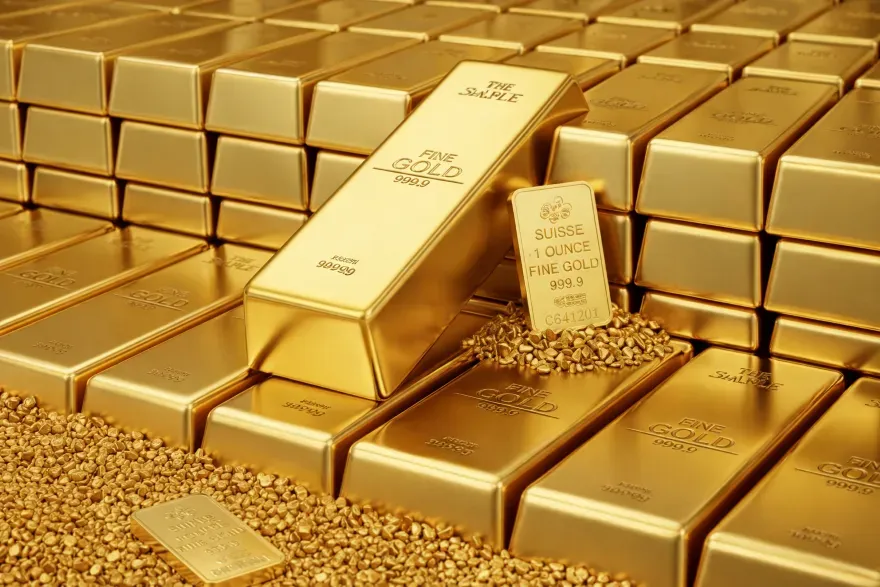
Dubai | EcoPulse24
Gold has fallen nearly 27% from its all-time high, defying one of the most supportive geopolitical and macroeconomic backdrops traditionally associated with strong gains in the precious metal.
Spot gold recently traded near $4,087.12 per ounce, down approximately $1,502 per ounce from its record peak of $5,589.11 per ounce, representing a decline of roughly 26.87%, according to Masadir Economics data.
| Gold Performance Since Record High | |
|---|---|
| Record High | $5,589.11/oz |
| Current Price - today prices | $4,087.12/oz |
| Dollar Loss | -$1,501.99/oz |
| Percentage Decline | -26.87% |
| Peak Date | 28 January 2026 |
The scale of the pullback is drawing increasing attention across global markets because it comes at a time when many of the conditions that typically support gold remain firmly in place.
Over the past several months, investors have navigated an environment marked by military conflict between the United States and Iran, significant disruptions to shipping and energy flows through the Strait of Hormuz, rising oil prices and a renewed acceleration in US inflation.
Yet instead of extending its rally, gold has surrendered more than a quarter of its value from its historic peak.
A Different Market Response Than Earlier This Year
When geopolitical tensions intensified earlier this year, investors rushed into traditional defensive assets, helping propel gold to record levels.
At the time, markets were pricing a scenario of prolonged instability across the Middle East, potential energy supply disruptions and a broader inflation shock.
However, as the year progressed, investor behavior began to change.
Rather than continuing to chase geopolitical hedges, markets increasingly focused on monetary policy, real interest rates and relative asset returns.
That shift has fundamentally altered the investment case for gold.
Inflation Returns, But Gold Does Not
The latest US inflation report showed consumer prices rising 4.2% year-over-year in May, marking the highest reading since 2023.
At first glance, such a development would normally be expected to support gold as investors seek protection from declining purchasing power.
Instead, the market's reaction has been more nuanced.
Investors appear increasingly focused on what higher inflation means for interest rates rather than inflation itself.
A stronger inflation outlook raises the likelihood that the Federal Reserve will maintain restrictive monetary policy for longer, supporting Treasury yields and strengthening the US dollar.
Both developments tend to reduce the relative attractiveness of non-yielding assets such as gold.
Real Yields Reclaim Investor Attention
One of the most important forces behind gold's decline has been the rise in real yields.
The US 10-year real Treasury yield recently traded around 2.21%, remaining near historically elevated levels.
For investors, real yields represent the inflation-adjusted return available from government bonds.
When those returns become more attractive, the opportunity cost of holding gold rises.
Unlike bonds, gold generates no income stream, making it less competitive in an environment where investors can earn meaningful real returns elsewhere.
Dollar Strength Changes Capital Flows
The US dollar has also re-emerged as a major competitor for global capital.
Since late February, the Dollar Index (DXY) has risen from approximately 97.8 to around 100, reflecting growing demand for dollar-denominated assets amid geopolitical uncertainty and expectations of higher-for-longer US interest rates.
Historically, a stronger dollar creates headwinds for gold because it increases the metal's cost for investors using other currencies.
More importantly, it redirects capital toward cash and fixed-income instruments offering attractive returns.
Safe-Haven Demand Is Being Shared
The current market environment highlights an important shift in investor behavior.
During previous periods of geopolitical stress, gold was often the primary destination for defensive capital.
Today, investors have a wider range of alternatives.
US Treasury securities, short-duration fixed-income instruments and even cash positions are competing directly with gold for safe-haven allocations.
As a result, geopolitical tensions alone are no longer sufficient to guarantee sustained gains in the precious metal.
EcoPulse24 Analysis
Gold's decline from $5,589.11 to approximately $4,087.12 per ounce may become one of the most important macroeconomic stories of 2026.
The metal has lost more than $1,500 per ounce, representing a decline of nearly 27% from its record high, despite a macroeconomic backdrop that would normally be considered highly supportive for gold.
At the beginning of the year, markets viewed geopolitical risk as the dominant force driving asset prices. Today, investors appear more concerned about the consequences of that risk - namely higher inflation, stronger real yields and a more restrictive monetary environment.
In other words, the market is no longer buying gold simply because uncertainty exists.
Instead, it is asking how that uncertainty affects interest rates, bond yields and the dollar.
The answer so far has favored income-producing assets over traditional inflation hedges.
For Gulf economies, this development carries broader implications. Elevated energy prices continue to support government revenues and liquidity, while stronger US yields influence financing costs across dollar-linked economies. Gold's weakness suggests investors currently view monetary conditions as a more powerful force than geopolitical instability.
The result is a striking paradox: a year marked by war, energy disruption and resurging inflation has produced not a new gold rally, but a decline of nearly 27% from gold's all-time high, erasing more than $1,500 per ounce despite one of the most geopolitically uncertain periods in recent years.
And that may say more about today's market than the price of gold itself.
What makes the decline particularly noteworthy is not the percentage loss itself, but the timing. Gold typically benefits from geopolitical instability, rising energy prices and accelerating inflation. In 2026, all three conditions have been present simultaneously. Yet investors have increasingly favored US dollar assets and inflation-adjusted bond yields over traditional safe-haven allocations, suggesting a significant shift in how markets are pricing risk.
Sources & References
Editorial Note
Disclaimer
© 2025 EcoPulse24. All rights reserved.