Hong Kong Stocks Hit Multi-Week Lows Amid Rising Geopolitical Risks and Slowing Retail Sales
Hong Kong stocks hit 11-week lows on geopolitical risks, weak China data, and slowing retail sales, despite improving business activity.

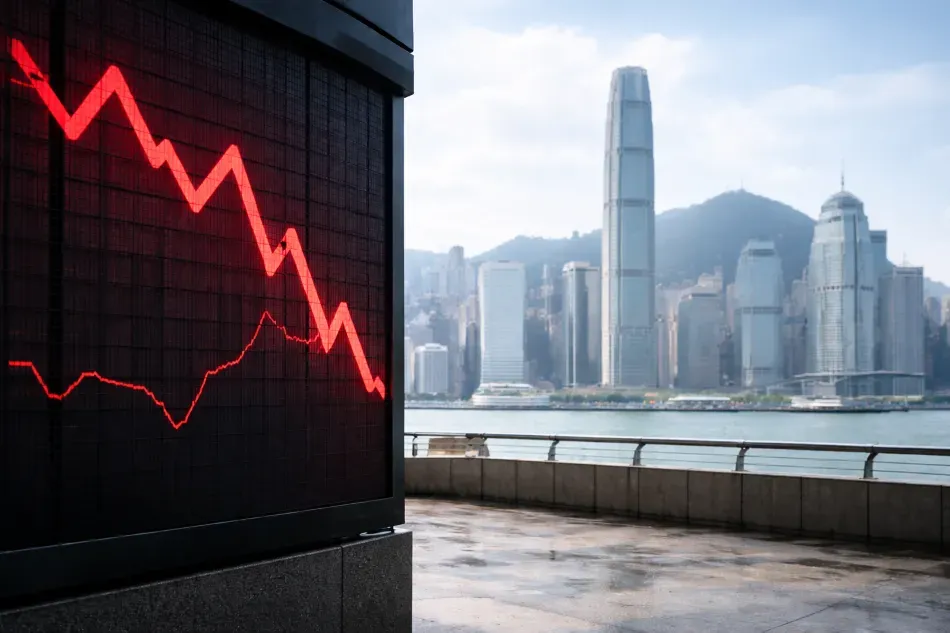
Hong Kong | EcoPulse24
Hong Kong markets saw a broad-based sell-off on Wednesday as global geopolitical tensions escalated and pressures on the Asian economy increased. Local economic data showed mixed signals, with private sector business activity improving but retail sales growth slowing.
The Hang Seng Index ended the trading session down 518 points to 25,249, a 2.0% drop and its third consecutive decline, reaching the lowest level since mid-December. The sell-off coincided with falling US equity futures, raising fears of further geopolitical risk repricing, especially due to Middle East tensions and their potential impact on energy markets and global inflation.
Morning trading saw an even steeper drop, with the index falling by 662 points to 25,098 - a 2.6% decline and near an 11-week low. Investor sentiment was also hit by weak Chinese economic data; official figures showed industrial activity contracted for a second straight month in February, highlighting ongoing weak domestic demand and investment despite resilient exports.
Most market sectors posted declines, led by financials, real estate, and consumer goods. Major companies faced notable selling pressure: Minimax Group shares dropped 9.6%, Akeso Inc fell 5.1%, AIA Group declined 5.0%, CITIC Ltd lost 4.5%, and MTR Corp slid 3.8%.
Conversely, some basic metals firms performed well, with aluminum stocks rising on global price gains after a major Qatari smelter halted operations, raising concerns about a global aluminum supply shortage.
On the consumer side, Hong Kong’s retail sales growth slowed in January 2026, up 3.4% year-on-year versus 5.1% in December, the slowest pace since August. Several consumer sectors saw notable sales declines: food, alcoholic beverages, and tobacco sales fell 10.8% (vs. a 0.4% dip in December); department store sales dropped 5.7% (from +0.6%); and fuel sales plunged 25% (vs. -21.9%). Other consumer goods growth slowed to 2.4% (from 5.3%), though durable goods sales remained strong, rising 34.3% (down from 39.6%).
Some sectors improved: clothing and footwear sales rose 5.3% (after an 8.4% drop), while jewelry, watches, and valuable gifts grew 10.8% (vs. 1.2%). On a monthly basis, retail sales grew 6.5% in January, up from 3.8% in December, indicating continued consumer activity despite slower annual growth.
In other economic data, the Hong Kong private sector PMI improved in February 2026, rising to 53.3 from 52.3 in January, marking the seventh consecutive month of expansion and the strongest business conditions in nearly three years. The improvement was driven by higher output and new orders, with backlogs accumulating at the fastest pace in 12 years. Companies responded by increasing hiring for the first time in four months, though job creation remained modest. Purchasing activity also rose, while supply chains experienced delivery delays for the first time since November.
Input cost inflation slowed but remained strong, while selling prices reached their highest since October 2023 as firms sought to maintain operating margins amid intense competition.
EcoPulse24 Analysis:
Recent developments in Hong Kong highlight a divergence between the real economy and financial markets. Private sector business activity shows clear improvement in output and orders, but local consumption remains fragile with slowing retail sales growth. External economic and geopolitical factors continue to play a major role, given Hong Kong’s close ties to China and global trade, making its financial markets sensitive to international economic shifts.
Explore Related Coverage
Sources & References
Editorial Note
Disclaimer
© 2025 EcoPulse24. All rights reserved.