India and the European Union Sign Historic Free Trade Agreement, Reshaping Global Commerce
India and EU sign a landmark free trade pact, boosting commerce and diversifying markets amid global trade tensions and US tariffs.

New Delhi | EcoPulse24
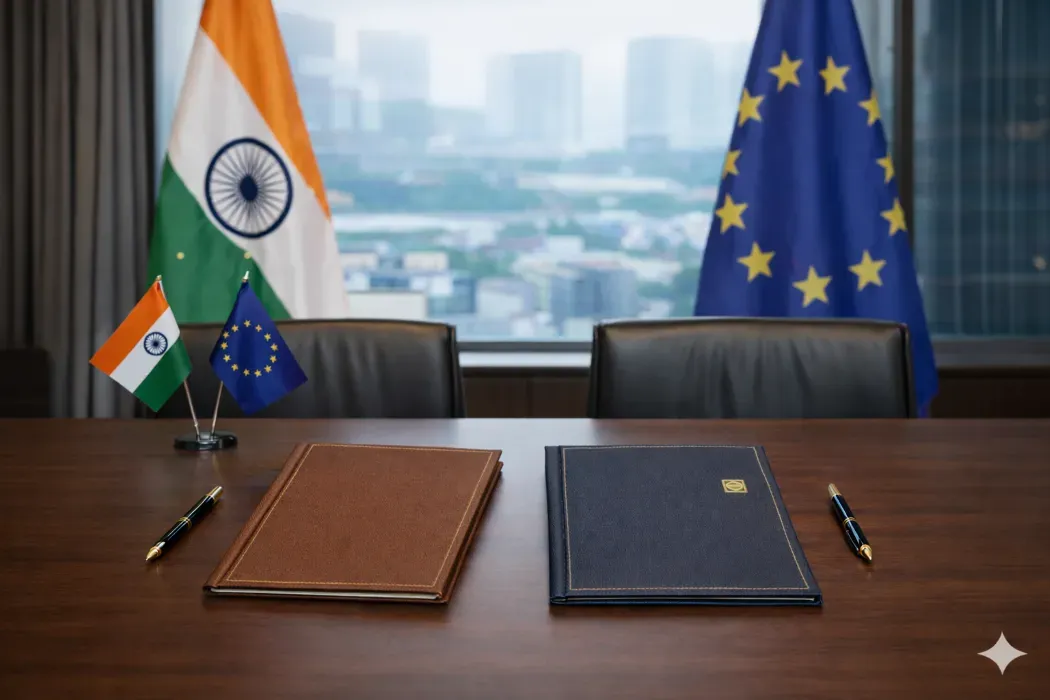
Economic relations between India and the European Union have entered a pivotal new phase with the signing of a "historic" free trade agreement - a move signaling a profound strategic shift in the global trading system amid rising protectionism and escalating geopolitical tensions.
The agreement, announced in New Delhi, crowns nearly two decades of negotiations and establishes a free trade zone linking two economies with a combined population of about two billion, forming a commercial force spanning Asia and Europe.
Modi: “The Mother of Agreements”
Indian Prime Minister Narendra Modi called the deal “the mother of agreements,” stating it is a turning point not only for India but for global trade as a whole, especially in a period marked by intense trade disputes and supply chain disruptions.
Speaking at the India Energy Week conference, Modi noted that the deal with the EU - which accounts for roughly 25% of global GDP and about one-third of world trade - complements India’s recent trade pacts with the UK and the European Free Trade Association, as part of a broader strategy to diversify partnerships and reduce reliance on any single market.
Modi emphasized that the agreement will provide a significant boost to key Indian export sectors such as textiles, gems and jewelry, and leather and footwear - all labor-intensive industries that form the backbone of Indian manufacturing.
Political and Economic Summit in New Delhi
Modi and European Commission President Ursula von der Leyen are set to issue a joint statement at the upcoming India-EU summit, outlining the implementation framework for the agreement. The deal is expected to include widespread tariff reductions, facilitation of goods and services movement, enhanced investment protection, and expanded cooperation in industrial value chains.
The move comes as the EU seeks to reaffirm its commitment to “fair trade and sustainable partnerships” over protectionism, as von der Leyen emphasized at the Davos Forum, stating that Europe chooses “partnership over isolation.”
India Seeks Alternatives After US Shock
For New Delhi, the agreement cannot be separated from recent global trade turbulence, especially after the US imposed 50% punitive tariffs on several Indian goods in August, disrupting India’s largest export market.
This shock prompted India to accelerate its efforts to diversify export markets, resulting in a series of trade deals with the UK, Oman, and New Zealand. The EU deal stands as the largest and most significant among them.
The agreement with Brussels is India’s fourth major trade pact since tensions with Washington escalated, clearly indicating a shift in India’s economic focus toward Europe and Asia.
Trade Figures: Heavyweight Economic Impact
According to European Commission data, trade between India and the EU exceeded €120 billion (about $140 billion) in 2024, making the EU India’s largest trading partner.
India’s exports to Europe include machinery and equipment, chemicals, base metals, metal products, and textiles, while Europe mainly exports transport equipment, heavy machinery, and chemicals to India.
Conversely, India is the ninth-largest trading partner for the EU, accounting for 2.4% of total EU goods trade - much lower than the shares held by the US, China, and the UK - indicating significant room for future growth.
The EU Cannot Fully Replace the US
Despite the deal’s strategic importance, analysts caution that the EU partnership cannot fully substitute for the US market, which remains India’s top export destination.
In 2024, India posted a trade surplus with the US of $45.8 billion, compared to a smaller surplus with the EU of $25.8 billion, reflecting America’s continuing dominance in India’s trade balance.
EcoPulse24 Analysis
The India-EU agreement is more than just tariff reduction; it is a political and economic statement on realigning trade alliances in a world rapidly shifting toward regional blocs rather than the open trading system that prevailed for decades.
For India, the deal provides strategic insurance against US market volatility and grants broader access to a stable, high-value European market. For the EU, it secures an industrial powerhouse partner and access to a growing consumer market at the heart of Asia.
However, the agreement’s success will depend on swift implementation and the ability to translate legal texts into tangible trade and investment flows. Amid rising global protectionism, this deal could serve as a counter-model, reaffirming that trade remains a tool of strength, not a political burden.
Explore Related Coverage
Sources & References
Editorial Note
Disclaimer
© 2025 EcoPulse24. All rights reserved.