Iran Conflict Tests Petrodollar System as Deutsche Bank Sees Path Toward “Petroyuan”
Iran tensions may weaken petrodollar dominance as yuan-based oil trade rises, signaling a shift toward a more fragmented global currency system.

EcoPulse24 | New York
A deepening conflict tied to Iran is beginning to test one of the foundational pillars of the global financial system: the dominance of the US dollar in oil trade.
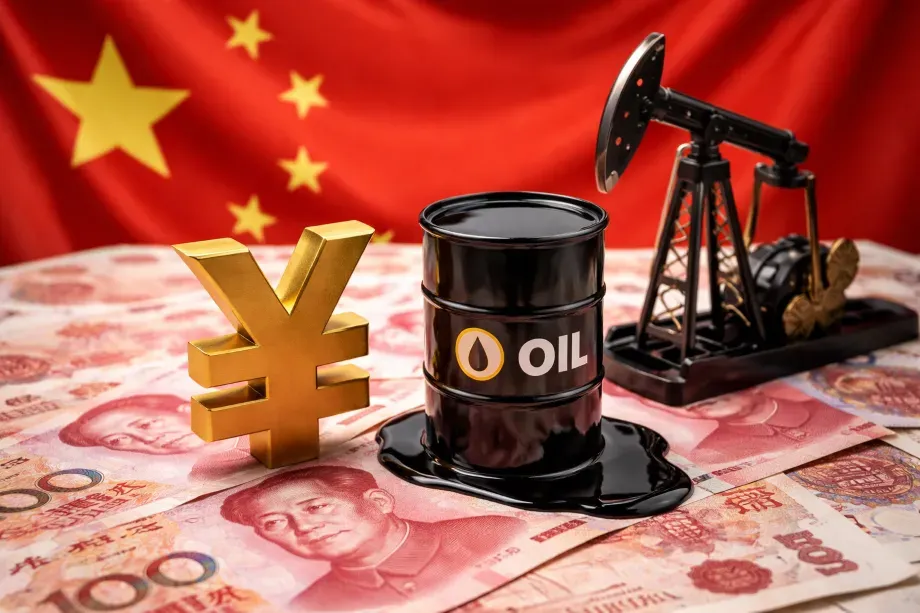
According to a recent Deutsche Bank research note, the evolving situation in the Middle East could act as a catalyst for structural changes in how energy is priced and settled globally, with the potential emergence of a yuan-based oil trade gaining renewed attention.
“The conflict could be the catalyst for erosion in petrodollar dominance and the beginnings of the petroyuan,” strategist Mallika Sachdeva wrote, pointing to mounting evidence that existing pressures on the system are accelerating rather than emerging for the first time.
At the center of the shift is the Strait of Hormuz, a critical chokepoint through which roughly a fifth of the world’s oil and gas supply flows. Recent reports indicate that Iran has allowed certain vessels to transit the strait under conditions that include settlement in Chinese yuan, introducing a new variable into the mechanics of global energy trade.
While Tehran has stated that foreign vessels may pass as long as they comply with its regulations and do not support hostile actions, the linkage between transit conditions and currency denomination marks a notable departure from established norms.
Any disruption-or perceived conditionality-around Hormuz carries immediate market consequences. The strait remains indispensable not only for crude flows, but also for broader commodity supply chains, and recent tensions have contributed to heightened volatility across energy markets.
Beyond the immediate geopolitical implications, Deutsche Bank’s analysis highlights a longer-term structural shift already underway. China has steadily expanded its role as the primary destination for Middle Eastern oil, while simultaneously accelerating efforts to internationalize the yuan and reduce reliance on the dollar in cross-border trade.
Saudi Arabia, a central pillar of the original petrodollar framework established in the 1970s, now exports significantly more crude to China than to the United States, reflecting a reorientation of global demand toward Asia. In parallel, sanctioned barrels from Russia and Iran have increasingly been traded outside dollar-based systems, further eroding the exclusivity of the existing framework.
Regional initiatives have also gained traction. Gulf economies, including Saudi Arabia, have explored alternative payment infrastructures such as Project mBridge, a cross-border digital currency platform aimed at facilitating multi-currency settlements.
Deutsche Bank warns that these developments, when combined with geopolitical stress, could expose fault lines in the petrodollar system with “significant downstream effects” for the dollar’s role in global trade, savings, and reserve allocation.
The petrodollar arrangement, formalized in 1974 through an agreement between the United States and Saudi Arabia, has long underpinned dollar liquidity and demand by linking oil pricing to US currency flows. Any shift away from that structure-even gradually-could have far-reaching implications for global capital markets.
EcoPulse24 Analysis:
What is unfolding is not an abrupt displacement of the dollar, but the early stages of a more fragmented monetary landscape. The convergence of geopolitical pressure, shifting energy flows, and alternative payment systems suggests a gradual diversification rather than a sudden break. However, the significance lies in the direction of change: once the exclusivity of the petrodollar is questioned, the system transitions from dominance to competition. In that environment, the balance of power in global finance becomes less about a single currency-and more about which networks can sustain trust, liquidity, and scale.
Sources & References
Editorial Note
Disclaimer
© 2025 EcoPulse24. All rights reserved.