NVIDIA Unveils Vera Rubin Platform, Bringing Supercomputer-Class AI to a Single Rack
NVIDIA unveiled Vera Rubin, a rack-scale platform delivering more than 7 exaflops of AI performance for scientific computing, climate research

Hamburg | EcoPulse24
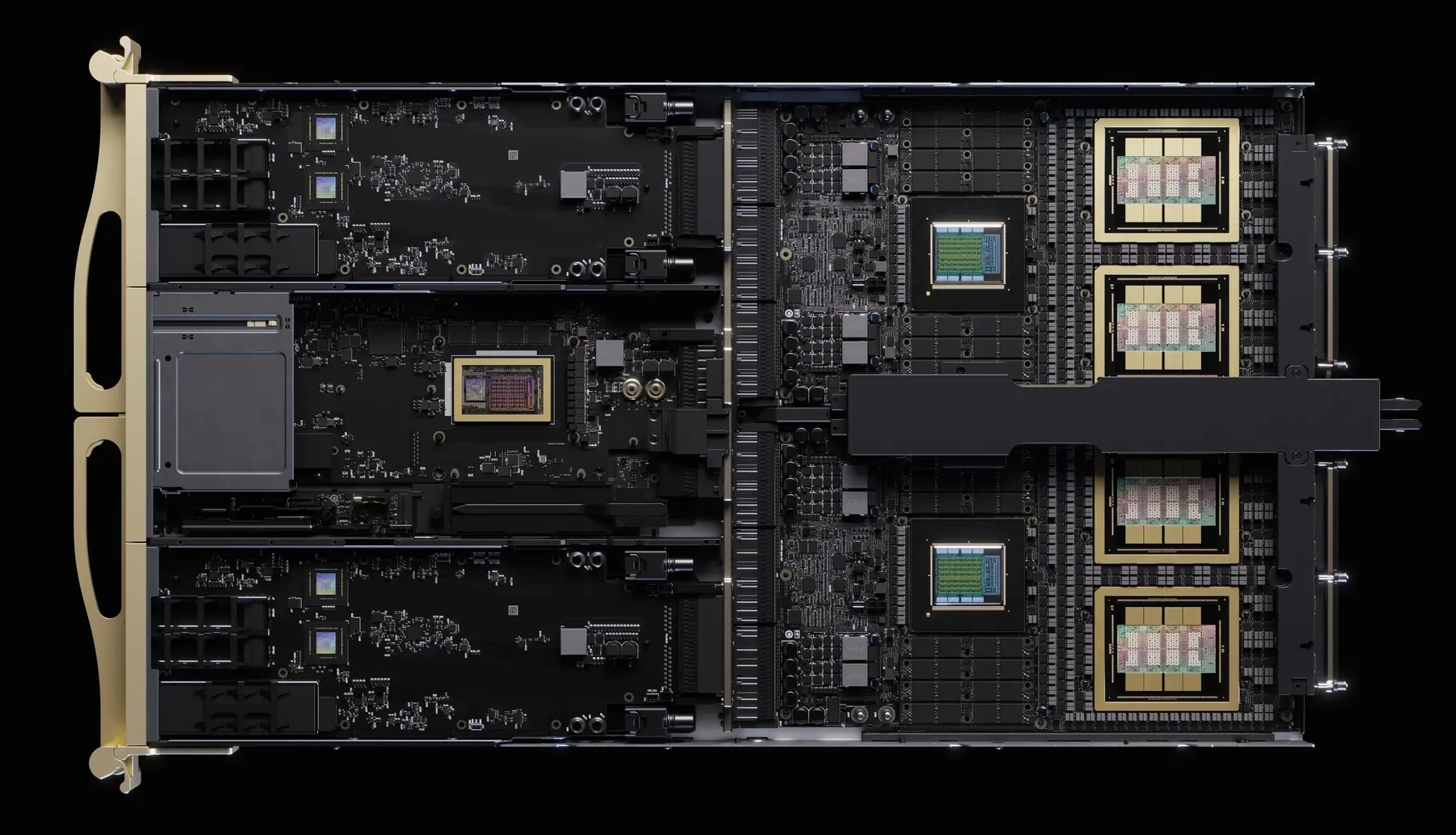
NVIDIA introduced its Vera Rubin platform, a rack-scale system delivering more than 7 exaflops of AI performance and native scientific computing capabilities for climate research, energy exploration and national security applications.
NVIDIA unveiled its next-generation Vera Rubin computing platform on Sunday, introducing what the company describes as a new class of rack-scale supercomputer capable of delivering world-class performance for artificial intelligence and scientific computing workloads.
Announced during ISC High Performance 2026, the platform combines NVIDIA's latest accelerated computing technologies into a unified architecture designed to support advanced simulations, artificial intelligence models and large-scale data analytics.
According to NVIDIA, a single Vera Rubin system can provide more than 7 exaflops of AI performance and 5 petaflops of native FP64 double-precision computing performance, capabilities that the company says can rival systems appearing on the TOP500 ranking of the world's most powerful supercomputers.
The platform is designed to address some of the world's most computationally demanding applications, including climate modeling, computational fluid dynamics, quantum chemistry, energy exploration and advanced scientific simulations.
From Hardware to Scientific Discovery
Vera Rubin combines NVIDIA Rubin GPUs and NVIDIA Vera CPUs connected through high-speed interconnect technologies including NVLink-C2C, ConnectX-9 SuperNICs and BlueField-4 data processing units.
The architecture employs direct liquid cooling and supports configurations of up to 144 GPUs in a single rack.
Unlike traditional computing systems that often separate simulation, analytics and artificial intelligence workloads across multiple infrastructures, Vera Rubin is designed to unify these capabilities within one platform.
Researchers will be able to run numerical simulations, train AI models, stream data from scientific instruments and perform real-time analytics simultaneously.
NVIDIA says the integrated approach is intended to shorten the time required for scientific discovery and accelerate industrial innovation.
Scientific Computing Enters the Era of Agentic AI
The company is positioning Vera Rubin as a platform built for the emerging age of agentic artificial intelligence, where AI systems increasingly participate in scientific workflows rather than simply processing information.
According to NVIDIA, the platform enables the development of scientific foundation models, AI-assisted analysis and surrogate models that can approximate complex simulations at significantly higher speeds.
The approach could fundamentally reshape how researchers conduct scientific experiments by increasingly integrating AI into every stage of the research process.
NVIDIA founder and Chief Executive Officer Jensen Huang described Vera Rubin as:
"A new instrument for science - a rack-scale supercomputer that brings simulation, AI and data processing together to help researchers and industries design and discover faster than ever."
Major Research Institutions Adopt Vera Rubin
Several leading scientific institutions have already selected Vera Rubin-based systems for next-generation computing infrastructure.
Germany's Leibniz Supercomputing Centre (LRZ) will deploy a new supercomputer called Blue Lion, powered by Vera Rubin and second-generation exascale-class HPE Cray technology.
Scheduled to become operational in 2027, Blue Lion is expected to deliver approximately 30 times the computing power of LRZ's current system and support research in astrophysics, environmental sciences and life sciences.
In the United States, the National Energy Research Scientific Computing Center (NERSC) at Lawrence Berkeley National Laboratory is building its next flagship supercomputer, Doudna, using Vera Rubin technology supplied by Dell Technologies.
The system will support molecular dynamics, high-energy physics, fusion energy research, materials science, drug discovery and astronomy.
Meanwhile, Los Alamos National Laboratory (LANL) has selected Vera Rubin technologies for its next-generation Mission, Vision and Veritas computing systems.
The platforms are designed to support national security workloads, open scientific research, foundation models, agentic AI, nuclear energy simulations, fusion research and quantum computing applications.
Global Manufacturers Prepare Deployments
Global infrastructure providers including Bull, Dell Technologies, GIGABYTE, HPE and Supermicro announced high-density Vera Rubin systems featuring direct liquid-cooled architectures.
NVIDIA said systems based on Vera Rubin NVL4 are expected to become available from manufacturers during the fourth quarter of this year.
EcoPulse24 Analysis
NVIDIA Is No Longer Selling Chips. It Is Building Scientific Infrastructure.
The significance of Vera Rubin extends well beyond performance benchmarks.
For decades, supercomputers were specialized national assets requiring enormous facilities and highly customized infrastructures.
NVIDIA is attempting to fundamentally change that equation.
By delivering supercomputer-class performance within a single rack, the company is compressing computing power that once required entire facilities into a significantly smaller and more standardized infrastructure.
The implications are profound.
Scientific institutions may gain the ability to perform increasingly complex climate simulations, energy models and molecular research with far shorter development cycles.
Industrial companies could deploy advanced computational capabilities for materials engineering, energy exploration and product design without building entirely new computing ecosystems.
The announcement also illustrates another strategic transformation.
Artificial intelligence is no longer being positioned merely as a productivity tool.
Increasingly, it is becoming part of the scientific method itself.
Researchers are moving toward environments where simulation, machine learning and real-time data analysis operate simultaneously and continuously influence one another.
This could dramatically accelerate scientific discovery across numerous disciplines. The announcement also reinforces NVIDIA's broader ambition.
The company increasingly appears to be positioning itself not simply as the world's leading AI-chip designer, but as the foundational infrastructure provider for the next generation of scientific computing.
If this transition succeeds, future breakthroughs in climate science, fusion energy, drug discovery, quantum computing and national security research may increasingly be built on NVIDIA's computing stack.
Sources & References
Editorial Note
Disclaimer
© 2025 EcoPulse24. All rights reserved.