Hormuz Disruption Drives 22% Surge in Russian Gas Flows to Europe, Repositioning Moscow in Energy Markets
Hormuz disruption caused Russian gas exports to Europe to surge 22% in March, highlighting renewed reliance on Moscow amid LNG supply shocks.

Brussels | EcoPulse24
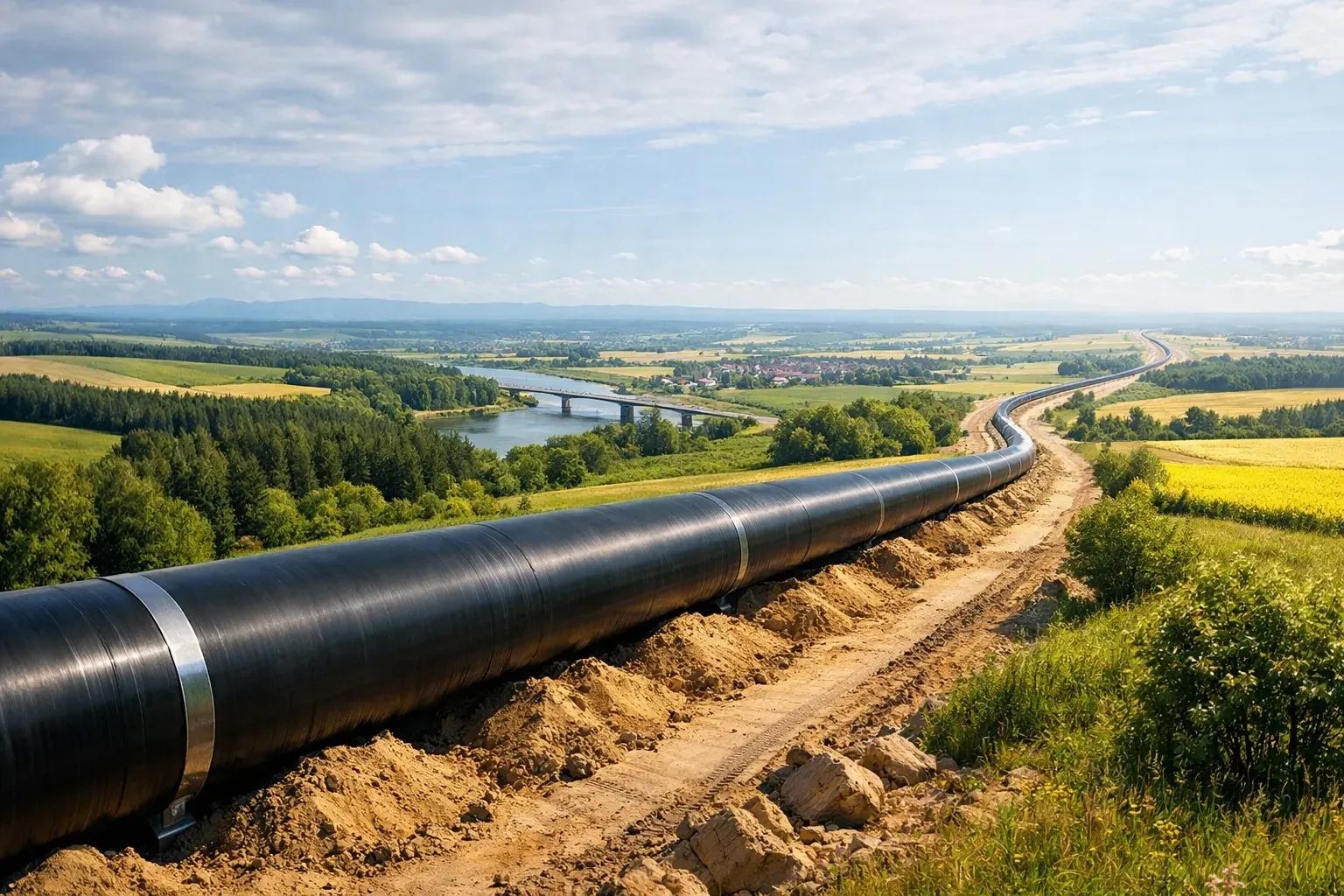
Russian gas exports to Europe surged 22% in March via the TurkStream pipeline, as the effective shutdown of the Strait of Hormuz disrupted global energy flows and forced Europe to turn back to pipeline supply, reshaping the continent’s energy dynamics despite its long-term decoupling strategy from Moscow.
Russian pipeline flows rebound sharply as market conditions tighten
Data from European gas transmission operators show that daily Russian gas flows to Europe via TurkStream rose to around 55 million cubic meters in March, bringing total monthly volumes to 1.7 billion cubic meters, up from 1.4 billion a year earlier. The increase marks a clear acceleration after relatively stable flows since February.
Hormuz disruption triggers a global supply shock in LNG markets
The surge in Russian gas flows coincides with the effective closure of the Strait of Hormuz, a critical chokepoint for roughly 20% of global oil and LNG trade. The disruption has constrained seaborne energy supply, particularly liquefied natural gas, tightening global markets and pushing Europe toward immediate alternatives.
Pipeline gas regains strategic value over seaborne LNG
With LNG flows disrupted, pipeline gas has re-emerged as the most reliable and immediate source of supply for Europe. Russian gas delivered via TurkStream - now the only active corridor after the Ukraine transit route expired in early 2025 - has become a critical fallback mechanism in an increasingly fragmented energy system.
Russia’s exports rise despite structural decline in recent years
In the first quarter of 2026, Russian pipeline gas exports to Europe rose 11% year-on-year to around 5 billion cubic meters. This comes after a sharp 44% drop in 2025, when volumes fell to 18 billion cubic meters - the lowest level since the 1970s - down from peak annual flows of around 180 billion cubic meters before the geopolitical rupture.
Europe’s dependency declines structurally but persists under stress
Russia’s share of European gas imports has fallen from around 40% historically to roughly 13% in 2025, reflecting the EU’s strategy to phase out Russian energy by 2027. However, the latest surge highlights a structural contradiction: diversification strategies reduce baseline dependency, but crisis conditions still force reliance on existing infrastructure.
Energy crisis forces emergency demand-side measures across Europe
European officials have warned of a “very serious situation” in energy markets, urging measures to reduce consumption, including remote work, lower transport fuel use, and greater reliance on public transit. These signals point to a prolonged adjustment period rather than a short-term disruption.
Key Russian Gas Flow Indicators to Europe
| Indicator | Value |
|---|---|
| March Flow Increase | +22% |
| Average Daily Supply | ~55 million m³ |
| Total Monthly Volume (March) | 1.7 bcm |
| Total Supply (Q1 2026) | ~5 bcm |
| Annual Decline (2025) | -44% |
| Russia Share of EU Gas Imports | ~13% |
EcoPulse24 Analysis
The rebound in Russian gas flows is not simply a short-term supply adjustment - it is a direct consequence of a geopolitical shock reshaping global energy hierarchies. The disruption in the Strait of Hormuz has exposed a critical vulnerability in Europe’s post-Russia energy strategy: while LNG was intended to replace pipeline dependence, it remains structurally exposed to maritime chokepoints and geopolitical risk.
What emerges is a reversal of strategic assumptions. Europe’s shift away from Russian gas was built on diversification through global LNG markets, but those markets are inherently fragile in times of conflict. When maritime routes are constrained, geography reasserts itself - and pipeline infrastructure regains primacy.
Russia’s advantage in this context is not purely economic, but structural. Its pipeline network, particularly through Turkey, positions it as a “last-resort supplier” that becomes indispensable when global flows are disrupted. This creates a paradox where geopolitical tensions that isolate Russia simultaneously enhance its leverage in moments of supply stress.
More broadly, the current dynamic signals a transition from a globalized energy system to a fragmented, security-driven model. Energy is no longer priced solely on supply-demand fundamentals but increasingly on access, routes, and geopolitical alignment. In this system, chokepoints like Hormuz do not just disrupt flows - they redistribute power.
For Europe, this episode underscores a deeper reality: energy independence is not binary. It is conditional, and in periods of systemic stress, previously sidelined suppliers can rapidly return to the center of the system.
Explore Related Coverage
Sources & References
Editorial Note
Disclaimer
© 2025 EcoPulse24. All rights reserved.