The Strait of Hormuz in Numbers: The World's Most Critical Energy Artery
The Strait of Hormuz handles 25% of seaborne oil and 20% of LNG trade; any disruption could spike global energy prices, mainly affecting Asia.

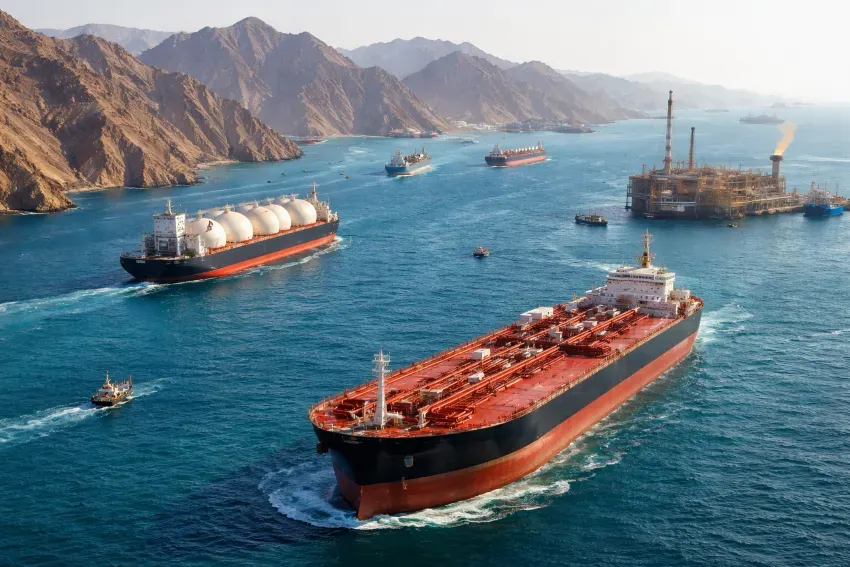
London | EcoPulse24
The Strait of Hormuz is one of the world's most important and sensitive maritime passages for the global economy, serving as a key conduit for international energy trade. This narrow waterway, separating Iran from the Arabian Peninsula and linking the Arabian Gulf to the Gulf of Oman and the Arabian Sea, is a primary route for crude oil and LNG exports from Gulf states to global markets - especially in Asia. According to the International Energy Agency (IEA), any significant disruption in navigation through the strait could deliver a severe shock to global energy markets.
At its narrowest, the strait is about 29 nautical miles (54 km) wide, but actual shipping lanes are only two nautical miles wide in each direction, separated by a two-mile buffer. This constricted geography requires precise navigation by large oil tankers, making the global energy trade vulnerable to accidents or security incidents.
IEA data for 2025 indicates that about 20 million barrels per day (bpd) of crude oil and petroleum products pass through the Strait of Hormuz - roughly 25% of the world's seaborne oil trade. Of this, crude oil accounts for about 15 million bpd, or 34% of global crude oil trade. Petroleum products make up about 5 million bpd, bringing the total to nearly 19.87 million bpd.
Saudi Arabia is the largest exporter via the strait, followed by Iraq and the UAE. Most oil passing through Hormuz is destined for Asia; about 80% is exported there, with China and India together accounting for 44% of crude exports in 2025. Europe's share is only about 4%.
Alternative export routes include pipelines in the UAE and Saudi Arabia, but these can only handle about a quarter of the oil volumes that move through the strait. For example, the UAE's ADCOP pipeline has a current capacity of 1.8 million bpd, while Saudi's Petroline can theoretically handle up to 7 million bpd, though actual usage is lower.
The strait is also vital for LNG exports, particularly from Qatar and the UAE. In 2025, about 112 billion cubic meters of LNG - 20% of global LNG trade - passed through Hormuz. Asia receives about 90% of this LNG, with countries like Bangladesh, India, and Pakistan highly dependent on these flows, importing roughly two-thirds of their LNG needs via the strait.
The IEA estimates that a disruption of gas flows through Hormuz could remove over 300 million cubic meters per day from global supply - about twice the amount delivered by the Nord Stream pipeline to Europe in 2021. With limited spare capacity elsewhere, this could drive sharp price increases and intensify competition between Asia and Europe for spot LNG cargoes.
While there is some global spare oil production capacity - over 4 million bpd, mainly in Saudi Arabia and OPEC - much of it would be stranded if the strait were closed, increasing market sensitivity to any disruption.
Given the sheer volume of oil and gas handled by the Strait of Hormuz, any significant interruption could quickly lead to price spikes and real supply shortages. Despite alternative pipelines, their capacity is insufficient to offset a major disruption. Thus, the stability of navigation through Hormuz remains a cornerstone of global energy security and price stability, especially for Asian economies heavily reliant on Gulf energy exports.
EcoPulse24 Analysis
IEA data confirms that the Strait of Hormuz will remain one of the world's most sensitive energy chokepoints for years to come. Its narrow geography and vital energy flows mean that any disruption could swiftly impact oil and gas prices and the global economy as a whole.
Explore Related Coverage
Sources & References
Editorial Note
Disclaimer
© 2025 EcoPulse24. All rights reserved.