US Gasoline Falls Below $4 a Gallon After Preliminary Iran Deal
Average US gasoline prices fell below $4 a gallon after the preliminary US-Iran deal and the reopening of the Strait of Hormuz eased oil prices.

Washington | EcoPulse24
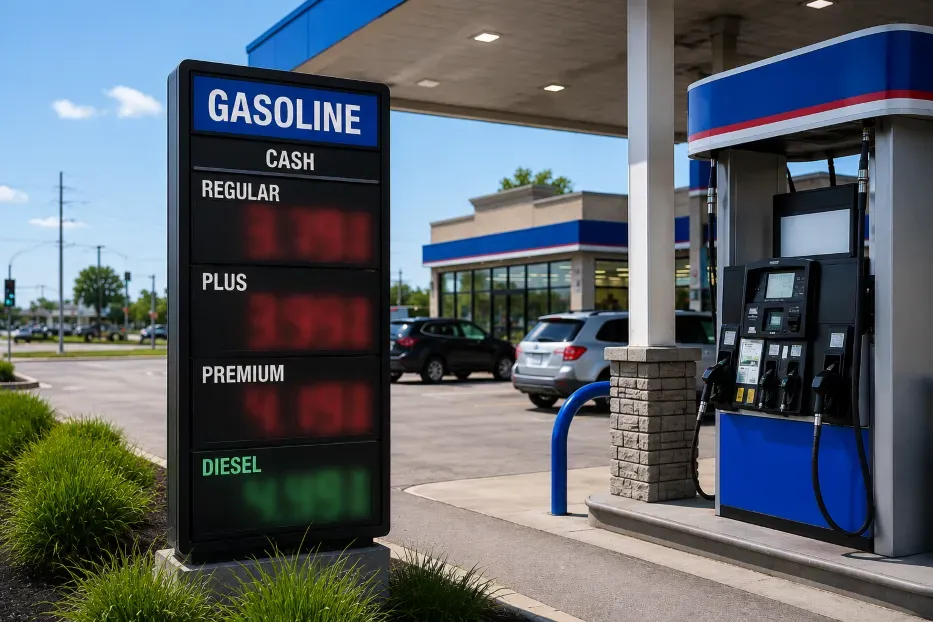
Average gasoline prices in the United States fell below $4 per gallon on Thursday for the first time in months after the United States and Iran signed a preliminary agreement to halt hostilities for 60 days and reopen the Strait of Hormuz, easing pressure on global oil and fuel markets.
Data from the American Automobile Association (AAA) showed that the average price of regular gasoline nationwide declined to $3.999 per gallon on Thursday, down from $4.025 a day earlier.
Fuel Prices Retreat as Oil Risk Premium Eases
US gasoline prices had remained below $3 per gallon before the first US-Israeli strikes on Iran in late February. However, prices surged to nearly $4.50 per gallon in May as Middle East supply concerns drove crude oil sharply higher.
Oil prices have since fallen by around 10% this week alone, reflecting growing expectations that energy shipments through the Strait of Hormuz will normalize.
Despite the decline, gasoline prices remain roughly one-third higher than they were before the conflict began.
Regional Price Differences Persist
Several regions across the Great Plains and southern United States have already seen gasoline prices fall below $4 per gallon, with some areas approaching $3.50.
Meanwhile, prices on the US West Coast remain substantially higher than $4 due to differences in taxes, distribution costs and refining capacity.
Diesel Prices Also Move Lower
The decline has not been limited to gasoline.
The average price of diesel fell to $5.13 per gallon on Thursday, down from more than $5.60 per gallon a month ago.
Lower diesel prices could provide some relief for trucking companies, farmers and other fuel-intensive industries that have faced elevated transportation and operating costs in recent months.
Energy Costs Had Fueled Broader Inflation Pressures
Higher fuel prices had significantly increased pressure on household budgets and contributed to rising prices across other sectors of the economy.
In the early stages of the conflict, crude oil prices climbed toward $120 per barrel, their highest level since the Russia-Ukraine war in 2022, triggering a rapid increase in gasoline prices at service stations nationwide.
According to the US Energy Information Administration (EIA), crude oil represents the largest component of retail gasoline prices, alongside refining, distribution, marketing and tax costs.
Inflationary Effects Extended Beyond Fuel
The energy shock also spilled into other sectors of the economy.
Airfares rose by approximately 27% in May, partly due to higher jet fuel costs.
Data from the US Bureau of Labor Statistics (BLS) showed that the Energy Price Index increased by:
-
10.9% in March
-
3.8% in April
-
3.9% in May
Energy accounted for more than 60% of the monthly increase in the Consumer Price Index (CPI) in May.
Economists caution that lower crude prices typically take time to fully feed through to retail gasoline prices and that substantial regional price differences are likely to persist.
EcoPulse24 Analysis
The decline of US gasoline prices below the psychologically important $4-per-gallon threshold carries significance well beyond consumers filling their tanks.
Fuel prices became one of the most visible consequences of the Iran conflict, quickly feeding into transportation costs, airline ticket prices and broader inflation expectations. Their retreat therefore represents an early signal that the energy shock that reshaped inflation forecasts and monetary policy expectations in recent months may be starting to unwind.
For financial markets, lower gasoline prices could eventually ease pressure on headline inflation and consumer spending. However, the transmission mechanism is not immediate. Oil prices have already retreated sharply, but retail fuel prices typically adjust with a lag, meaning the full economic benefit may take weeks to materialize.
The bigger question for investors is whether the reopening of the Strait of Hormuz proves durable. If Gulf energy flows normalize and crude prices continue to decline, the inflation narrative that drove much of the recent market volatility could begin to reverse, potentially reshaping expectations for interest rates, consumer spending and global growth in the second half of 2026.
Sources & References
Editorial Note
Disclaimer
© 2025 EcoPulse24. All rights reserved.