Race Against Time: Will the U.S. Senate Deliver America's First Federal Crypto Market Framework?
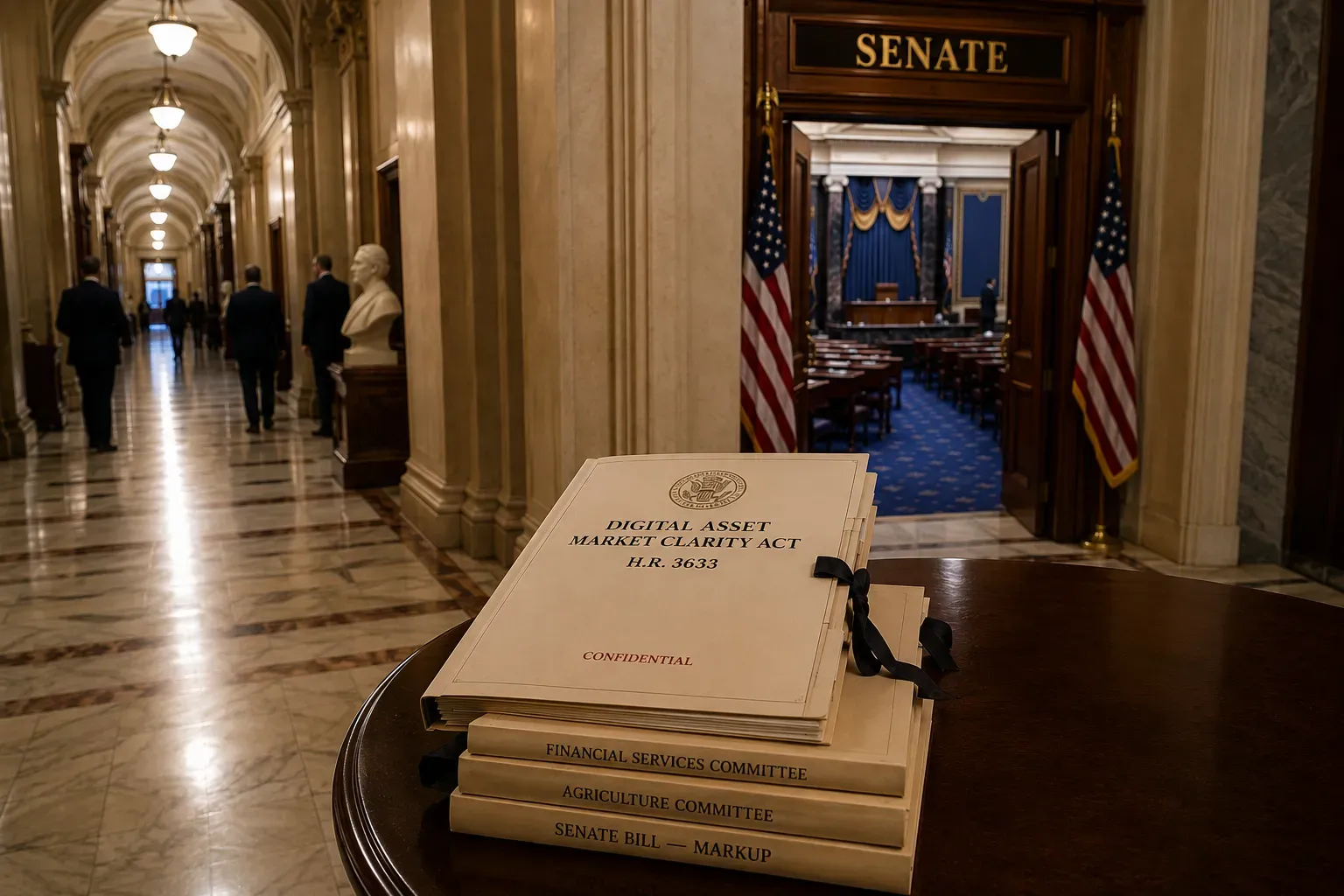
The U.S. Senate enters a decisive phase for the CLARITY Act as lawmakers race to establish America's first federal digital asset framework.

Washington | EcoPulse24
The United States has entered what could become the defining legislative moment for its digital asset industry, as the Senate faces mounting pressure to decide whether the CLARITY Act will become the country's first comprehensive federal framework governing cryptocurrency markets or remain another unfinished attempt at regulatory reform.
The debate has intensified ahead of Congress' August recess, with supporters arguing that regulatory certainty is essential to keep innovation inside the United States, while opponents continue to raise concerns over investor protection, decentralized finance, stablecoin oversight and potential conflicts of interest involving President Donald Trump.
CLARITY Act reaches its most critical stage
On July 17, 2026, the House Financial Services Subcommittee on Digital Assets, Financial Technology and Artificial Intelligence held a field hearing at Federal Hall National Memorial in New York titled "Building the Future of Finance: How the CLARITY Act Unlocks Innovation."
Although the hearing carried no legislative authority to advance the bill, it represented one of the final public opportunities for lawmakers, industry executives and market participants to reinforce support before the Senate's legislative calendar narrows ahead of the August recess.
The hearing also marked one year since the House approved the legislation, underscoring how a proposal that once enjoyed significant bipartisan momentum now faces a far more uncertain path in the Senate.
What the CLARITY Act would change
Formally known as the Digital Asset Market Clarity Act (H.R. 3633), the legislation seeks to establish the first comprehensive federal regulatory structure governing digital assets in the United States.
The proposal would divide oversight responsibilities between the Commodity Futures Trading Commission (CFTC) and the Securities and Exchange Commission (SEC), replacing years of legal uncertainty that has largely been shaped through enforcement actions and court decisions rather than explicit legislation.
Under the framework, sufficiently decentralized blockchain networks meeting statutory maturity standards would generally fall under the CFTC's jurisdiction as digital commodities in spot markets. Digital assets sold primarily to finance early-stage projects would remain subject to SEC oversight as investment contracts, accompanied by tailored disclosure requirements.
Authorized stablecoins would continue operating under a separate regulatory structure alongside existing banking supervision and the GENIUS Act framework governing payment-related digital assets.
The legislation aims to replace regulatory ambiguity with statutory certainty, allowing issuers, exchanges, custodians and institutional investors to understand applicable rules before launching products instead of discovering them through litigation.
Industry argues certainty is essential
Several witnesses used the New York hearing to illustrate how regulatory uncertainty has already shaped global business decisions.
Randi Abernethy, Head of Clearing and Risk at Bullish, told lawmakers that the company originally established its regulated operations in Gibraltar because no comparable federal U.S. framework existed when the platform launched in 2021.
Ryan Louvar, Chief Legal Officer at WisdomTree, argued that both established financial institutions and emerging technology companies require predictable governance, compliance and risk-management standards before committing capital to new digital asset products.
Their testimony reflects a broader concern across the industry that prolonged regulatory uncertainty continues to encourage companies to establish licensed operations in jurisdictions offering clearer supervisory regimes.
Senate arithmetic remains the biggest obstacle
The House approved the CLARITY Act in July 2025 with broad bipartisan support, passing the legislation by a vote of 294-134.
Its Senate journey has proven considerably more difficult.
The Senate Banking Committee advanced the bill in May 2026 by 15 votes to 9, receiving support from only two Democratic members while several lawmakers continued pressing for stronger consumer protections, expanded disclosure requirements and additional safeguards governing decentralized finance.
The legislation was subsequently placed on the Senate Legislative Calendar, making it eligible for floor consideration. However, no formal cloture motion had been filed and Senate leadership had not publicly scheduled floor debate at the time this report was prepared.
With Republicans holding 53 Senate seats, supporters may still require bipartisan backing to overcome procedural hurdles requiring approximately 60 votes, making Democratic support one of the decisive variables determining the bill's future.
Trump's support meets conflict-of-interest criticism
President Donald Trump has repeatedly declared that he would sign the CLARITY Act should it reach his desk, framing cryptocurrency regulation as part of a broader strategic competition with China in digital finance and artificial intelligence.
However, Trump's public backing has also intensified criticism surrounding his personal financial interests in the digital asset sector.
Several Democratic lawmakers continue calling for stricter ethics provisions covering elected officials after financial disclosures published in early July reportedly detailed approximately $1.4 billion in crypto-related income associated with Trump-linked ventures.
Those concerns have become one of the principal political obstacles complicating bipartisan negotiations, alongside disagreements over decentralized finance regulation and stablecoin policy, including whether issuers should be permitted to provide yield-like incentives.
Time pressure grows before August
The Senate returned to Washington in mid-July with only a limited number of legislative working days remaining before Congress begins its August recess.
Even if lawmakers secure sufficient votes to advance the CLARITY Act, the proposal would still require reconciliation between Senate committee versions before being aligned with the House-passed legislation and ultimately presented to the President for signature.
Failure to complete that process during the current legislative session could significantly delay implementation, particularly with the November midterm elections capable of reshaping committee leadership and congressional priorities.
Prediction markets have reflected that uncertainty, with implied probabilities for passage declining from spring highs as investors reassessed the remaining legislative timeline.
UAE already operates under multiple regulatory frameworks
While Washington continues debating its first unified federal digital asset framework, the United Arab Emirates already operates through multiple regulatory authorities covering different jurisdictions.
At the federal level, the Securities and Commodities Authority oversees digital asset activities within mainland UAE outside financial free zones, while the Central Bank regulates payment-token policies and stablecoin usage in designated domestic transactions.
Dubai's Virtual Assets Regulatory Authority supervises virtual asset activities outside the Dubai International Financial Centre, whereas the Dubai Financial Services Authority independently regulates firms operating inside the DIFC.
Meanwhile, Abu Dhabi Global Market's Financial Services Regulatory Authority has continued expanding its digital asset framework, including regulations governing staking activities and enhanced supervisory powers over products presenting systemic risks.
Rather than relying on a single nationwide licensing authority, the UAE operates through jurisdiction-specific regulators, requiring firms to obtain authorization from the authority responsible for their intended activities.
Legislative Roadmap
| Stage | Status |
|---|---|
| House approval | Completed |
| Senate Banking Committee | Completed |
| Senate Legislative Calendar | Completed |
| Senate floor vote | Pending |
| Cloture threshold | Pending bipartisan support |
| Senate reconciliation | Pending |
| House-Senate reconciliation | Pending |
| Presidential signature | Pending legislative approval |
EcoPulse24 Analysis
The CLARITY Act represents far more than another cryptocurrency bill. It is fundamentally a test of whether the United States can transition digital assets from an enforcement-driven legal environment toward an institutional regulatory model capable of supporting long-term capital formation.
For years, uncertainty surrounding the respective roles of the SEC and CFTC has discouraged investment, complicated product development and encouraged firms to establish regulated operations in competing financial centres. A statutory framework would significantly improve legal predictability for exchanges, custodians, asset managers and banks considering tokenized financial products.
Yet regulatory certainty alone will not determine the legislation's success. Political credibility has become equally important. Allegations surrounding conflicts of interest involving senior elected officials have transformed what might otherwise be a technical financial bill into a broader debate over governance standards and public trust.
The legislation also illustrates a larger structural challenge facing policymakers worldwide: traditional securities law was designed around centralized issuers and identifiable intermediaries, whereas decentralized blockchain networks frequently operate without conventional corporate structures. Reconciling those realities remains one of the defining regulatory questions of modern financial markets.
From a macroeconomic perspective, the outcome will influence where blockchain investment, tokenization projects and institutional digital-asset infrastructure are built over the coming decade. Jurisdictions capable of delivering legal clarity without undermining market integrity are likely to capture a growing share of global capital flows.
Whether the CLARITY Act ultimately succeeds or fails, the coming weeks will shape not only the future of U.S. cryptocurrency regulation but also America's competitive position within the rapidly evolving global digital financial system.
Explore Related Coverage
Sources & References
Editorial Note
Disclaimer
© 2025 EcoPulse24. All rights reserved.