A Documented Investigation into the Largest Content Purge in Search History and Its Structural Impact on Digital Publishing
Dubai | EcoPulse24
Introduction: When Google Redefined What “Deserves to Exist”
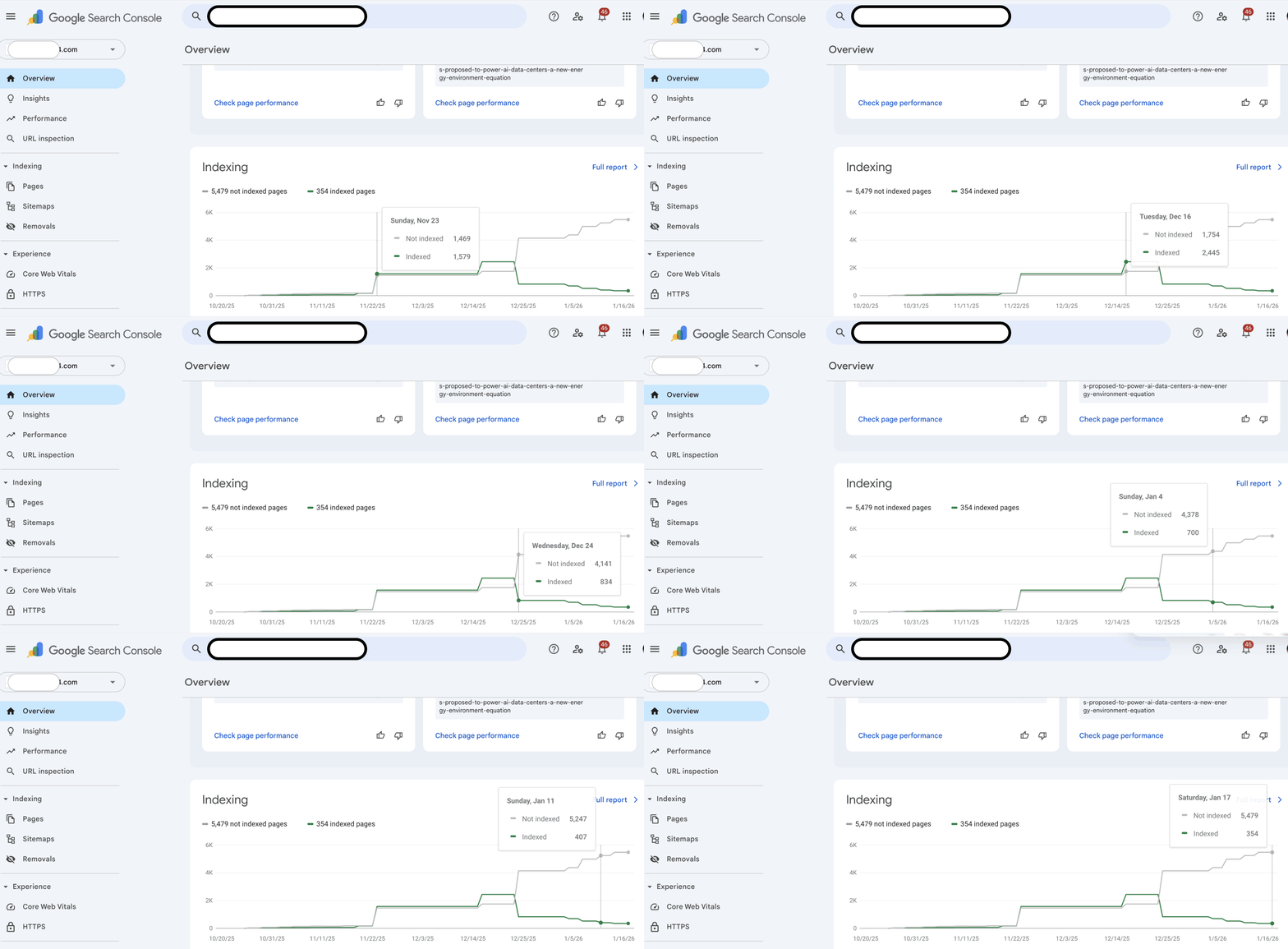
In late May 2025, an unusual and highly disruptive pattern began appearing across Google Search Console accounts worldwide. This was not a conventional ranking fluctuation, nor a seasonal traffic adjustment. Instead, large volumes of previously indexed and crawled pages were reclassified into “Crawled – Currently Not Indexed” and “Crawled – Previously Indexed” states, signaling a deliberate decision by Google to exclude them from its search index.
By January 2026, the persistence and scale of this phenomenon confirmed that it was neither temporary nor isolated. What emerged instead was a structural change in how Google governs index inclusion, fundamentally altering the assumptions publishers have long held about discoverability in search.
This investigation reconstructs the event chronologically and analytically, relying exclusively on expert analyses, technical reporting, and institutional research provided, without extrapolation beyond documented evidence.
May 27, 2025: The First Verifiable Turning Point
Independent SEO expert Dr. Marie Haynes identified May 27, 2025, as the point at which indexed page counts began declining sharply across numerous websites she monitored via Google Search Console.
The pattern was consistent and repeatable:
-
A clear decline in indexed URLs
-
A corresponding increase in pages categorized as “Crawled – Currently Not Indexed”
Crucially, Haynes’ analysis did not frame the shift as a penalty. Instead, it distinguished between pages that were fully removed from the index and pages that technically remained indexed but ceased to rank or surface.
Characteristics of Pages Removed from the Index
Across roughly forty sites spanning multiple industries, the pages most frequently affected shared common attributes:
-
Very old or outdated content
-
Thin pages with limited depth or originality
-
Content that paraphrased information already widely available
-
Simple definitional or comparison-based articles
-
Pages produced primarily to satisfy SEO demand rather than user need
In most documented cases, page removals were not accompanied by a decline in clicks, indicating that Google was pruning content that users rarely selected in search results.
Public remarks from Google representatives John Mueller and Martin Splitt aligned with this assessment, reiterating that Google does not index all crawled content and may remove pages after determining limited user engagement.
The “Indexing Purge”: Evidence Beyond Official Explanations
While Google characterized the changes as routine adjustments, a more expansive picture emerged from data analyzed by Adam Gent through the Indexing Insight platform.
Large-scale monitoring revealed:
-
More than 25% of tracked URLs were actively removed
-
Many websites lost between 15% and 75% of indexed pages
-
A clear departure from the previously observed 130-day indexing cycle
Rather than waiting extended periods before removal, Google began recrawling pages within a 90–130 day window and deindexing them shortly thereafter. According to Indexing Insight, this level of active removal had no historical precedent at such scale.
Engagement as the Dominant Signal
Cross-referencing indexing data with Search Analytics consistently showed that removed pages shared one defining trait: minimal or zero engagement.
Pages that generated no meaningful clicks, impressions, or queries were systematically excluded. Notably, even sites that lost a majority of indexed pages often experienced stable or improved overall search performance, reinforcing the conclusion that Google was eliminating inactive documents rather than penalizing domains.
June 2025 Core Update: A Shift from Ranking to Index Selection
The June 2025 Core Update confirmed that the changes observed in May were not an endpoint. Multiple technical analyses and field reports indicated that the update extended beyond ranking recalibration and reinforced large-scale index contraction.
Within professional circles, the prevailing interpretation shifted decisively. The issue was no longer where pages ranked, but whether they remained indexed at all.
The Role of AI: Correlation Without Confirmation
Several analyses raised the possibility that expanded AI Overviews and AI Mode influenced Google’s index pruning strategy, particularly given the disproportionate removal of easily summarized informational content.
However, no official source confirmed a causal relationship. While the correlation is notable, it remains an analytical hypothesis rather than an established conclusion.
November–December 2025: A Breakdown in Transparency
Between mid-November and mid-December 2025, Google Search Console’s Page Indexing and Performance reports experienced a delay of nearly one month.
According to reporting by Barry Schwartz, this disruption prevented publishers from validating fixes or monitoring the indexing status of new content during a critical phase of algorithmic change. The restoration of reports on December 18, 2025, confirmed that substantial indexing activity occurred during a period of reduced visibility.
December 2025: The Third Core Update and Financial Exposure
On December 11, 2025, Google launched its third core update of the year, with an 18-day rollout that coincided with the holiday season.
Industry tracking documented heightened volatility, complete page disappearances, and sharp declines in Google Discover traffic for news publishers. The timing intensified financial exposure, particularly for organizations dependent on year-end search referrals.
Google’s Official Position: Silent Updates and No Guarantees
On December 9–10, 2025, Google updated its official Core Updates documentation, acknowledging two critical points:
-
The existence of continuous, unannounced core updates
-
The absence of any guarantee that site improvements will yield measurable search gains
This marked a fundamental shift in expectations. Index inclusion was no longer predictable, nor tied to discrete update cycles.
Impact on Journalism and Digital Publishing
Data from the Reuters Institute and Nieman Lab in January 2026 quantified the broader consequences:
-
Global Google search traffic declined by 33%
-
U.S. search traffic fell by 38%
-
Google Discover traffic dropped by 21%
In response, publishers accelerated strategic shifts toward original reporting, video-first formats, adaptable “liquid content,” and direct audience relationships less dependent on search.
What the Evidence Confirms
Based solely on documented sources:
-
The May 2025 indexing event was global and systemic
-
Page removal correlated strongly with engagement signals
-
Most removals had no negative effect on clicks
-
Subsequent core updates reinforced index contraction
-
Google formally acknowledged silent updates and uncertainty
-
Publishers now operate within a non-deterministic indexing environment
Conclusion: A Structural Break, Not a Temporary Crisis
Between May 2025 and January 2026, Google indexing ceased to function as a technical default and became an algorithmic editorial filter.
The defining question has shifted from why pages were removed to what Google now considers worthy of remaining indexed. That answer is not contained in a single policy document but emerges from a convergence of data, silent updates, and a redefined philosophy of search visibility that is reshaping the future of digital publishing.