EcoPulse24 - Deep Dive
Picture a stretch of water so narrow you could theoretically see both shores on a clear day. Just 21 nautical miles at its tightest point. Two shipping lanes, each barely two miles wide, moving in opposite directions. And yet, through this improbable bottleneck, flows roughly one in every five barrels of oil consumed on the planet - every single day.
Welcome to the Strait of Hormuz. The place that keeps energy ministers awake at night, sends oil traders scrambling to their screens at the first sign of Middle East tension, and has been fought over, occupied, and threatened with closure more times than any other patch of ocean in modern history.
It doesn't look like much on a map. But pull that thread, and the entire global economy starts to unravel.
What's in a Name?
The word "Hormuz" is old deeply, layered-history old and linguists still can't fully agree on where it comes from.
The most widely accepted theory traces it to Hur-mogh, a local Persian phrase meaning "date palm," likely a reference to the vegetation that once marked the coastline. A second school of thought connects it to Ahura Mazda, the supreme deity of Zoroastrianism ancient Persia's dominant religion - whose name was sometimes rendered as "Hormozd" before the final consonant was dropped for easier pronunciation.
A third theory ties it directly to the kings of ancient Persia: "Hormuz" was the name of five different rulers of the Sassanid dynasty, and the region may simply have taken on their name the way so many places do by outlasting the people who once ruled it.
What most historians do agree on is that the strait takes its name from the Kingdom of Hormuz, a remarkable trading empire that flourished from the 11th through the 17th centuries. At its height, this kingdom controlled both shores of the Persian Gulf and served as the beating commercial heart of the medieval East the place where Persian horses, Indian spices, Chinese silk, and Arabian incense all changed hands before heading west toward Europe's markets.
The Portuguese, who occupied the island in the 16th century, summed it up in a phrase that still echoes today: "If all the world were a single golden ring, Hormuz would be its jewel."
Geography: A Chokepoint by Accident of Nature
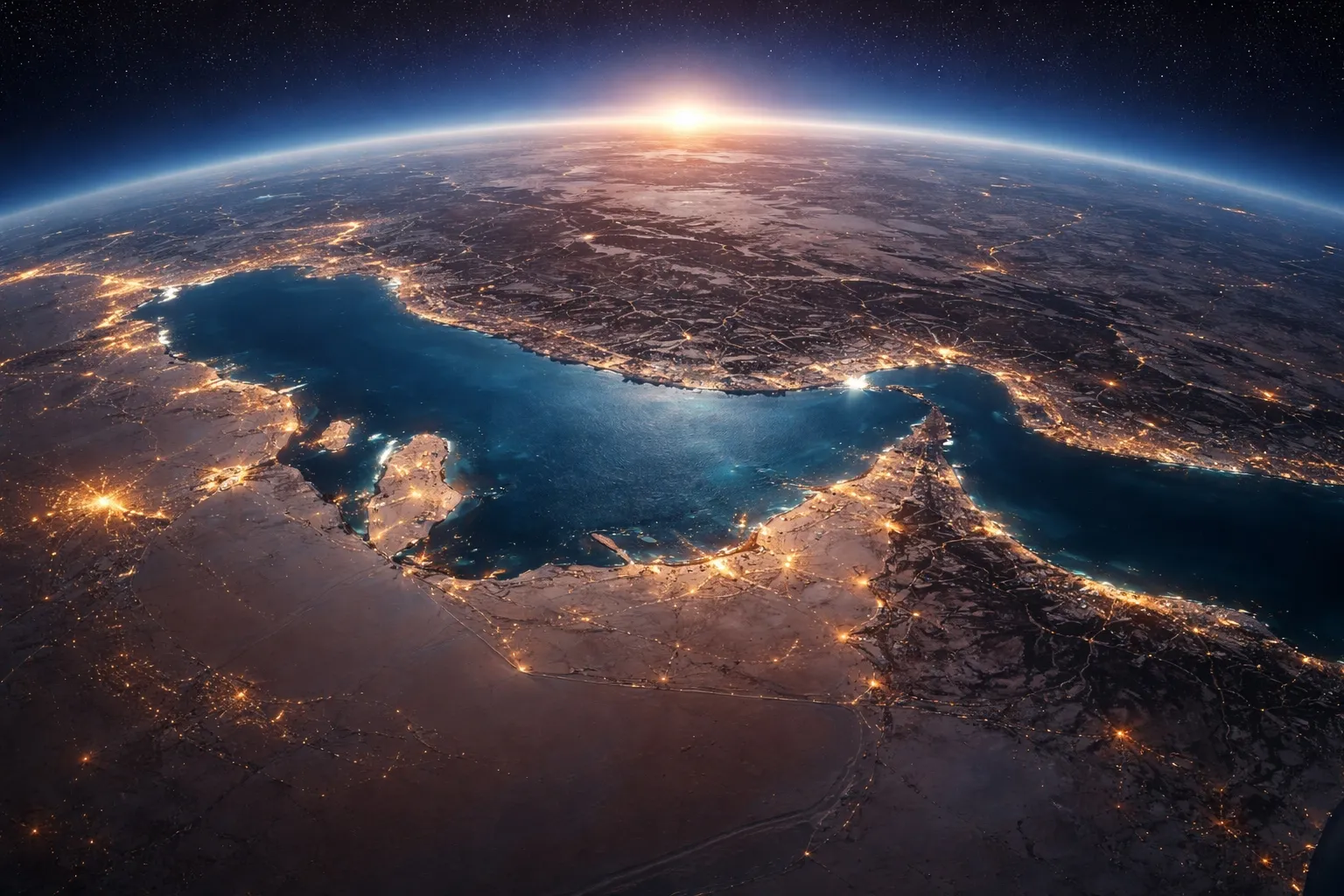
The Strait of Hormuz sits at the eastern end of the Persian Gulf, forming the only sea passage connecting that landlocked body of water to the Gulf of Oman, the Arabian Sea, and ultimately the Indian Ocean.
Iran runs along its northern shore specifically the province of Hormozgan, dotted with strategic islands. Oman holds the southern side, through its Musandam Peninsula, a geographical quirk: a piece of Omani territory cut off from the rest of the country by a strip of land belonging to the UAE.
The numbers are worth sitting with:
- Length: approximately 167 km (104 miles)
- Width: ranges from 95 km down to just 33 km at the narrowest navigable point
- Depth: between 60 and 100 meters deep enough to handle the world's largest supertankers
- Shipping lanes: two lanes, each just two nautical miles wide, separated by a two-mile buffer zone
That last point is the one that tends to surprise people. The entire commercial traffic of the world's most important oil route squeezes through four nautical miles of usable sea lane. A minor incident a grounded tanker, a naval stand-off, a blocked passage can back up dozens of ships within hours.
Scattered across the strait are islands that have been contested, occupied, and fortified for centuries. On the Iranian side: Qeshm (the largest island in the Persian Gulf), Hormuz, and Larak. Then there are the three islands Greater Tunb, Lesser Tunb, and Abu Musa that Iran has controlled since 1971 but which the UAE still claims as its own. Their value isn't scenic. They offer a commanding vantage point over every ship that passes through.
Six Thousand Years of Importance
The strait's strategic significance didn't begin with oil. It began with civilization itself.
Archaeological evidence and ancient rock carvings in Oman's Musandam region show that Sumerian sailors were navigating these waters as far back as the third millennium BC more than 5,000 years ago. For them and their successors, the strait was the gateway between the civilizations of Mesopotamia and the riches of India, East Africa, and China. Spices, precious stones, ivory, incense the luxury goods of the ancient world all had to pass through here.
Marco Polo passed through Hormuz twice, in 1272 and 1293, and left vivid accounts of a city overflowing with merchandise from every corner of the known world. Merchants from Egypt, Syria, Persia, India, and China converged on its markets. It was, in the language of his era, a global trading hub the Dubai of the medieval world, if you like.
In the 14th century, Ibn Battuta the Moroccan explorer who makes Marco Polo look like a homebody described the city of Hormuz as one of the most vibrant and prosperous he had encountered anywhere in the Islamic East.
Then came the Portuguese.
In September 1507, Afonso de Albuquerque sailed into the harbor with a small fleet and imposed tribute on the local king. He began building a fort, but a mutiny among his own captains forced him to abandon the project and retreat in 1508. He came back in 1515 with 27 ships and 1,500 soldiers, and this time there was no retreat. The Portuguese established full control and built the Castle of Our Lady of the Conception, making Hormuz the third pillar of their Eastern empire alongside Goa and Malacca.
For over a century, Portugal effectively taxed the trade of the entire Eastern world through this one island.
In 1622, the Safavid Persian Shah Abbas I, aided by ships from England's East India Company, drove the Portuguese out in what historians call one of the most consequential power shifts in Persian Gulf history. The Portuguese never returned.
After that, the British, the Dutch, the Ottomans, and eventually the Americans all took their turn calculating just how much Hormuz was worth to whoever controlled it.
From Spice Route to Oil Highway
For most of its long history, Hormuz was valuable because luxury goods passed through it. High-value, low-volume trade. Important, but not civilization-altering.
That changed with oil.
The first commercial oil discovery in the broader region came in Iran in 1908, followed by Bahrain in 1932, then Kuwait and Saudi Arabia in 1938. Within two decades, the Persian Gulf had gone from a regional waterway known mostly to traders and British colonial administrators to the energy heartland of the industrial world.
By the 1950s and 60s, supertankers were replacing dhows. The commodity moving through Hormuz was no longer cardamom and pearls but crude oil - hundreds of millions of barrels of it, year after year, heading east to fuel the factories of Japan and Korea, and west to power the cars and power plants of Europe and America.
The 1973 Arab oil embargo delivered the first brutal lesson in just how exposed the global economy had become to disruptions in this corner of the world. Hormuz itself wasn't closed but the episode made clear that whoever threatened this waterway was threatening everyone.
The world had built itself around the assumption that oil would always flow through the strait. It had never seriously questioned what would happen if it didn't.
The Numbers: What Actually Flows Through Hormuz
This is where the abstraction becomes viscerally real. According to the U.S. Energy Information Administration (EIA), based on 2024 tanker tracking data:
| Metric | Figure | Source |
|---|---|---|
| Average daily oil flow | 20 million barrels/day | EIA 2024 |
| Share of global oil consumption | ~20% | EIA 2024 |
| Share of global seaborne oil trade | More than 25% | EIA 2024 |
| LNG (liquefied natural gas) share | ~20% of global LNG trade | EIA 2024 |
| Qatar's daily LNG exports via strait | 9.3 billion cubic feet | EIA 2024 |
| Flows destined for Asian markets | 84% (oil) and 83% (LNG) | EIA 2024 |
| China's share of oil imports | 37.7% of total Hormuz flows | EIA Q1 2025 |
| India's share | 14.7% | EIA Q1 2025 |
| South Korea's share | 12.0% | EIA Q1 2025 |
| Japan's share | 10.9% | EIA Q1 2025 |
| Saudi Arabia's share of exports | 37.2% of all crude transiting | EIA Q1 2025 |
| Navigable shipping lane width | 2 nautical miles per direction | International Maritime |
| Daily tanker traffic (oil) | 20 to 30 loaded tankers | Historical average |
Pause on that first number: 20 million barrels every single day. That's roughly 230 barrels per second, 24 hours a day, 365 days a year - moving through a channel no wider than the distance between two mid-sized American cities.
And here's the geopolitical kicker buried in those statistics: 84% of it goes to Asia. China, India, Japan, and South Korea receive nearly 70% of all Hormuz crude combined. Which means that any Iranian threat to close the strait isn't primarily aimed at Washington or London it hits Beijing and Tokyo hardest. The countries most dependent on Hormuz stability are, in many cases, also Iran's largest trading partners.
That is not a coincidence. That is leverage.
Iran's Card: The Sword That Cuts Both Ways
Iran sits on the northern shore of the strait and its Islamic Revolutionary Guard Corps (IRGC) controls naval operations throughout the Gulf. Iran doesn't just border Hormuz it overlooks it, with military bases on multiple strategic islands and a navy specifically configured for operations in confined, shallow waters.
Since the 1980s, threatening to close the strait has been Iran's most reliable geopolitical trump card. When tensions rise with the U.S., with Israel, with the international community over its nuclear program the threat surfaces. It is credible enough to move oil markets, scare shipping insurers, and concentrate minds in capitals from Washington to Riyadh.
In 2008, the commander of the IRGC stated publicly that Iran would close the strait if attacked, declaring it would "create chaos in global oil markets." The U.S. Fifth Fleet commander responded that such an action would be considered an act of war.
But here's the paradox that every serious analyst acknowledges: Iran also depends on the strait. Its own oil exports its primary source of government revenue even under sanctions flow through Hormuz. Closing it would be like burning your own house down to inconvenience your neighbors. Economically irrational. But in a crisis, rationality has limits.
The other dimension often overlooked is Oman. While Iran controls the northern shore, the actual shipping lanes run through Omani territorial waters. Oman which has historically maintained cordial relations with Iran, the U.S., and the broader Gulf states simultaneously holds a quiet but real card of its own.
The Alternatives: Why There Really Aren't Any
One of the most striking facts about Hormuz is not how much flows through it, but how little can flow around it.
The Gulf states are effectively landlocked within the Persian Gulf. Their only natural exit to the open ocean is through the strait - unless they invest heavily in overland pipelines to bypass it. Two such pipelines exist:
Saudi Arabia's East-West Pipeline: With a capacity of up to 7 million barrels per day, it can move crude from Gulf terminals to Red Sea ports, completely bypassing Hormuz.
UAE's Habshan-Fujairah Pipeline: Capacity of approximately 1.8 million barrels per day, routing Emirati oil to the Gulf of Oman via the port of Fujairah, which has grown significantly as a strategic oil hub.
Combined maximum bypass capacity: roughly 8.8 million barrels per day.
The problem? 20 million barrels per day currently transits the strait. Iraq, Kuwait, Qatar, and Iran have no meaningful bypass alternative whatsoever. Even with Saudi and Emirati pipelines running at full capacity, approximately 14 million barrels per day remain structurally dependent on a single maritime passage.
No other chokepoint in the global energy system carries this level of irreplaceable concentration. The Suez Canal handles diverse cargo. The Panama Canal serves containers and bulk goods. Hormuz serves one thing hydrocarbons and does it with essentially no backup.
A History of Close Calls
The strait has been the stage for some of the modern era's most dangerous maritime confrontations.
During the Iran-Iraq War (1980-1988), the "Tanker War" phase saw hundreds of attacks on oil vessels in and around the strait from 1984 onwards. Iran and Iraq both targeted each other's tankers and those of neutral nations. The U.S. eventually intervened directly, reflagging Kuwaiti tankers and escorting them through. In April 1988, an American naval operation sank roughly half of Iran's operational naval fleet in a single day.
In 2019, a series of tanker attacks in the Gulf of Oman widely attributed to Iran combined with the downing of an American drone and missile strikes on Saudi Aramco facilities, pushed oil prices up by 15% in a single session. Shipping insurance premiums in the region tripled overnight.
In April 2024, IRGC commandos rappelled from a helicopter onto a container ship in the strait a brazen show of force that signaled Iran's ongoing willingness to use the waterway as a pressure point.
Each episode has followed the same basic script: tension rises, oil markets spike, shipping companies reroute or add security surcharges, insurance premiums soar, and the world is reminded, briefly and uncomfortably, how fragile its energy supply chains really are.
What Closure Would Actually Cost
No one has ever successfully closed the Strait of Hormuz for an extended period. But the economic modeling of what that would look like is sobering.
Oil prices could surge well beyond $100 per barrel within days of a genuine closure some analysts project $130 or higher in a sustained disruption scenario. For context, every $10 increase in oil prices shaves roughly 0.2% off European and British GDP over a sustained period. For Asia's more energy-dependent economies, the hit would be significantly deeper.
LNG markets would be hit even harder, and faster, than oil markets. Unlike crude oil, which can be drawn from strategic reserves to buffer supply shocks, there is no meaningful LNG equivalent of the Strategic Petroleum Reserve. Qatar's gas which represents around 20% of global LNG trade has no alternative export route. A closure would cascade almost immediately into heating and electricity markets across Europe and Asia.
And tanker rates would go vertical. By late February 2026, the daily cost of chartering a Very Large Crude Carrier (VLCC) for a single Middle East-to-China voyage had already exceeded $200,000 per day a leading indicator of how market stress translates into shipping costs long before a single cargo is actually disrupted.
The Bigger Picture: Geography as Destiny
Five centuries after the Portuguese called it the jewel in the world's ring, Hormuz remains what it has always been: a place where geography creates power, and power creates conflict.
What makes it unique among the world's strategic waterways isn't its width or its depth. It's the combination of enormous volume, zero redundancy, and contested sovereignty three factors that, taken together, create a level of systemic risk that has no real parallel anywhere in the global economy.
The Suez Canal can be bypassed via the Cape of Good Hope. The Panama Canal, while vital, handles goods that could theoretically be rerouted overland. The Strait of Malacca serves diversified trade flows with partial alternatives. But Hormuz carries the oil and gas of the world's largest hydrocarbon-producing region, and the bypass pipelines cover barely a third of current flows at best.
Which brings us back to that deceptively simple image: two shipping lanes, each two miles wide, connecting the Persian Gulf to the world. Somewhere between 17 and 20 million barrels of oil passing through them every day. The jagged coastline of Iran to the north. The quiet cliffs of Oman to the south.
And every energy minister on the planet watching to see what happens next.
FAQs
Q: Can Iran actually close the Strait of Hormuz and what would happen if it did?
Iran has the military capability to severely disrupt traffic through the strait, but a full and sustained closure is far harder to execute than the rhetoric suggests. The Islamic Revolutionary Guard Corps controls the northern shore, operates fast-attack boats, mines, and anti-ship missiles, and could create serious chaos within hours. However, "disrupting" and "closing" are two very different things. The U.S. Fifth Fleet, permanently based in Bahrain, exists precisely to keep the strait open, and any Iranian attempt at full closure would trigger an immediate military response. The more realistic scenario and the one markets actually price is a prolonged period of attacks, insurance paralysis, and rerouting that stops short of a formal blockade but produces many of the same economic effects. As for the cost: oil prices would surge well beyond $100 per barrel within days, LNG markets would seize up almost immediately, and the global economy would begin absorbing a supply shock with very few available buffers.
Q: Why do China, Japan, India, and South Korea still depend so heavily on Hormuz haven't they had decades to find alternatives?
The honest answer is that there are no real alternatives to find. The Persian Gulf holds the world's largest concentration of proven oil reserves, and those reserves sit behind a single maritime exit. Asian economies didn't choose Hormuz dependency geography imposed it.
Building overland pipelines from the Gulf to non-Hormuz ports would require crossing multiple sovereign territories, at costs running into the hundreds of billions of dollars, for infrastructure that would still be vulnerable to regional instability. The more practical response has been strategic petroleum reserves: Japan, South Korea, and China all maintain significant stockpiles precisely to buy time in a disruption scenario. But stockpiles are a delay mechanism, not a solution. At current consumption rates, even the most generously stocked reserves buy weeks, not months.
Q: Oman controls the actual shipping lanes.. so why does it stay silent?
This is one of the most underappreciated geopolitical facts about the strait. The navigable shipping channels run through Omani territorial waters, not Iranian ones meaning Iran cannot technically "close" Hormuz without Oman's waters being part of the equation.
Yet Oman consistently stays out of Gulf confrontations, maintains diplomatic relations with Iran, hosts quiet back-channel talks between Washington and Tehran, and presents itself as the region's permanent neutral. This is not passivity it is strategy. Oman's leverage depends entirely on its neutrality. The moment it takes sides, it loses the one thing that makes it indispensable: the trust of every party simultaneously. Muscat understands that its geographic card is most valuable when it is never fully played.
EcoPulse24 - Energy & Economy Analysis | ecopulse24.com