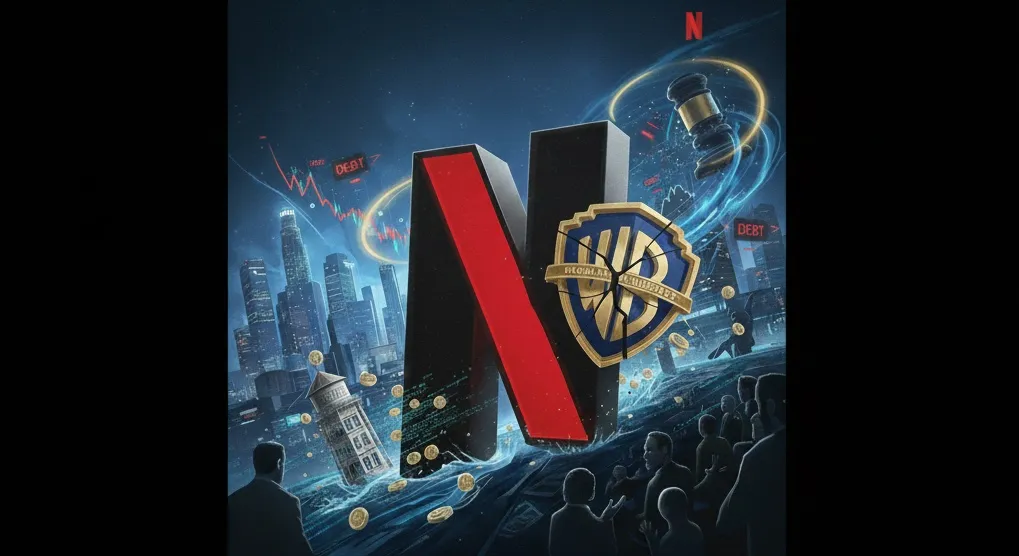
A seismic $72 billion takeover is set to rewrite Hollywood’s power map as Netflix, once the insurgent of streaming, transforms into a legacy media titan by acquiring Warner Bros. Discovery. The deal promises unmatched IP dominance, but triggers debt fears, regulatory risks, and a harsh market backlash.
By EcoPulse24 | December 6, 2025
The Bombshell Announcement
On the morning of Friday, December 5, 2025, Netflix (NASDAQ: NFLX) dropped what might be the biggest bombshell in entertainment industry history: a definitive agreement to acquire Warner Bros. Discovery's film and television studios, along with HBO and HBO Max, in a staggering $82.7 billion deal (enterprise value) with $72 billion in equity value.
The announcement sent shockwaves through Hollywood and Wall Street alike. Here was Netflix - the company that spent two decades building, not buying - suddenly morphing into the very thing it disrupted: a traditional media behemoth. The streaming pioneer that sent Blockbuster to bankruptcy and forced every studio to rethink theatrical releases was now buying one of Hollywood's oldest and most storied studios, founded 102 years ago in 1923.
Yet the market's reaction was anything but celebratory. By the closing bell, Netflix shares had tumbled nearly 3% to around $100-101, while Warner Bros. Discovery stock jumped 6.3% to $25.33. The divergence told a story: Warner shareholders were thrilled to cash out at a premium, while Netflix investors were spooked by the sheer audacity and risk of the move.
What makes this deal so controversial? Why did it happen? And most importantly, what went wrong with Netflix's stock in the days leading up to and following this announcement? Let's dig deep.
The Players: Who's Who in This Hollywood Drama
Netflix: The Disruptor Turned Acquirer
Ted Sarandos (Co-CEO) and Greg Peters (Co-CEO) are the masterminds behind this acquisition. Sarandos, the content guru who famously said "the goal is to become HBO faster than HBO can become us," is now literally buying HBO. The irony is not lost on industry observers.
Netflix finished 2024 with $39 billion in revenue and more than 300 million global subscribers. The company's market capitalization hovers around $460 billion, making it one of the world's most valuable media companies. But growth has been slowing. After surging 80% in 2024, Netflix stock is up only about 16-20% in 2025, and the company stopped reporting subscriber numbers earlier this year - a move that raised eyebrows about transparency.
Reed Hastings, Netflix's co-founder and former CEO (now chairman), plays a pivotal role in this story - but not the way you'd expect.
Warner Bros. Discovery: The Legacy Giant Under Pressure
David Zaslav, CEO of Warner Bros. Discovery, has been under intense pressure since the 2022 merger of WarnerMedia (spun off from AT&T) and Discovery. The combined company carried crushing debt loads exceeding $40 billion and faced declining cable revenue as cord-cutting accelerated.
Warner Bros. Discovery owns an unparalleled content library: the entire DC Comics universe (Batman, Superman, Wonder Woman), Harry Potter franchise, Game of Thrones, Friends, The Big Bang Theory, The Sopranos, The Wizard of Oz, Casablanca, Citizen Kane, and HBO's prestige programming. But translating that IP into streaming profits proved elusive. HBO Max had only 128 million subscribers as of September 2024 - respectable, but far behind Netflix.
The company announced in June 2025 its intention to split into two entities: one housing the studios and streaming assets, the other holding cable networks like CNN, TNT, Discovery Channel, and Bleacher Report. This "Discovery Global" spinoff, scheduled for Q3 2026, would set the stage for today's Netflix deal.
The Other Bidders: Paramount, Comcast, and the Auction Drama
This wasn't a quiet negotiation. Warner Bros. Discovery launched a formal auction process in fall 2025, and the bidding war turned contentious:
-
Paramount Skydance (run by David Ellison, son of Oracle billionaire Larry Ellison) made multiple aggressive bids, reportedly offering $30 per share all-cash for the entire company including cable networks. Paramount had completed its own $8 billion merger with Skydance in August 2025 and saw Warner as a way to create a true media powerhouse.
-
Comcast/NBCUniversal quietly explored a bid for the studio and streaming assets, but ultimately stepped back.
-
Netflix emerged as the frontrunner with an offer of $27.75 per share in cash and stock - below Paramount's cash offer but structured to appeal to Warner's board, which favored Netflix's financial strength and strategic fit.
The drama reached a peak when Paramount sent a scathing letter to Warner's management on December 4, accusing them of running an "unfair process" that favored Netflix, abandoning "the semblance and reality of a fair transaction process" and "abdicating its duties to stockholders." Paramount argued it was being frozen out despite offering more money.
Warner Bros. Discovery reportedly favored Netflix because:
- Regulatory path: Netflix's bid excluded cable assets, reducing antitrust complexity
- Financial certainty: Netflix could secure $59 billion in debt financing from Wells Fargo, BNP Paribas, and HSBC
- Cultural fit: Netflix promised to maintain theatrical releases and preserve Warner's operations
By Thursday evening, December 4, Netflix and Warner entered exclusive negotiations, effectively shutting out Paramount. By Friday morning, the deal was announced.
The Deal Structure: Following the Money
Let's break down the numbers, because they're staggering:
The Price Tag
- $27.75 per share to Warner Bros. Discovery shareholders
- $23.25 in cash + $4.50 in Netflix stock (subject to a collar mechanism)
- Equity value: $72 billion
- Enterprise value: $82.7 billion (including Warner's debt)
To put this in perspective: Warner's entire market cap was only $60 billion before the deal. Netflix is paying $72 billion just for the studios and streaming division - a 20% premium over the whole company's value.
What Netflix Gets
- Warner Bros. Film Studio (theatrical releases, century-old library)
- Warner Bros. Television (production powerhouse)
- HBO (prestige cable network)
- HBO Max (streaming platform with 128M subscribers)
- DC Studios (Batman, Superman, entire DC universe)
- Content library including Harry Potter, Lord of the Rings (partial rights), Friends, Big Bang Theory, Game of Thrones, Sopranos, and thousands of classic films
What Netflix Doesn't Get
Warner's cable networks (CNN, Discovery, TNT Sports, etc.) will be spun off into Discovery Global, a separate publicly traded company in Q3 2026.
The Financing
Netflix is taking on $59 billion in bridge loans from major banks to complete the cash portion. The company also faces:
- A $5.8 billion reverse breakup fee if the deal fails regulatory approval
- A $2.8 billion breakup fee Warner would pay if it walks away for a better offer
Expected Synergies
Netflix projects $2-3 billion in annual cost savings by year three after closing, primarily from:
- Eliminating duplicate streaming infrastructure
- Consolidating content licensing
- Streamlining production operations
The deal is expected to be accretive to Netflix's GAAP earnings within two years.
Timeline
- Q3 2026: Warner completes Discovery Global spinoff
- Mid-2026 to Early 2027: Expected deal closing (pending regulatory approval)
Why Now? The Strategic Rationale
For Netflix, this deal represents a dramatic strategic pivot. The company has never made a major acquisition. Sarandos and Peters have repeatedly emphasized they are "builders, not buyers," preferring to invest billions in original content rather than acquire established libraries.
So what changed?
1. Growth Ceiling Concerns
Netflix's subscriber growth is slowing. The company added fewer net subscribers in recent quarters, and its decision to stop reporting subscriber counts raised suspicions that the news wasn't good. With over 300 million subscribers, the addressable market for premium streaming is becoming saturated in developed countries.
2. Content Arms Race
Every studio launched its own streaming service (Disney+, Paramount+, Peacock, Apple TV+), fragmenting the market and pulling content back from Netflix. The company needed to own rather than license tent-pole franchises to ensure long-term content security.
3. The IP Advantage
Warner's library offers something Netflix has struggled to build: generational franchises with decades of brand equity. Batman, Superman, Harry Potter, Game of Thrones - these aren't just shows, they're cultural institutions with built-in global audiences and endless spinoff potential.
4. Theatrical Presence
Netflix has largely bypassed theaters, premiering most content directly on streaming. This created tension with filmmakers (directors like Christopher Nolan refuse to work with Netflix) and limited box office revenue. Acquiring Warner Bros. gives Netflix instant credibility and infrastructure for theatrical releases, which it has promised to maintain.
5. Competitive Pressure
Disney is dominating family entertainment. Amazon is spending billions on Prime Video. YouTube and TikTok are stealing attention from younger demographics. Netflix needed a moat - something competitors couldn't replicate. Warner's IP library provides that.
6. Valuation Opportunity
Warner Bros. Discovery was undervalued due to its debt burden and troubled merger history. The stock traded at less than 5x EBITDA, while Disney trades at 10-12x. For Netflix, this represented a rare chance to buy AAA assets at a discount.
The Market's Harsh Verdict: Why NFLX Stock Tanked
Here's where the story takes a dark turn for Netflix shareholders. In the days surrounding the announcement, Netflix stock didn't surge on the transformative deal - it collapsed.
The Numbers Don't Lie
- December 3, 2025: Netflix closed at $109.35
- December 3 intraday: Stock plunged 6.3% to as low as $102.64 on heavy volume
- December 5, 2025: After deal announcement, stock fell another 2-3% to $100-101
- Total decline: From recent highs around $134 in late 2024, Netflix is down approximately 23-25%
Warner Bros. Discovery, meanwhile, surged 6.3% on the news. Paramount stock tumbled 9.8% after losing the bid. The market spoke loudly: this deal creates value for Warner shareholders, destroys value for Netflix shareholders (at least in the short term), and eliminates a potential acquirer for Paramount.
Five Reasons Wall Street Hit the Sell Button
1. Massive Debt Load
Netflix is taking on $59 billion in new debt to finance the acquisition. The company has historically operated with relatively modest leverage, generating strong free cash flow ($9 billion projected for 2025). Now it's transforming into a highly leveraged company overnight. In a rising interest rate environment, that debt will be expensive to service.
Analysts worry that Netflix's financial flexibility will evaporate. Share buybacks? Unlikely. Dividend? Forget it. Aggressive content spending? May have to be trimmed. The company that prided itself on financial discipline is now playing in the big leagues of corporate debt.
2. Regulatory and Antitrust Risk
This deal will face intense scrutiny from regulators in the US and EU. Netflix is the dominant streaming platform with over 300 million subscribers. Adding HBO Max's 128 million creates a company controlling nearly half the global streaming market.
Key concerns:
- Market concentration: The combined entity would dwarf competitors
- Content hoarding: Critics fear Netflix could withhold Warner content from rivals, reducing consumer choice
- Pricing power: A near-monopoly could raise subscription prices
- Theater impact: Cinema groups warn the deal threatens the theatrical ecosystem
Congress is already mobilizing. Senator Amy Klobuchar and others have expressed concerns about "one massive media giant" forcing Americans into "higher subscription prices and fewer choices." Former President Trump, who actively opposed the AT&T-Time Warner merger in his first term, may weigh in again.
Approval timeline: 12-18 months minimum, possibly longer. The deal could be blocked, approved with conditions (forced asset sales), or approved but delayed. Each scenario carries risk.
3. Integration Nightmares
Mergers of this size rarely go smoothly. Netflix must integrate:
- Two massive technology platforms (Netflix's streaming infrastructure + HBO Max's)
- Different corporate cultures (Silicon Valley tech vs. old Hollywood studio system)
- Union negotiations and labor agreements
- Theatrical distribution networks Netflix doesn't currently operate
- International operations in 190+ countries
Historical mega-mergers (AOL-Time Warner, Disney-Fox) have shown that synergies are overestimated and costs are underestimated. Netflix's projected $2-3 billion in savings could easily be eaten by unexpected integration expenses.
4. Valuation Concerns
Netflix is paying a significant premium for Warner assets:
- $72 billion for studios/streaming vs. $60 billion for the entire company
- ~15-18x estimated EBITDA (high for a struggling streaming business)
- Assumes Netflix can unlock value Warner couldn't
Some analysts question whether Warner's IP is worth the price. HBO Max subscriber growth has stalled. The DC universe has produced box office flops (Blue Beetle, The Flash). The streaming wars have proven that content libraries don't automatically translate to subscribers - Disney+ and Paramount+ both overpaid for content that underperformed.
Is Netflix repeating their mistakes at an even larger scale?
5. The Reed Hastings Insider Sale
This is the smoking gun that spooked retail investors.
On December 1, 2025 - just four days before the deal announcement - Netflix co-founder and chairman Reed Hastings sold 375,470 shares for approximately $40.7 million at prices between $106.85 and $108.89.
The kicker: This sale reduced his direct holdings by 99% - from nearly 380,000 shares to just 3,940 shares.
Hastings still controls over 21 million shares through the Hastings-Quillin Family Trust (worth over $2 billion), but the optics are terrible. When a co-founder dumps essentially all his personal shares days before the biggest deal in company history, investors ask: "What does he know that I don't?"
Possible explanations:
- Personal liquidity needs (though Hastings is a billionaire)
- Pre-planned 10b5-1 trading program (legally defensible but poorly timed)
- Concerns about deal risk (the market's interpretation)
- Estate planning or diversification (rational but suspicious timing)
Whatever the reason, the $40.7 million sale triggered a 6.3% single-day drop on December 3, erasing billions in market cap. When insiders sell, retail investors panic - especially in high-valuation growth stocks like Netflix trading at 45x trailing earnings.
This wasn't Hastings' only recent sale. He also sold 403,740 shares on October 31 for $45.3 million and 421,760 shares on October 1 for $49.4 million. In three months, Hastings dumped over $135 million in Netflix stock.
Pattern? Preparation? Or prescience?
The Broader Context: What This Means for Streaming
This deal doesn't happen in a vacuum. It's the culmination of years of streaming wars, consolidation, and a fundamental reshaping of media.
The Streaming Winter
The pandemic-era streaming boom is over. Every major company - Netflix, Disney, Warner, Paramount - is now focused on profitability over growth. The era of spending billions to acquire subscribers at any cost has ended. Companies are:
- Raising prices (Netflix just hiked rates again)
- Cracking down on password sharing (Netflix's successful but unpopular move)
- Cutting content budgets (Disney, Warner, Paramount all trimming spending)
- Bundling services (Disney+/Hulu/ESPN+, Max combining HBO and Discovery)
- Emphasizing ads (Netflix's ad-tier has 190 million monthly active viewers)
Consolidation Accelerates
The Netflix-Warner deal is the biggest but not the only one:
- Paramount-Skydance merged in August 2025 ($8 billion)
- Disney explored buying Paramount before Skydance won
- Comcast is considering spinning off NBCUniversal cable networks
- Apple and Amazon are rumored to be eyeing acquisitions
The industry is moving from 15+ streaming services toward 3-5 dominant platforms. Smaller players (Peacock, Paramount+, Max) can't compete with Netflix and Disney's scale. Consolidation is inevitable.
The Theater vs. Streaming Détente
Netflix's promise to maintain theatrical releases for Warner Bros. films is a seismic shift. The company that killed Blockbuster and threatened theaters is now becoming a theatrical distributor.
Why? Because filmmakers demand it. Directors like Denis Villeneuve, Christopher Nolan, and Martin Scorsese refuse to work with Netflix due to its streaming-first model. Winning Oscars requires theatrical releases (Academy rules). And box office revenue, while not Netflix's focus, adds up - Warner Bros. generated $9+ billion in theatrical revenue in recent years.
This could mark the beginning of a new hybrid model: prestige films get theatrical windows, then migrate to streaming. Netflix gets cultural cachet and filmmaker credibility. Theaters get guaranteed content from the biggest streaming platform. Everyone (theoretically) wins.
The Human Drama: Winners, Losers, and Wildcards
Winners
David Zaslav: The embattled Warner CEO exits stage left with a golden parachute and a successful sale, escaping the debt crisis he inherited.
Warner shareholders: Receiving a 20% premium over market value in cash and Netflix stock.
HBO creators and executives: Will Netflix maintain HBO's prestige brand and editorial independence? If yes, they gain Netflix's $17 billion content budget. If no, expect an exodus of talent.
DC fans: Netflix's financial firepower could revitalize the struggling DC cinematic universe. Imagine the resources Netflix pours into Stranger Things or Squid Game applied to Batman and Superman.
Movie theater chains: Netflix committing to theatrical releases provides a lifeline to struggling cinema operators (AMC, Cinemark, Regal).
Losers
Netflix shareholders (short-term): Taking on massive debt, regulatory risk, and integration challenges while the stock tanks.
Paramount: Lost the bidding war, eliminating a potential exit strategy for Shari Redstone. Paramount stock fell 10% on the news.
Small streaming services: Peacock, Paramount+, Apple TV+, and others now face an even more dominant Netflix with an unbeatable content library.
Independent creators: Consolidation means fewer buyers for content, reducing leverage in negotiations.
Cinema United (theater trade group): Despite Netflix's promises, the group calls the deal an "unprecedented threat" to theaters, fearing Netflix will eventually prioritize streaming over theatrical.
Wildcards
Donald Trump: As president-elect (inauguration January 2025), Trump's DOJ will review the deal. In his first term, Trump actively lobbied against the AT&T-Time Warner merger, calling it "too much concentration of power." Will he oppose Netflix-Warner too? Trump's unpredictability makes this a major wildcard.
FTC Chair Lina Khan: Known for aggressive antitrust enforcement, Khan could push for tough conditions or even attempt to block the deal outright.
Filmmakers and talent: Will A-list directors embrace Netflix-Warner or flee to remaining independent studios? Their choice will determine if the combined company can maintain Warner's creative prestige.
The Unanswered Questions
As the dust settles, critical questions remain:
-
Will regulators approve this deal? The US and EU have 12-18 months to decide. Forced asset sales or conditions could significantly alter the deal's value.
-
Can Netflix maintain HBO's brand identity? HBO is synonymous with prestige. Will it become just another Netflix category, diluting its value?
-
What happens to theatrical releases long-term? Netflix's commitment to theaters may be temporary, designed to win filmmaker support and regulatory approval.
-
How will Netflix handle the debt? $59 billion is a lot of money. Will free cash flow cover debt service, or will content spending suffer?
-
Where's the real value? Is it in Warner's IP (Batman, Harry Potter) or HBO's prestige brand? Or is Netflix overpaying for declining assets?
-
What did Reed Hastings know? His insider sales will be scrutinized for years. Was it coincidence, or did the co-founder see risks investors are only now discovering?
-
Will other studios follow? Could Disney acquire Paramount? Apple buy A24? Amazon gobble up Lionsgate? This deal may trigger an acquisition frenzy.
The Bottom Line: A Historic Gamble
Netflix's $72 billion acquisition of Warner Bros. Discovery is the biggest bet in streaming history - and one of the riskiest. Ted Sarandos and Greg Peters are betting that:
- Warner's IP is worth the premium
- Regulators will approve (or impose manageable conditions)
- Integration will go smoothly
- Debt won't cripple financial flexibility
- The combined entity will dominate streaming for decades
Wall Street is skeptical. The 3-6% stock decline reflects investor fears that Netflix is overpaying, taking on excessive risk, and abandoning the disciplined approach that made it successful.
But here's the contrarian view: If Netflix pulls this off - if regulators approve, integration succeeds, and the company unlocks Warner's IP - this deal could be remembered as a masterstroke. A combined Netflix-Warner would control:
- 400+ million subscribers
- The deepest content library in the world
- Theatrical distribution (credibility with filmmakers)
- Pricing power in streaming
- A moat competitors can't cross
The question isn't whether this deal is bold. It's whether it's brilliant or reckless.
Reed Hastings' insider sales suggest even Netflix's co-founder has doubts. The market's harsh reaction indicates Wall Street sees more risk than reward. But Ted Sarandos and Greg Peters are doubling down, betting $72 billion that Netflix can become not just the future of entertainment - but its past and present as well.
Time will tell if they're visionaries or victims of hubris. For now, all we know is this: Hollywood will never be the same.
Key Takeaways:
- Deal size: $82.7B enterprise value, $72B equity value
- What Netflix gets: Warner Bros. studios, HBO, HBO Max, DC universe, iconic franchises
- Why stock fell: Debt concerns, regulatory risk, integration challenges, Reed Hastings' $40.7M insider sale
- Timeline: Q3 2026 spinoff, mid-2026 to early-2027 closing
- Biggest risk: Antitrust rejection or heavy conditions from US/EU regulators
- Biggest opportunity: Unmatched content library and subscriber base if deal succeeds
This story is developing. Regulatory reviews, shareholder votes, and market dynamics will shape the outcome over the next 12-18 months. One thing is certain: Netflix has gone all-in, and there's no turning back now.