EcoPulse24 News Desk
December 3, 2025
Saudi Arabia’s Cabinet, chaired by Crown Prince and Prime Minister Mohammed bin Salman, approved the 2026 state budget on Tuesday, setting a strategic milestone in the country’s economic transformation.
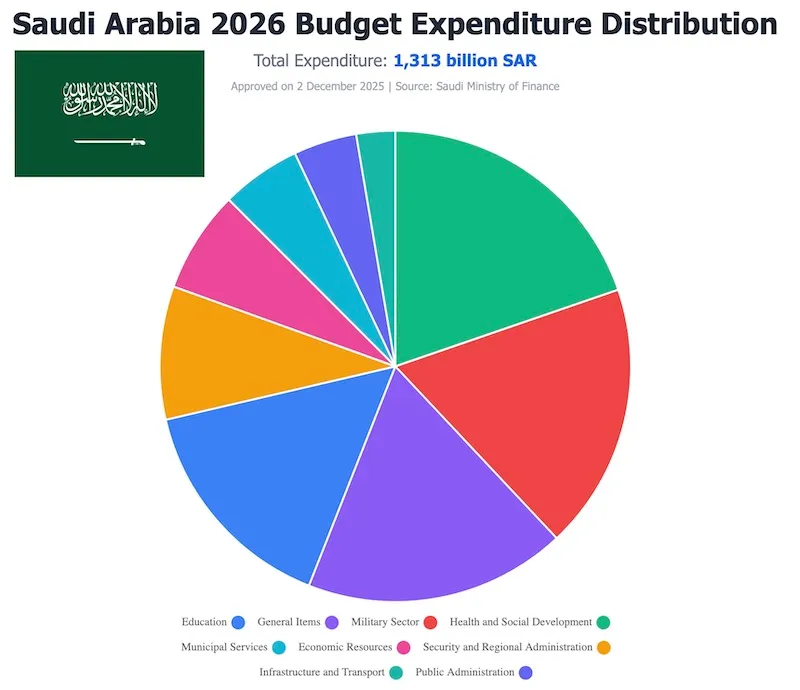
The budget outlines record spending of SAR 1.313 trillion ($350 billion), with a planned deficit of SAR 165.4 billion, equivalent to just 3.3% of GDP.
Saudi Arabia 2026 Budget Expenditure Distribution
Financial Highlights: Fiscal Discipline with Strategic Expansion
The Ministry of Finance released detailed estimates that reflect a careful balance between development priorities and fiscal prudence.
-
Total expenditure: SAR 1,312.8 billion ($350.1 billion)
-
Total revenues: SAR 1,147.4 billion ($306 billion)
-
Expected deficit: SAR 165.4 billion ($44 billion) or 3.3% of GDP
This marks a substantial improvement from 2025, when the deficit was projected at SAR 245 billion (5.3% of GDP), signaling a 32% reduction in the deficit in a single year.
Officials attributed the improvement to enhanced fiscal management and rising non-oil revenue.
Growth Forecast: Expansion Led by Non-Oil Sectors
Saudi Arabia expects its economy to grow 4.6% in 2026, driven primarily by non-oil activity expanding by 4.7%, underscoring the progress of economic diversification efforts.
Preliminary data shows the economy grew 4.1% in the first three quarters of 2025, with:
-
Non-oil sector growth: 4.7%
-
Oil sector growth: 3.9%
These indicators reinforce the Kingdom’s trajectory toward the goals of Vision 2030, despite global macroeconomic uncertainty and volatility in oil markets.
Inflation is projected to remain low and stable at 2% in 2026, down from 2.3% in 2025, highlighting the effectiveness of monetary policy and its support for consumer purchasing power.
The Ministry expects revenues to gradually rise to SAR 1.294 trillion by 2028, supported by stronger economic performance and expanding non-oil income streams.
Public Debt: A Sustainable, Long-Term Strategy
Finance Minister Mohammed Al-Jadaan said public debt is expected to reach SAR 1.457 trillion by end-2025 (31.7% of GDP) and rise to SAR 1.622 trillion in 2026 (32.7%) - levels he described as safe and sustainable by international standards.
He noted that the government will continue to access local and international markets to finance the deficit and refinance maturing debt, while exploring alternative funding strategies to support growth.
Addressing concerns over the rising deficit, Al-Jadaan stated:
“The current deficit level is a deliberate policy choice. We need to invest in our economy, and as long as the returns exceed the cost of borrowing, we will continue this approach.”
This underscores the government’s strategy of using “optional deficit” to accelerate Vision 2030 investment rather than fund recurrent expenditure.
Spending Priorities: Investing in People and the Future
The 2026 budget focuses on spending across infrastructure, education, healthcare, tourism, technology, renewable energy, and support for mega-projects that serve as pillars of Vision 2030.
The budget launches the third phase of Vision 2030, centered on maximizing impact and accelerating delivery, following earlier stages that focused on enabling reforms and building capacity.
Social programs remain a priority, along with efforts to create sustainable employment opportunities, particularly for Saudi youth.
Tourism alone is expected to generate 1.6 million jobs by 2030, while unemployment fell to 7.1% in Q2 2024, with expectations of further decline.
Role of Private Sector and Sovereign Funds
The statement underscored the central role of the Public Investment Fund (PIF) in advancing Vision 2030 targets through strategic sector development and global partnerships.
The National Development Fund and associated development funds complement the budget by stimulating growth and diversification.
The government aims to strengthen the business environment and attract foreign direct investment, while incentivizing private sector expansion.
The objective is to raise the private sector’s share of GDP from around 40% today to 65% by 2030 - a key measure of economic transformation.
Risks and Challenges: Pragmatism in Uncertain Times
The Finance Ministry acknowledged that the global economic outlook remains uncertain for 2026 and beyond, citing risks such as:
-
Rising geopolitical tensions
-
Growing protectionism
-
Trade restrictions and tariff hikes
Such dynamics could dampen global trade, weaken oil demand, and increase market volatility.
In response, the ministry outlined three budget scenarios:
-
Optimistic: SAR 107 billion deficit
-
Base case (adopted): SAR 165 billion deficit
-
Adverse: SAR 250 billion deficit
This approach reflects flexibility, realism, and preparedness for evolving economic conditions.
Crown Prince: “Citizens are the Top Priority”
After approving the budget during a Cabinet session in Dammam, Crown Prince Mohammed bin Salman instructed ministers to:
“Fully commit to executing the programs and projects that support Vision 2030 objectives, placing citizens and their well-being at the forefront.”
He stressed the Kingdom’s commitment to empowering its people, fostering comprehensive development, and leading in multiple fields, rooted in values derived from Islamic principles.
“We will continue moving forward with confidence to achieve our goals,” he said.
Expert Views: Confidence in the Economic Path
Ismail Al-Ani, Head of Government and Public Sector at KPMG Middle East, said Saudi Arabia’s deficit is “optional”, noting:
“It is not used to finance operating expenses, but to accelerate Vision 2030 targets.”
He argued that Saudi Arabia is pursuing a calculated expansionary policy, aiming for long-term investment returns that outperform borrowing costs.
International institutions also raised their outlook:
-
IMF: 3.9% growth in 2026
-
World Bank: 4.5%
-
Saudi Minister of Economy, Faisal Al-Ibrahim: 6.5%
Reflecting broad optimism across sectors.
Regional Comparison: Saudi Arabia Leads the Pack
Saudi Arabia stands out as one of the fastest-growing economies in the G20, with IMF projections of 4% growth in 2025, compared with:
-
1.3% in the UK
-
0.7% in France
-
0.2% in Germany
This reinforces its position as the largest economy in the Middle East and the world’s biggest oil exporter, and a leading destination for global investment.
Conclusion: A Clear Roadmap Toward a Sustainable Future
The 2026 budget reflects Saudi Arabia’s ongoing commitment to Vision 2030, with an emphasis on:
-
Impact-driven execution
-
Fiscal discipline
-
Diversified revenue streams
-
Job creation
-
Youth empowerment
The Kingdom appears set on building a robust, diversified, and sustainable economy, with citizens at the heart of its development agenda.
Budget Snapshot
| Item | 2025 (Revised Est.) | 2026 (Proposed) | Change |
|---|---|---|---|
| Total Expenditure | 1.336 tn SAR | 1.313 tn SAR | -1.7% |
| Revenues | ~1.09 tn SAR | 1.147 tn SAR | +5.1% |
| Fiscal Deficit | 245 bn SAR (5.3%) | 165.4 bn SAR (3.3%) | -32.5% |
| GDP Growth | 4.4% | 4.6% | +0.2% |
| Public Debt | 1.457 tn SAR (31.7%) | 1.622 tn SAR (32.7%) | +11.3% |