OpenAI just dropped a bombshell - and the numbers don't lie.
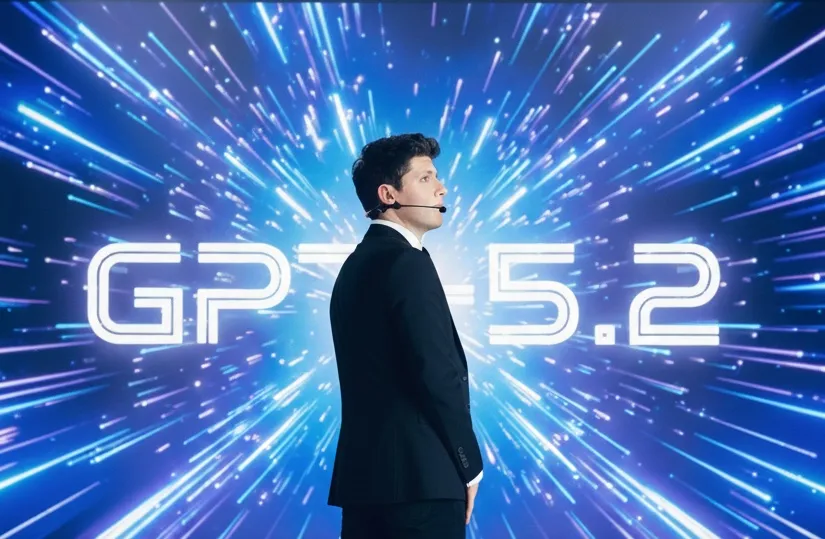
When Sam Altman shared benchmark results on X (formerly Twitter) comparing GPT-5.2 Thinking against Anthropic's Claude Opus 4.5 and Google's Gemini 3 Pro, the AI community erupted. The message was clear: OpenAI isn't just competing anymore - they're dominating.
GPT-5.2 isn't merely an incremental upgrade from GPT-5.1. It's a declaration of superiority across every metric that matters: coding, reasoning, mathematics, and knowledge work. This is the model that makes other "frontier" systems look like yesterday's news.
Let's break down what makes GPT-5.2 the undisputed champion - and why it matters for everyone from solo developers to Fortune 500 companies.
⚠️ Important Note: GPT-5.2 is 40% more expensive than GPT-5 and GPT-5.1. But as you'll see, the performance gains often justify - and sometimes exceed - the cost increase.
The Benchmark Massacre: GPT-5.2 vs. The World
Sam Altman didn't mince words. The comparison chart he posted tells a brutal story of technical dominance. Here's how GPT-5.2 stacks up against the competition:
Software Engineering: A Clean Sweep
SWE-Bench Pro (Real-world software engineering tasks)
- 🥇 GPT-5.2 Thinking: 55.6%
- GPT-5.1 Thinking: 50.8%
- Claude Opus 4.5: 52.0%
- Gemini 3 Pro: 43.3%
OpenAI doesn't just lead here - they demolish Google's offering by 12.3 percentage points. For developers building automated coding agents or debugging complex systems, this gap is massive.
Scientific Reasoning: Where GPT-5.2 Embarrasses the Competition
GPQA Diamond (Graduate-level science questions, no tools)
- 🥇 GPT-5.2 Thinking: 92.4%
- Gemini 3 Pro: 91.9%
- GPT-5.1 Thinking: 88.1%
- Claude Opus 4.5: 87.0%
A near-perfect score. This isn't just impressive - it's borderline frightening for what it signals about AI's capability to handle expert-level scientific reasoning.
CharXiv Reasoning (Scientific figure interpretation)
- 🥇 GPT-5.2 Thinking: 82.1%
- Gemini 3 Pro: 81.4%
- GPT-5.1 Thinking: 67.0%
- Claude Opus 4.5: -
The 15-point leap from GPT-5.1 to GPT-5.2 here is staggering. It signals a fundamental breakthrough in visual-scientific reasoning.
Advanced Mathematics: The Real Test
FrontierMath (Cutting-edge mathematics problems)
- 🥇 GPT-5.2 Thinking: 40.3% (Tier 1-3)
- Gemini 3 Pro: 37.6%
- GPT-5.1 Thinking: 31.0%
- Claude Opus 4.5: -
Tier 4 (Hardest Problems):
- 🥇 Gemini 3 Pro: 18.8%
- GPT-5.2 Thinking: 14.6%
- GPT-5.1 Thinking: 12.5%
Interestingly, Google edges out OpenAI on the absolute hardest math problems - but across the broader FrontierMath suite, GPT-5.2 dominates.
AIME 2025 (Competition-level mathematics)
- 🥇 GPT-5.2 Thinking: 100.0%
- Gemini 3 Pro: 95.0%
- GPT-5.1 Thinking: 94.0%
- Claude Opus 4.5: 92.8%
Perfect. Score. OpenAI just achieved what many thought impossible: flawless performance on competition mathematics without tools.
Abstract Reasoning: The Cognitive Ceiling
ARC-AGI 1 (Abstract pattern recognition)
- 🥇 GPT-5.2 Thinking: 86.2%
- Claude Opus 4.5: 80.0%
- Gemini 3 Pro: 75.0%
- GPT-5.1 Thinking: 72.8%
ARC-AGI 2 (Even harder abstract reasoning)
- 🥇 GPT-5.2 Thinking: 52.9%
- Claude Opus 4.5: 37.6%
- Gemini 3 Pro: 31.1%
- GPT-5.1 Thinking: 17.6%
This is perhaps the most shocking result. GPT-5.2 triples its predecessor's performance on ARC-AGI 2 and absolutely crushes Anthropic and Google. For AI researchers, this benchmark measures something close to "true" intelligence - the ability to reason about novel patterns without prior training.
Knowledge Work: The Practical Battlefield
GDPval (Real-world knowledge tasks)
- 🥇 GPT-5.2 Thinking: 70.9%
- Claude Opus 4.5: 59.6%
- Gemini 3 Pro: 53.5%
- GPT-5 (baseline): 38.8%
For business users, this is the metric that matters most. GPT-5.2 doesn't just outperform competitors - it leaves them in the dust with an 11-17 point advantage.
What Makes GPT-5.2 Different? The Technical Breakthroughs
1. Long-Context Mastery
GPT-5.1 handled large inputs reasonably well. GPT-5.2 never forgets.
It leads on OpenAI's MRCRv2 long-context benchmark, reliably processing:
- Entire legal contracts
- Multi-file codebases spanning thousands of lines
- Research papers with complex cross-references
- Financial reports with dense data tables
The result: More accurate summaries, fewer hallucinations, better logical continuity across 100+ page documents.
2. Vision Gets 50%+ Smarter
The chart benchmark numbers hint at this, but the real-world difference is dramatic:
- Far fewer errors reading business dashboards, charts, or complex UIs
- Better spatial reasoning for architectural diagrams
- Improved understanding of annotated scientific figures
GPT-5.2 can now analyze a multi-panel research figure and extract insights that previously required human interpretation.
3. Coding That Actually Works
Leading SWE-Bench Pro is one thing. But GPT-5.2's coding abilities go deeper:
- Multi-file editing that maintains consistency across complex projects
- Legacy code refactoring that actually improves architecture
- Debugging that identifies root causes, not just symptoms
- Full UI component generation with minimal scaffolding
Developers report that GPT-5.2 feels less like an assistant and more like a senior engineer who actually understands the codebase.
4. Tool Calling That Finally Works Reliably
This is the unsung hero of GPT-5.2.
GPT-5.1 could call tools, but often chose poorly or repeated steps. GPT-5.2:
- Understands intent before executing
- Chains tools across multi-step workflows
- Explains its reasoning via structured preambles
- Recovers from failures gracefully
For businesses building AI agents, this reliability shift is everything. It's the difference between a prototype and a production system.
5. "xhigh" Reasoning: The Nuclear Option
GPT-5.2 introduces xhigh reasoning effort - essentially telling the model "take as much time as you need to get this right."
For tasks requiring:
- Multi-stage problem decomposition
- Research-style analysis
- Complex planning or strategy
- Expert-level troubleshooting
...xhigh mode produces results that genuinely rival human experts.
6. Context Compaction: Infinite Conversations
A new compaction system compresses earlier conversation turns while preserving meaning.
Benefits:
- Sessions that stretch for hours without degradation
- Better memory across 100+ message exchanges
- Lower token costs for long-running workflows
- More stable reasoning in iterative projects
7. Spreadsheet and Document Superpowers
GPT-5.2 is significantly better at:
- Reading and interpreting complex spreadsheets
- Understanding Excel formulas and dependencies
- Generating structured tables from unstructured data
- Analyzing PDF-heavy workflows
- Catching data inconsistencies humans miss
Financial analysts, auditors, and data scientists are reporting time savings of 60-70% on routine analysis tasks.
8. The Elephant in the Room: 40% Higher Pricing (But Worth It)
Let's be blunt: GPT-5.2 is 40% more expensive than GPT-5 and GPT-5.1.
This isn't a small increase. For high-volume applications, this could mean thousands or tens of thousands of dollars in additional costs.
But here's the twist - in real-world usage, GPT-5.2 often ends up cheaper:
- It uses fewer reasoning tokens for the same task
- It requires shorter, simpler prompts
- It avoids redundant steps that waste tokens
- It gets things right the first time
In real workflows, many users report GPT-5.2 is actually cheaper than GPT-5.1 when you factor in time and retries.
The Competitive Landscape: Who's Winning, Who's Struggling?
OpenAI: Unchallenged Leader
The benchmark data makes this undeniable. Across eight major categories, GPT-5.2 leads in six outright and ties/barely trails in the remaining two.
OpenAI's strategic bet on reasoning-first AI is paying massive dividends. While competitors focused on parameter count or multimodal tricks, OpenAI built a model that actually thinks.
Google: Strong #2, But Clearly #2
Gemini 3 Pro puts up a fight in:
- Science questions (GPQA Diamond: 91.9% vs 92.4%)
- Hardest math problems (FrontierMath Tier 4: 18.8% vs 14.6%)
But it badly trails in:
- Software engineering (12.3 points behind)
- Abstract reasoning (21-point deficit on ARC-AGI 2)
- Knowledge work (17.4 points behind)
Google has world-class AI - but they're not winning the race.
Anthropic: Falling Behind
Claude Opus 4.5 was supposed to be competitive. The numbers tell a different story:
- Software engineering: 3.6 points behind GPT-5.2
- Science reasoning: 5.4 points behind
- Math competitions: 7.2 points behind
- Abstract reasoning: 15.3 points behind on ARC-AGI 2
- Knowledge work: 11.3 points behind
Anthropic's focus on "constitutional AI" and safety is admirable, but they're sacrificing raw capability - and it shows.
When Should You Use GPT-5.2?
Choose GPT-5.2 when you need:
- Complex multi-step reasoning
- Data-heavy analysis and decision-making
- Professional code generation and debugging
- Tool-driven autonomous agents
- Long document comprehension
- Visual intelligence for charts, diagrams, or UIs
- Extended technical or business conversations
This is the model for serious work.
When GPT-5.1 (or Others) Still Make Sense
Stick with GPT-5.1 for:
- General chat and brainstorming
- Simple content generation
- Everyday research queries
- Non-technical creative tasks
- Cost-sensitive, high-volume applications
Consider Claude for:
- Tasks requiring extreme ethical guardrails
- Constitutional AI alignment priorities
Consider Gemini for:
- Deep Google ecosystem integration
- Specific Google Workspace workflows
The Bottom Line: A New Standard
GPT-5.2 isn't just better than GPT-5.1 - it's better than every other frontier model by a margin too large to ignore.
Sam Altman's benchmark post wasn't arrogance. It was receipts.
For businesses building AI products, the message is clear: if you're not using GPT-5.2 (or planning to), you're already behind. The performance gap is too large, the reliability improvements too significant, and the competitive advantage too obvious.
For everyday users, GPT-5.2 represents something more profound: the moment AI stopped being a clever tool and started becoming an actual thinking partner.
It reasons like an expert. It plans like a strategist. It codes like a senior engineer. And it does all of this with a consistency that makes you forget you're talking to a machine.
The AI race isn't over. But right now, there's only one clear winner.
Source: Benchmark data shared by Sam Altman on X (December 2025). OpenAI official documentation and performance testing.
Note: All models were tested with maximum available reasoning effort for fair comparison.