Carney Reaffirms Canada's Commitment to USMCA Amid Trump's 100% Tariff Threats Over China Deal
PM Carney affirms Canada's USMCA commitment after Trump threatens 100% tariffs over a China trade deal, raising US-Canada tensions.

Ottawa - EcoPulse24
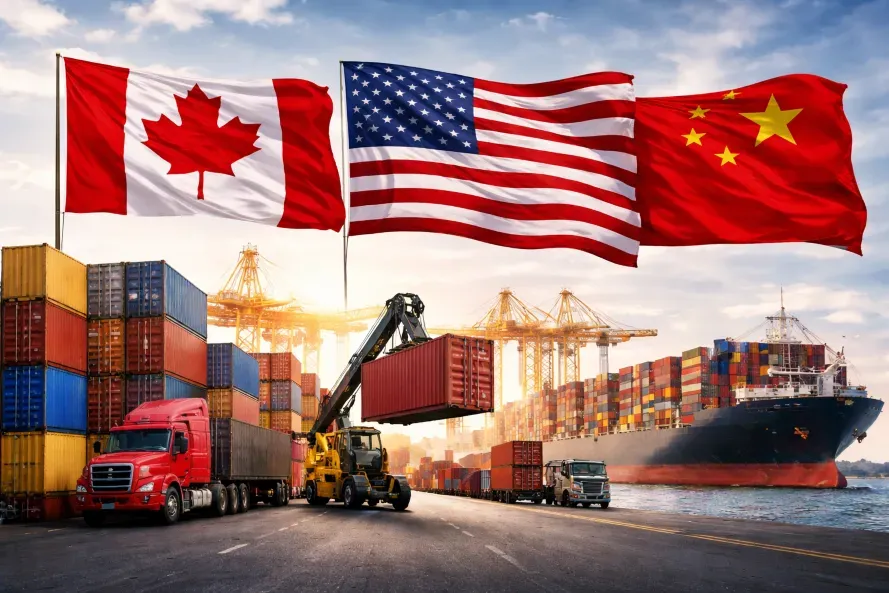
Canadian Prime Minister Mark Carney sought to defuse an escalating diplomatic crisis with Washington by affirming on Sunday that Canada "respects its commitments" under the US-Mexico-Canada Agreement (USMCA) and has no plans for comprehensive free trade with non-market economies, directly referencing China. Carney's remarks respond to President Donald Trump's threat to impose a 100% tariff on all Canadian imports if Ottawa pursues a broad trade agreement with Beijing. The backdrop is a week of volatility in US-Canada relations and growing uncertainty about North America's economic future.
Twists in US Policy
The crisis highlights a recurring pattern in Trump's administration: rapid shifts and using economic pressure as a political tool. On January 16, after Carney announced a preliminary trade deal with China during his historic visit to Beijing, Trump expressed public support. However, by January 24, Trump reversed course, threatening tariffs and accusing Carney of turning Canada into a "dumping ground" for Chinese goods.
Davos Speech as a Flashpoint
The immediate trigger was Carney's January 22 speech at the World Economic Forum in Davos, which Washington interpreted as a direct rebuke of US policy. Carney declared the "rules-based international order is over" and urged "middle powers" to cooperate against economic coercion by larger states, implicitly criticizing Trump's tariffs.
Details of the Canada-China Deal
Carney's Beijing agreement with President Xi Jinping allows:
- Canada to import 49,000 Chinese EVs annually at a 6.1% tariff (down from 100%), rising to 70,000 over five years
- Extension of tariff exemptions on Chinese steel and aluminum until end-2026
China will:
- Lower canola seed tariffs from 84% to 15% by March 2026
- Remove tariffs on canola meal, lobster, crab, and peas through at least 2026
- Resume talks on canola oil and pork
The deal is valued at CA$4 billion/year in canola exports and CA$3 billion in total agricultural and seafood exports.
Strategic Context: Canada in a Bind
The crisis comes just five months ahead of the scheduled USMCA review (July 2026). Over 85% of Canada-US trade is tariff-free under USMCA, with daily trade exceeding CA$3.6 billion. However, Trump has imposed sectoral tariffs under Section 232, hitting Canadian steel, aluminum, and sometimes autos, severely impacting key provinces.
Carney's Diversification Strategy
Since taking office in March 2025, Carney has pursued economic diversification to reduce dependence on the US, targeting Asian and European markets, deepening ties with China, and forging alliances with "middle powers." Canada has also pledged to raise defense spending to 2% of GDP by March 2026 in response to US demands.
Domestic Reactions
Supporters, such as Saskatchewan Premier Scott Moe, welcome the China deal for agriculture. Critics, including Ontario Premier Doug Ford and opposition leader Pierre Poilievre, warn it risks US relations and national security.
Potential Scenarios
Analysts outline four scenarios:
1. Limited escalation and compromise before the USMCA review (40% probability)
2. "Zombie USMCA" - neither renewed nor ended, with ongoing sectoral tariffs (35%)
3. Full economic split with mutual 100% tariffs and recession (15%)
4. Canada-Mexico alliance for joint US negotiations (10%)
Conclusion
The Canada-US crisis exemplifies a new, harsher global order: alliances are less stable, economic coercion is on the rise, and middle powers like Canada must balance between giants. The coming months before the USMCA review will be decisive.
Explore Related Coverage
Sources & References
Editorial Note
Disclaimer
© 2025 EcoPulse24. All rights reserved.