Egyptian Central Bank Issues Short-Term Dollar Treasury Bills to Boost Liquidity Ahead of External Debt Peaks
Egypt issues $950M in 1-year dollar T-bills to boost liquidity as $50.8B in external debt repayments loom by September.

Cairo | EcoPulse24
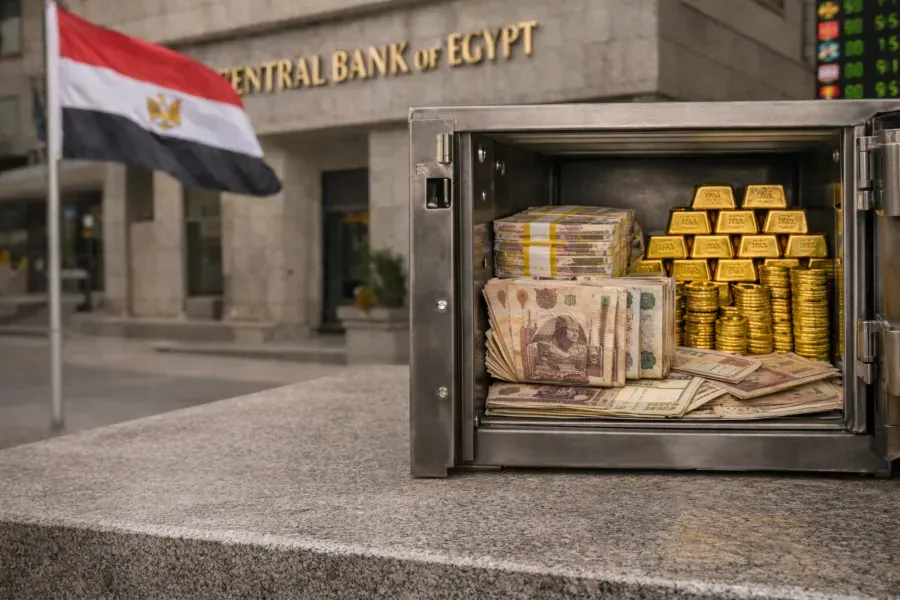
The Central Bank of Egypt is set to issue $950 million in one-year, dollar-denominated treasury bills on Monday, aiming to strengthen short-term dollar liquidity.
This move comes as the Egyptian government faces high external debt obligations. World Bank data shows that by the end of September, Egypt is due to repay about $50.8 billion in external debt, including nearly $21 billion in deposits and currencies held at the central bank - most of which are regularly renewed, especially with Gulf countries.
Figures indicate that in the first quarter alone, about $28 billion in repayments are due, including $13.6 billion in central bank deposits. Second quarter 2026 obligations are around $12.7 billion, including $3.35 billion in deposits, while third quarter 2025 obligations reach $9.8 billion, with $3.8 billion in central bank deposits and currencies.
Egypt’s external debt rose by $2.48 billion in Q3 2025 to reach $163.7 billion by September, up from $161.23 billion in June, according to World Bank data. This occurred despite government debt declining to $80.76 billion in September from $81.99 billion in June, and central bank loans falling to $37.3 billion from $37.33 billion. Meanwhile, bank sector debt increased to $23.56 billion from $22.24 billion, and other sectors’ debt rose to $22.09 billion from $19.66 billion over the same period.
Simultaneously, the central bank reported net foreign reserves rising to $51.452 billion in December, up from $50.216 billion in November. Gold reserves within the total increased by $914 million in December to $18.17 billion, with an annual gold reserve increase of $7.5 billion offsetting a $3.2 billion decline in foreign currency balances.
EcoPulse24 Analysis:
The issuance of dollar-denominated treasury bills reflects a strategy to manage liquidity gaps ahead of peak external repayments, using short-term instruments to ease immediate pressure on reserves. With a large share of regularly renewed deposits in the debt structure, the approach relies on a mix of temporary financing and reserve enhancement - especially gold - to redistribute risk, without fundamentally changing medium-term obligations.
Explore Related Coverage
Sources & References
Editorial Note
Disclaimer
© 2025 EcoPulse24. All rights reserved.