Eye on Jordan Markets: Banks Anchor the Rally as Amman Stocks Hold Above 4,000 Points
Jordan's ASE Index closed above 4,000 points as gains in banking and financial stocks offset weakness in mining and energy shares.

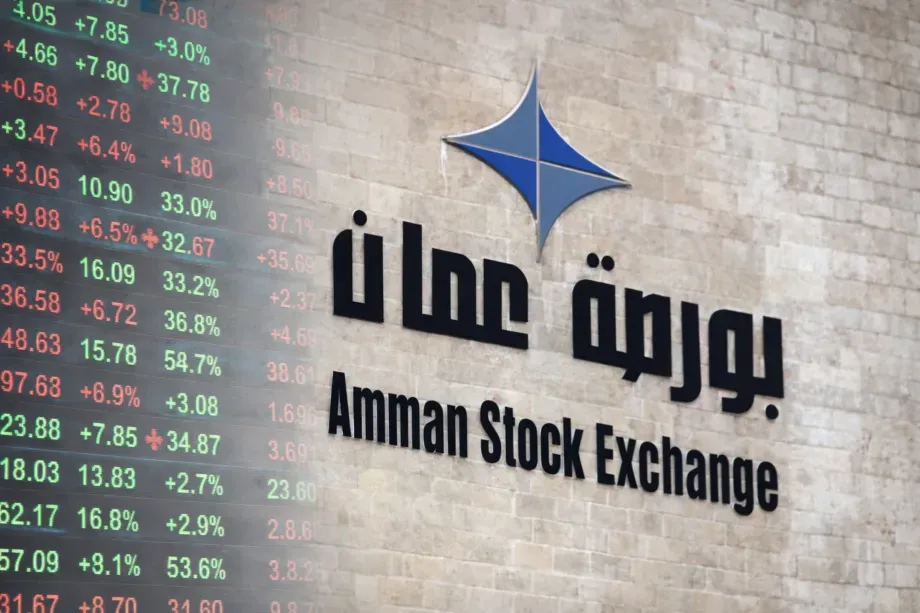
Amman | EcoPulse24
Jordanian equities began the week on a resilient note, with the ASE General Index closing at 4,019.76 points, up 0.10%, as strength in banking and financial stocks offset weakness in industrial and mining shares.
While the headline gain may appear modest, Monday's session carried broader significance for investors: the market successfully maintained levels above the psychologically important 4,000-point threshold, reinforcing a recovery that has steadily improved sentiment toward Jordanian assets in 2026.
The session generated JOD 18.76 million in turnover across more than 6.31 million shares, with 5,137 transactions executed. Market breadth remained balanced, with 36 stocks advancing, 33 declining, and 33 closing unchanged, suggesting selective accumulation rather than speculative buying.
Banking Sector Provides Stability
The banking sector once again emerged as the backbone of the market.
Arab Bank, one of Jordan's largest listed companies and a bellwether for investor sentiment, gained 1.34% to close at JOD 7.57, generating more than JOD 3.1 million in traded value.
Meanwhile, Jordan Islamic Bank advanced 1.26% to JOD 4.83, extending support from investors seeking exposure to Jordan's financial sector.
The broader financial sector rose 0.61%, while banks gained 0.64%, helping offset weakness elsewhere in the market.
Phosphate, Energy and Industry Weigh on Performance
The market's strongest drag came from several heavyweight industrial names.
Jordan Phosphate Mines, the most actively traded stock of the day by value, fell 1.54% despite attracting nearly JOD 5.9 million in turnover.
Jordan Petroleum Refinery also declined 1.09%, reflecting pressure across parts of the energy complex.
As a result:
-
Mining and extraction fell 1.10%
-
Industrials declined 0.60%
-
Services slipped 0.53%
The divergence between financial and industrial sectors highlights a market currently favoring earnings stability and defensive balance sheets over commodity-linked exposure.
Real Estate and Chemicals Show Strength
Not all cyclical sectors struggled.
Real estate stocks posted modest gains of 0.33%, while the chemicals sector delivered one of the strongest performances of the day, advancing 3.18%.
Engineering and construction companies also rose 2.74%, pointing to pockets of optimism tied to domestic economic activity and infrastructure-related themes.
Market Leaders
Most Active by Value
| Company | Value Traded (JOD) |
|---|---|
| Jordan Phosphate Mines | 5.86 million |
| Arab Bank | 3.14 million |
| Jordan Islamic Bank | 2.01 million |
| United Cable Industries | 1.89 million |
| Jordan Petroleum Refinery | 1.43 million |
Top Gainers
-
Philadelphia University (+6.25%)
-
Ready Mix Concrete (+5.43%)
-
Ihdathiat Co. (+4.92%)
-
Phoenix Holdings (+4.84%)
-
Arab Investors Union (+4.65%)
Top Losers
-
SURA (-5.00%)
-
JIIG (-4.84%)
-
APCT (-4.47%)
-
Jerusalem Insurance (-3.95%)
-
Arab International Education (-3.94%)
Why the 4,000 Level Matters
Crossing and maintaining levels above 4,000 points is more than a technical milestone for the Amman Stock Exchange.
For years, regional investors have viewed Jordan's market as one of the Gulf and Levant region's more conservative exchanges - characterized by lower volatility, strong banking institutions, and a focus on dividend-paying companies.
Holding above this level reinforces confidence that domestic liquidity remains supportive despite a challenging global backdrop marked by geopolitical tensions, shifting interest-rate expectations, and energy-market volatility.
EcoPulse24 Analysis
The most important message from Monday's session was not the index gain itself - it was the market's ability to remain constructive despite weakness in some of its largest industrial names.
Jordan's market is currently benefiting from three supportive factors:
First, regional risk sentiment has improved following the announcement of a US-Iran peace agreement and the anticipated reopening of the Strait of Hormuz. Lower oil prices reduce inflation pressures across energy-importing economies, including Jordan.
Second, the banking sector continues to provide stability. Arab Bank and Jordan Islamic Bank remain among the region's strongest financial institutions and continue to attract investor interest during periods of uncertainty.
Third, global investors are increasingly searching for markets that combine reasonable valuations, stable financial systems, and exposure to domestic growth rather than highly speculative themes.
While the Amman Stock Exchange may not attract the same headlines as Riyadh, Dubai, or Abu Dhabi, its performance suggests investors are gradually rewarding stability over excitement.
If regional tensions continue to ease and global financial conditions improve during the second half of 2026, Jordanian equities could find themselves benefiting from a broader rotation into overlooked frontier and emerging markets.
For now, the message from Amman is clear:
The market is holding its ground, and the financial sector remains firmly in control of the narrative.
Sources & References
Editorial Note
Disclaimer
© 2025 EcoPulse24. All rights reserved.