Gulf War Disrupts Aluminum Expansion and Drives Long-Term Price Risks, Goldman Sachs Warns
Gulf conflict halts aluminum output, raising long-term price risks as supply growth stalls, warns Goldman Sachs; prices hit 4-year high.

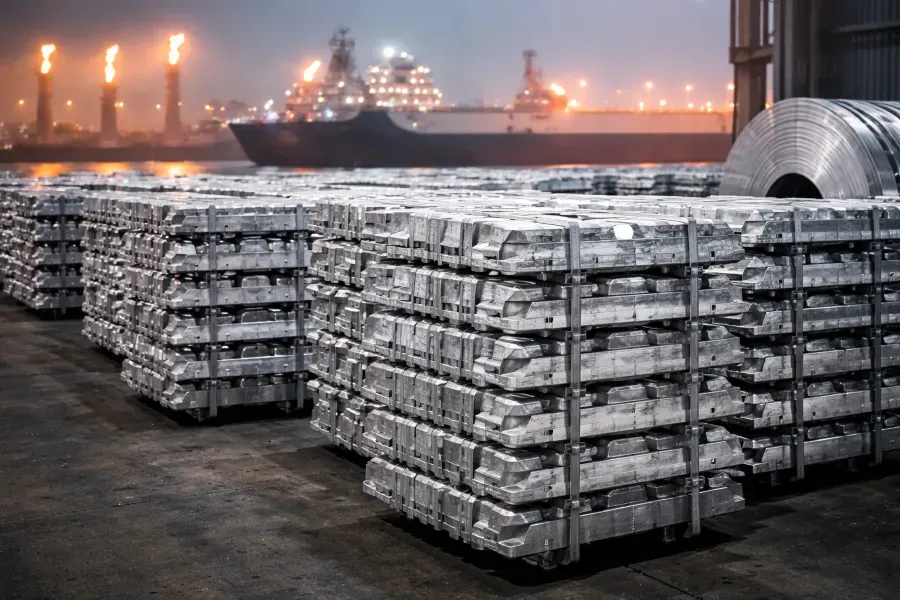
Abu Dhabi | EcoPulse24
The war in the Gulf is disrupting the region’s role as a key source of future aluminum supply, raising the risk of sustained price increases as production halts and expansion plans become increasingly uncertain, according to Goldman Sachs.
Gulf’s aluminum expansion outlook deteriorates amid conflict
The Gulf region, which accounts for roughly 20% of global aluminum production outside China, had been expected to drive the next wave of capacity growth due to its structural energy cost advantage. However, the ongoing conflict has significantly clouded that outlook, complicating both current operations and future expansion plans.
Iran strike forces shutdown at key UAE aluminum facility
The disruption intensified after an Iranian strike forced Emirates Global Aluminium (EGA) to halt operations at its Al Taweelah smelter in Abu Dhabi. The attack damaged power infrastructure, triggering an uncontrolled shutdown in which molten aluminum solidified within processing equipment.
Emirates Global Aluminium today announced that the company’s Al Taweelah site sustained significant damage during the Iranian missile and drone attacks at Khalifa Economic Zone Abu Dhabi. Assessment of the damage is ongoing.
EGA’s Al Taweelah smelter produced 1.6 million tonnes of cast metal in 2025. EGA had substantial metal stock on the water when the conflict began, and stock on the ground in some overseas locations.
source:EGA
Restart delays signal prolonged supply disruption
Such shutdowns, commonly referred to as “pot freeze” events, can take between six and eight months to reverse, according to Goldman Sachs. This creates not only immediate supply constraints but also extended production losses, tightening the global aluminum market.
Hormuz disruption raises broader regional supply risks
The effective closure of the Strait of Hormuz adds another layer of risk, threatening the flow of raw materials and accelerating inventory drawdowns across the region. This raises the likelihood of additional production disruptions beyond a single facility.
Aluminum prices surge as market reprices structural risk
Aluminum prices in London climbed to their highest closing level in four years following the Iranian strike, returning to levels last seen after the outbreak of the war in Ukraine. The move signals that markets are pricing not just current disruptions, but the potential loss of future supply growth.
Recent price action shows that aluminum remains elevated despite short-term pullbacks, reflecting persistent supply-side risk.
Markets continue to price structural disruption rather than temporary volatility, keeping the broader trend firmly upward.
| Indicator | Value |
|---|---|
| Aluminum Price | $3,468.23 |
| Daily Change | -55.57 |
| Daily Change (%) | -1.58% |
| Monthly Change | +5.82% |
| Yearly Change | +41.21% |
| Last Update | Apr 02 |
Goldman Sachs warns of long-term pricing pressure
Goldman Sachs noted that the Gulf had been expected to host new smelter capacity to meet global demand growth. With that trajectory now uncertain, the bank warns that long-term price risks are skewed to the upside as supply expansion becomes more constrained.
| Indicator | Value |
|---|---|
| Gulf Share of Global Production (ex-China) | 20% |
| Smelter Restart Time | 6 – 8 months |
| London Aluminum Prices | 4-year closing high |
| Disruption Cause | Iranian strike and power loss |
| Key Risk | Supply shortage and higher prices |
EcoPulse24 Analysis
The disruption in the Gulf aluminum sector represents more than a temporary production shock - it marks a structural break in the global supply narrative. According to Goldman Sachs’ Trina Chen, the region was not only a major producer but also the most viable source of future capacity expansion due to its energy advantage. The conflict has therefore impacted both current output and the pipeline of future supply.
This dual shock is critical. Markets are no longer reacting solely to the shutdown of a single facility, but to the erosion of the Gulf’s role as the marginal supplier of global aluminum growth. As a result, price formation is shifting from cyclical demand dynamics to structural supply constraints.
The impact extends beyond aluminum itself. The shutdown of energy-intensive smelting capacity raises costs across downstream industries including automotive, construction, aerospace, and packaging. At the same time, investment decisions are being repriced, as geopolitical risk becomes a central factor in capital allocation for new industrial projects in the region.
Potential alternatives - such as increasing output in other regions, drawing down inventories, or boosting recycling - face significant limitations. Europe remains constrained by high energy costs, while new capacity elsewhere requires long lead times and substantial capital. Recycling can partially offset supply pressure but cannot fully replace primary production at scale.
In this context, the Strait of Hormuz emerges as a critical systemic chokepoint, linking energy security directly to metals production. The current environment suggests that aluminum is transitioning into a geopolitically sensitive commodity, where supply stability is increasingly tied to regional security conditions rather than purely economic factors.
Sources & References
Editorial Note
Disclaimer
© 2025 EcoPulse24. All rights reserved.