India's Trade Deficit Widens to $34.68 Billion Amid Rising Imports and Unemployment Despite Stock Market Recovery
India's trade deficit hit $34.68B in Jan 2026 amid rising imports and unemployment, despite a stock market rebound and new US/EU trade deals.

New Delhi | EcoPulse24
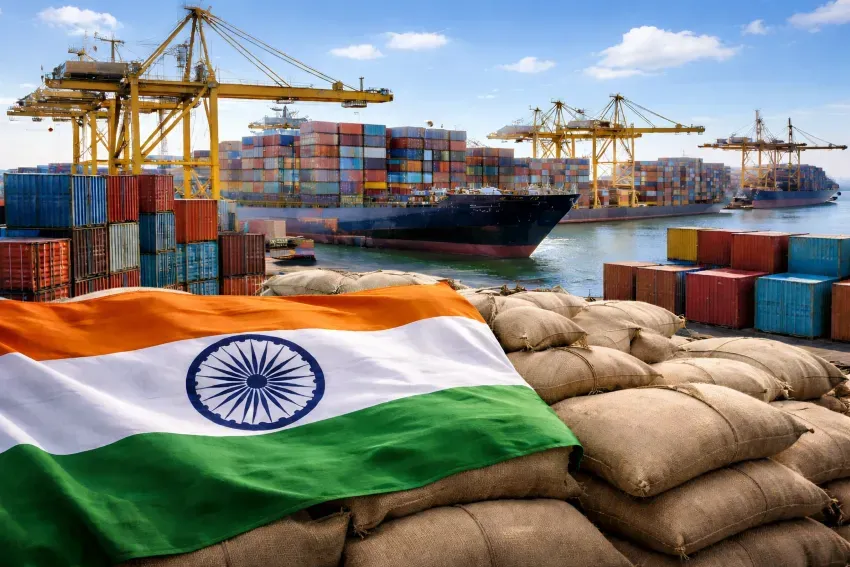
India's trade deficit widened to $34.68 billion in January 2026, marking one of the largest goods balance gaps in recent months. This development coincides with major political and trade maneuvers as India seeks to reposition itself within global supply chains. The deficit far exceeded market forecasts of $26 billion and was up from $23.43 billion in January 2025, registering the second-highest gap since the record $41.68 billion in October.
The pressure came from imports, which surged 19.2% year-on-year to $71.24 billion, driven by increased purchases of gold and silver. In contrast, exports rose only 0.6% to $36.56 billion, highlighting a clear imbalance between external and domestic/investment demand.
This growing deficit occurred just weeks before New Delhi finalized a provisional trade deal with the US, under which President Donald Trump reduced tariffs on Indian goods to 18% from 50%, offering exporters significant relief. In return, India agreed to cut Russian oil imports and double its annual purchases of US goods. The deal was followed by a trade understanding with the EU, reflecting India's strategy to diversify its trading partners and reduce single-source geopolitical dependencies.
On the financial markets side, the BSE Sensex closed Monday up 0.8% at 83,277 points, ending a three-session losing streak. Energy stocks led gains, with Power Grid up 4.6% and NTPC up 1.6%, amid continued strong demand for electricity and infrastructure. Banks also supported performance, with HDFC Bank up 2.3%, Axis Bank up 1.9%, and Bajaj Finserv up 1.3%. In contrast, technology shares remained under pressure following last week's selloff over concerns about AI's impact on traditional business models, with Tech Mahindra falling 1.4%.
Paradoxically, the stock market's recovery coincided with signs of labor market weakness. Unemployment rose to 5.0% in January from 4.8% in December, surpassing market expectations. Urban unemployment increased to 7.0% from 6.7%, and rural unemployment to 4.2% from 3.9%. Notably, female unemployment accelerated, reaching 9.8% in cities (up from 9.1%) and 4.3% in rural areas (up from 3.6%). The employment rate declined to 53.1% from 53.4%, and labor force participation fell to 55.9% from 56.1%, indicating a slight cooling in labor market dynamics.
A broader analysis reveals an economy in a delicate transition phase. Strong domestic demand and rising imports reflect robust consumption and investment activity, but put pressure on the current account and increase the rupee's sensitivity to external shocks. Meanwhile, new trade openings with the US and EU could boost industrial and service exports in the medium term, especially in technology, pharmaceuticals, and automotive sectors.
The central challenge for policymakers is to balance three fronts: managing the trade deficit, stimulating growth without triggering inflationary pressures, and maintaining labor market stability. If India can translate new trade agreements into tangible export flows, the current deficit may prove cyclical, tied to an investment expansion, rather than a permanent structural imbalance.
However, if imports continue to significantly outpace exports while the labor market slows, the Reserve Bank of India may be forced to tighten monetary policy or intervene to support the currency, potentially impacting stock valuations.
In summary, while India's financial markets show resilience, the economy faces clear external imbalances and underlying labor market pressures. The coming period will determine whether New Delhi can turn its geopolitical repositioning into sustainable economic gains.
Explore Related Coverage
Sources & References
Editorial Note
Disclaimer
© 2025 EcoPulse24. All rights reserved.