Microsoft Unveils Majorana 2 Quantum Chip, Targets Scalable Quantum Computing by 2029
Delivers a 1,000-fold improvement in qubit reliability compared with its predecessor and has prompted Microsoft to accelerate by 2029.

Seattle | EcoPulse24
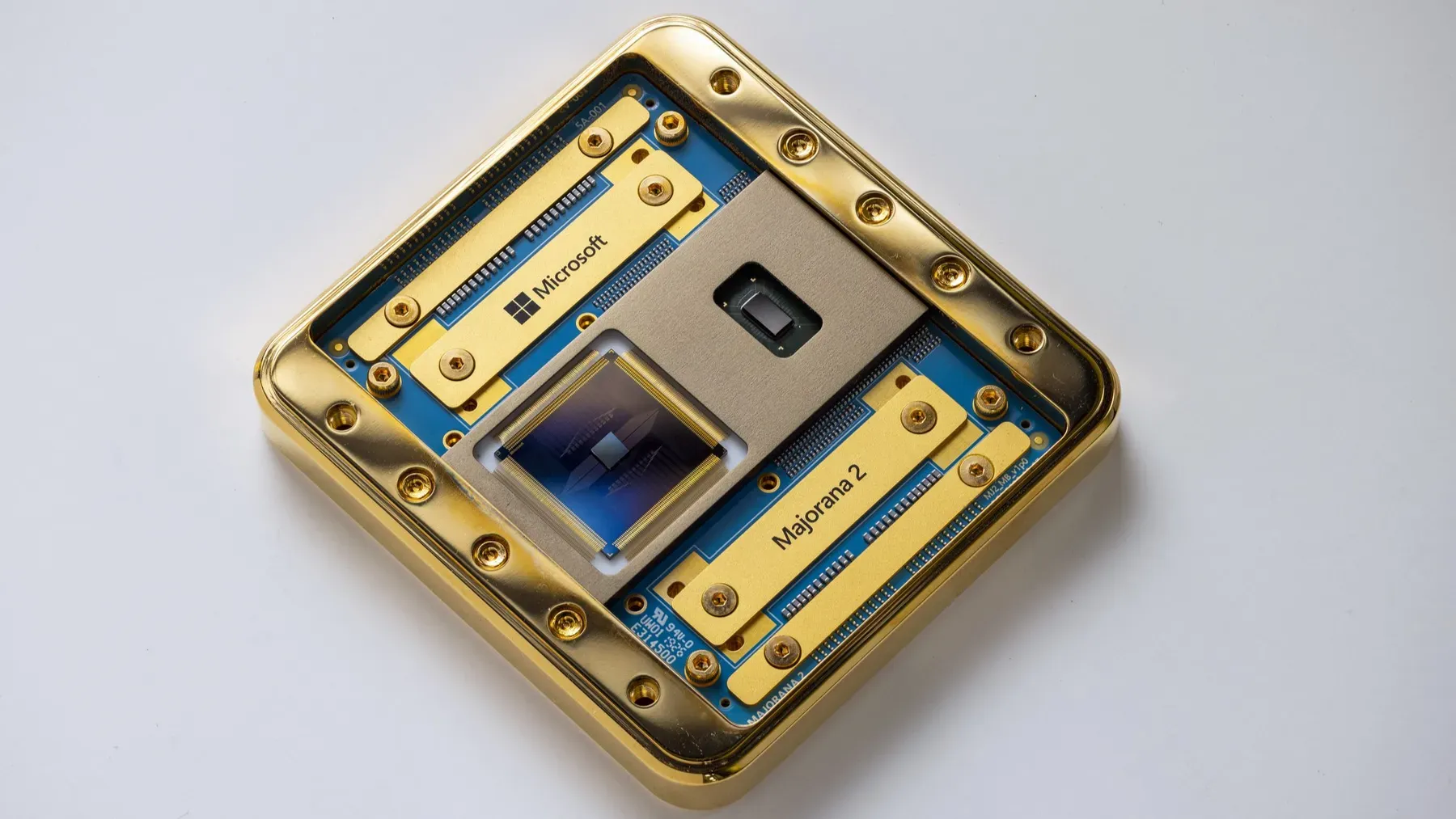
Microsoft has unveiled Majorana 2, the next generation of its topological quantum computing platform, marking a significant milestone in the company’s long-term effort to build a commercially viable quantum computer. The new chip delivers a 1,000-fold improvement in qubit reliability compared with its predecessor and has prompted Microsoft to accelerate its roadmap toward scalable quantum computing by 2029.
The announcement coincided with the general availability of Microsoft Discovery, the company’s AI-powered scientific research platform, whose agentic AI capabilities played a key role in accelerating the development of the new quantum architecture.
Qubit Reliability Improved by 1,000 Times
According to Microsoft, Majorana 2 incorporates a new materials stack that dramatically increases the stability of topological qubits, the fundamental building blocks of quantum computers.
The company reported an average qubit lifetime of 20 seconds, with some qubits remaining stable for as long as one minute. This represents a substantial leap from conventional quantum approaches, where qubit lifetimes are often measured in microseconds.
Microsoft compared the breakthrough to developing a smartphone battery capable of lasting nearly three years on a single charge instead of one day, illustrating the scale of the improvement in quantum stability.
Accelerating the Roadmap to Commercial Quantum Computing
Microsoft said the combination of higher reliability, operation speeds measured in one microsecond, and qubit dimensions of approximately one-hundredth of a millimeter has placed the project on a path toward a scalable quantum computer with commercial value by 2029.
The company noted that this timeline represents a major acceleration compared with earlier projections, effectively cutting its original roadmap in half.
“We need to make improvements each year that will get us closer to delivering a computer that we believe will have massive commercial and societal value,” said Chetan Nayak, Microsoft Technical Fellow and a leader of the quantum program. “Where are we relative to last year? We’re 1,000 times better.”
Agentic AI Becomes Central to Quantum Research
Microsoft revealed that agentic AI has become deeply integrated into the company’s quantum research workflow.
Scientists and engineers have been using Microsoft Discovery to automate measurements, optimize fabrication processes, manage research workflows, identify previously unnoticed defects, and generate new scientific hypotheses.
According to Nayak, AI agents now serve as a natural extension of the research process, helping teams analyze information, synthesize findings, and accelerate experimentation across multiple disciplines.
New Materials Drive Majorana 2 Improvements
One of the most significant engineering changes in Majorana 2 is the replacement of aluminum with lead in the chip’s superconducting structure.
Microsoft said lead provides stronger shielding against cosmic disturbances and environmental interference that can destabilize fragile quantum states. While the transition required years of experimentation to overcome technical tradeoffs, it ultimately resulted in major gains in device performance and reliability.
The company also highlighted the growing role of AI-driven simulations in identifying optimal material compositions and accelerating manufacturing decisions.
AI Unlocks Insights from Decades of Research Data
Microsoft’s quantum program has accumulated nearly two decades of scientific and engineering data spanning multiple disciplines, including physics, materials science, software development, fabrication, and mechanical engineering.
The company said AI agents are now helping researchers identify patterns and correlations that would be difficult for any individual scientist to detect, effectively connecting knowledge across previously isolated data sources.
Microsoft emphasized that AI serves as a decision-support tool rather than an autonomous decision-maker, maintaining what researchers describe as a “scientist-in-the-loop” model.
Microsoft Discovery Expands Beyond Internal Research
Alongside Majorana 2, Microsoft announced the general availability of Microsoft Discovery, a platform designed to help organizations accelerate frontier research and development through AI-powered scientific workflows.
The platform combines specialized AI research agents, reasoning engines, enterprise-grade security controls, governance tools, and transparency mechanisms to support advanced scientific exploration.
Microsoft also introduced an early-preview version of the Microsoft Discovery application, allowing individuals to download and run core capabilities locally using a GitHub Copilot account, lowering barriers to AI-assisted scientific research.
EcoPulse24 Analysis
Majorana 2 represents more than a hardware upgrade. It illustrates the growing convergence between quantum computing and agentic artificial intelligence, two technologies increasingly viewed as foundational to the next era of scientific and industrial innovation.
Microsoft’s latest announcement suggests that AI is evolving beyond productivity assistance into a direct contributor to scientific discovery, helping researchers manage complexity, accelerate experimentation, and uncover insights hidden within massive datasets.
If Microsoft achieves its goal of delivering a scalable quantum computer by 2029, the implications could extend across pharmaceuticals, advanced materials, energy systems, logistics optimization, cybersecurity, and global supply chains.
The announcement also strengthens Microsoft’s position in the global quantum race against competitors such as IBM and Google, highlighting a future where leadership may depend not only on quantum hardware advances but also on how effectively companies combine AI and quantum technologies to accelerate real-world innovation.
Explore Related Coverage
Sources & References
Editorial Note
Disclaimer
© 2025 EcoPulse24. All rights reserved.