Oil Climbs Above $92 as US Strikes on Iran Trigger Global Risk-Off Shift Across Markets
Oil prices rebounded sharply while US stock futures and Japanese equities moved lower after the United States launched new military strikes on Iran

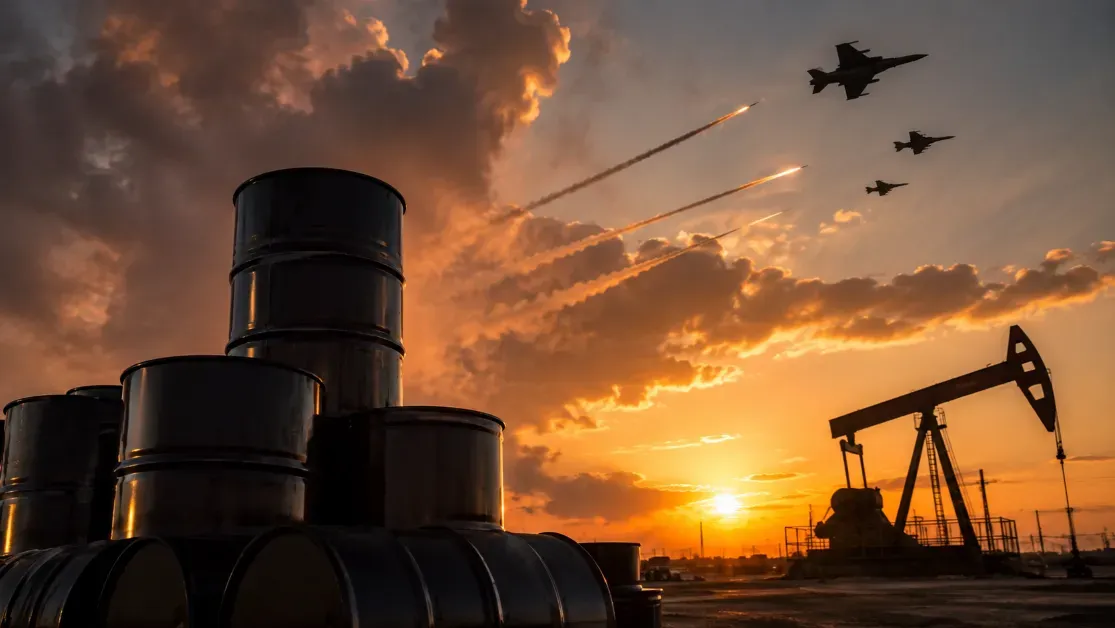
New York | EcoPulse24
Oil prices rebounded sharply while US stock futures and Japanese equities moved lower after the United States launched new military strikes against Iran, reigniting geopolitical concerns across global markets and raising fresh questions about the durability of the recently announced ceasefire between Israel and Iran.
The renewed escalation pushed investors back toward a risk-off stance, lifting energy prices and pressuring equities ahead of key US inflation data and growing uncertainty over the outlook for Middle East stability.
US Launches New Strikes Against Iran Following Helicopter Incident
The latest market reaction followed confirmation from the US military that President Donald Trump ordered what officials described as "self-defense strikes" against Iranian targets after an American Apache helicopter was shot down.
Iranian Foreign Minister Abbas Araghchi responded by stating that Iran's armed forces would not leave any attack or threat unanswered, raising concerns that the latest military exchange could undermine efforts to stabilize the region following recent ceasefire discussions.
The development marked a significant shift in sentiment only one day after markets had welcomed signs of de-escalation between Israel and Iran.
Brent and WTI Rebound as Energy Traders Reprice Geopolitical Risk
Brent crude rose above $92 per barrel while US crude climbed above $89 per barrel, recovering part of Tuesday's steep losses.
Oil markets had fallen sharply after Israel and Iran agreed to suspend hostilities earlier in the week, with traders initially betting that the risk of supply disruptions across the Gulf would ease.
However, the new US strikes forced energy markets to reassess geopolitical risk premiums tied to Middle East supply security and the future stability of shipping routes linked to the Strait of Hormuz.
Additional support came from US inventory data published by the American Petroleum Institute (API), which showed crude oil inventories fell by 9.1 million barrels last week to their lowest level in four months.
The decline suggests buyers continue to secure replacement supplies following disruptions and uncertainty across regional energy trade routes.
US Futures Turn Lower as Investors Seek Safety
The geopolitical escalation weighed on sentiment across US equity futures.
Futures linked to major US indices moved lower as investors balanced the implications of higher oil prices, renewed geopolitical uncertainty and the upcoming release of US inflation data.
Markets are also reassessing the Federal Reserve outlook after stronger-than-expected employment data reinforced expectations that interest rates could remain elevated for longer than previously anticipated.
The technology sector remained under pressure, with semiconductor shares continuing a volatile correction after months of AI-driven gains.
Investors increasingly fear that valuations across parts of the semiconductor industry may have advanced faster than underlying earnings expectations.
Japanese Equities Retreat as Technology Shares Lead Losses
Asian markets reacted negatively to the renewed tensions.
Japan's Nikkei 225 fell 1.2%, while the broader Topix index lost 0.4%, reversing part of the previous session's gains.
Technology and semiconductor-linked companies led the decline, including SoftBank Group, Fujikura, Murata Manufacturing, Taiyo Yuden and Kioxia Holdings.
The selloff reflected both geopolitical concerns and broader weakness across global technology shares.
Separately, Japan's wholesale inflation accelerated to 6.3% year-over-year in May, the fastest pace in more than three years, highlighting the growing impact of higher energy costs on the country's economy.
Rising Oil Prices Add Complexity to Inflation Expectations
The renewed jump in crude prices arrives at a sensitive moment for central banks and financial markets.
Higher energy costs risk feeding into transportation, manufacturing and consumer prices globally, potentially slowing the pace of disinflation that policymakers have been seeking.
For the Federal Reserve, another period of sustained energy inflation could complicate decisions surrounding future interest-rate policy, particularly if headline inflation begins to reaccelerate alongside resilient labor market conditions.
Market Snapshot
| Asset | Latest Move |
|---|---|
| Brent Crude | Above $92 |
| WTI Crude | Above $89 |
| US Stock Futures | Lower |
| Nikkei 225 | -1.2% |
| Topix | -0.4% |
| US Crude Inventories | -9.1 Million Barrels |
Why Markets Are Reacting So Strongly
The latest moves reflect more than a military incident.
Investors are attempting to price the possibility that the conflict could evolve from a regional confrontation into a prolonged period of instability affecting energy infrastructure, shipping lanes and global inflation expectations.
The Strait of Hormuz remains one of the world's most important energy corridors, handling a significant share of global oil and LNG exports. Any renewed threat to maritime traffic through the waterway immediately affects commodity markets and investor sentiment worldwide.
EcoPulse24 Analysis
The significance of today's market reaction extends beyond the immediate rise in oil prices. Financial markets are beginning to reprice geopolitical risk after briefly assuming that the Israel-Iran conflict was moving toward de-escalation.
Energy markets reacted first because crude oil remains the most direct transmission channel between Middle East instability and the global economy. The rebound above $92 in Brent reflects concerns that supply security remains vulnerable despite recent diplomatic efforts.
The second transmission channel is inflation. Higher oil prices increase transportation and production costs across multiple sectors, creating the risk that inflation remains elevated for longer than central banks currently expect. This dynamic is particularly important in the United States, where investors are already debating the timing and magnitude of future Federal Reserve policy moves.
The third transmission channel is risk appetite. Equity markets tend to react negatively when geopolitical uncertainty rises because investors demand a higher risk premium for holding growth-sensitive assets. The weakness in US futures and Japanese equities illustrates how quickly global capital shifts toward a defensive posture when conflict risks intensify.
At the same time, falling US crude inventories reinforce the view that physical oil markets remain tighter than many expected. When supply disruptions coincide with lower inventories, commodity markets become more sensitive to geopolitical headlines and price volatility increases.
Taken together, the latest developments suggest that global markets have entered a new phase where geopolitical risk, energy security and inflation expectations are once again becoming closely linked. As long as uncertainty surrounding US-Iran relations persists, oil markets are likely to remain the primary barometer of investor confidence and broader macroeconomic stability.
Explore Related Coverage
Sources & References
Editorial Note
Disclaimer
© 2025 EcoPulse24. All rights reserved.