UAE Tops Global AI Adoption for Third Consecutive Quarter - First Economy to Break 70%
UAE leads global AI adoption at 70.1%, first to surpass 70%, far above 17.8% global average, driven by major Microsoft investment.

EcoPulse24 | Dubai
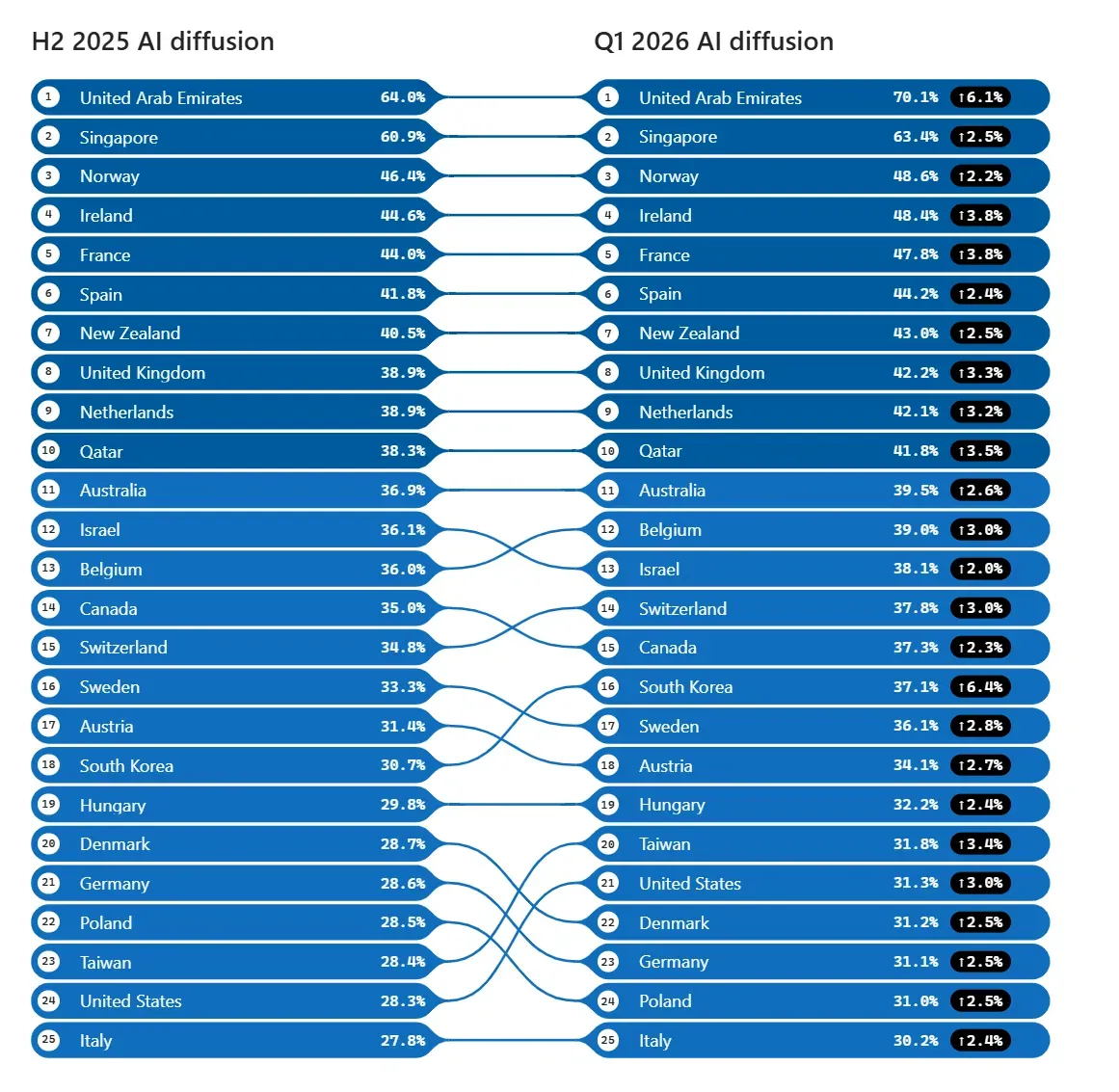
The United Arab Emirates has retained its position as the world's leading economy in AI adoption for the third consecutive quarter, reaching 70.1% of the working-age population - becoming the first economy globally to cross the 70% threshold, according to Microsoft's AI Diffusion Report for Q1 2026.
Key Figures - Source: Microsoft AI Diffusion Report Q1 2026
| Item | Detail |
|---|---|
| UAE AI adoption rate | 70.1% |
| Global ranking | 1st - third consecutive quarter |
| Global average | 17.8% |
| UAE adoption trajectory | 59.4% → 64% → 70.1% |
| Microsoft UAE commitment | $15.2 billion |
| Expected economic contribution | $74.4 billion |
| Jobs supported | 152,000+ |
| AI skills training target | 1 million learners by 2027 |
| Microsoft Elevate UAE beneficiaries | 250,000 students & teachers + 55,000 government employees |
| Microsoft presence in UAE | 30+ years |
| Cloud regions | Abu Dhabi and Dubai + redundancy zones |
A Record No Economy Has Matched
The report, published by Microsoft's AI Economy Institute and drawing on aggregated data across more than 100 global markets, places the UAE's AI adoption rate at nearly four times the global average of 17.8%. The progression tells the story of sustained, deliberate investment: from 59.4% to 64% to 70.1% - each step reflecting deepening integration of AI into the UAE's workforce, education system, and institutional fabric.
The Foundation Behind the Numbers
Amro Kamel, Managing Director of Microsoft UAE, attributed the result to long-term investment in the right foundations. "This growth reflects deliberate, long-term investment in the right foundations, even during more challenging periods," he said. "The credit belongs to the UAE - its government, institutions, businesses, and people who have made AI part of how they work and learn."
Microsoft has operated in the UAE for more than three decades, supported by a cloud infrastructure comprising two regions in Abu Dhabi and Dubai with multiple redundancy zones, and a sovereign cloud collaboration with G42 and Core42 supporting public sector and regulated industries.
Skills at Scale
Under its $15.2 billion commitment to the UAE spanning AI infrastructure, skills, and innovation, Microsoft is targeting one million AI-skilled learners by 2027 - a goal expanded through Microsoft Elevate UAE to reach more than 250,000 students and teachers and over 55,000 government employees. Microsoft and its partners are projected to contribute $74.4 billion to the UAE economy and support more than 152,000 jobs in the years ahead.
The Global Divide
Globally, the report highlights a widening gap between high-income and lower-income regions, with AI adoption growing more than twice as fast in wealthier markets. Digital connectivity, infrastructure, and AI capability in local languages are identified as the primary barriers to equitable diffusion.
Explore Related Coverage
Sources & References
Editorial Note
Disclaimer
© 2025 EcoPulse24. All rights reserved.