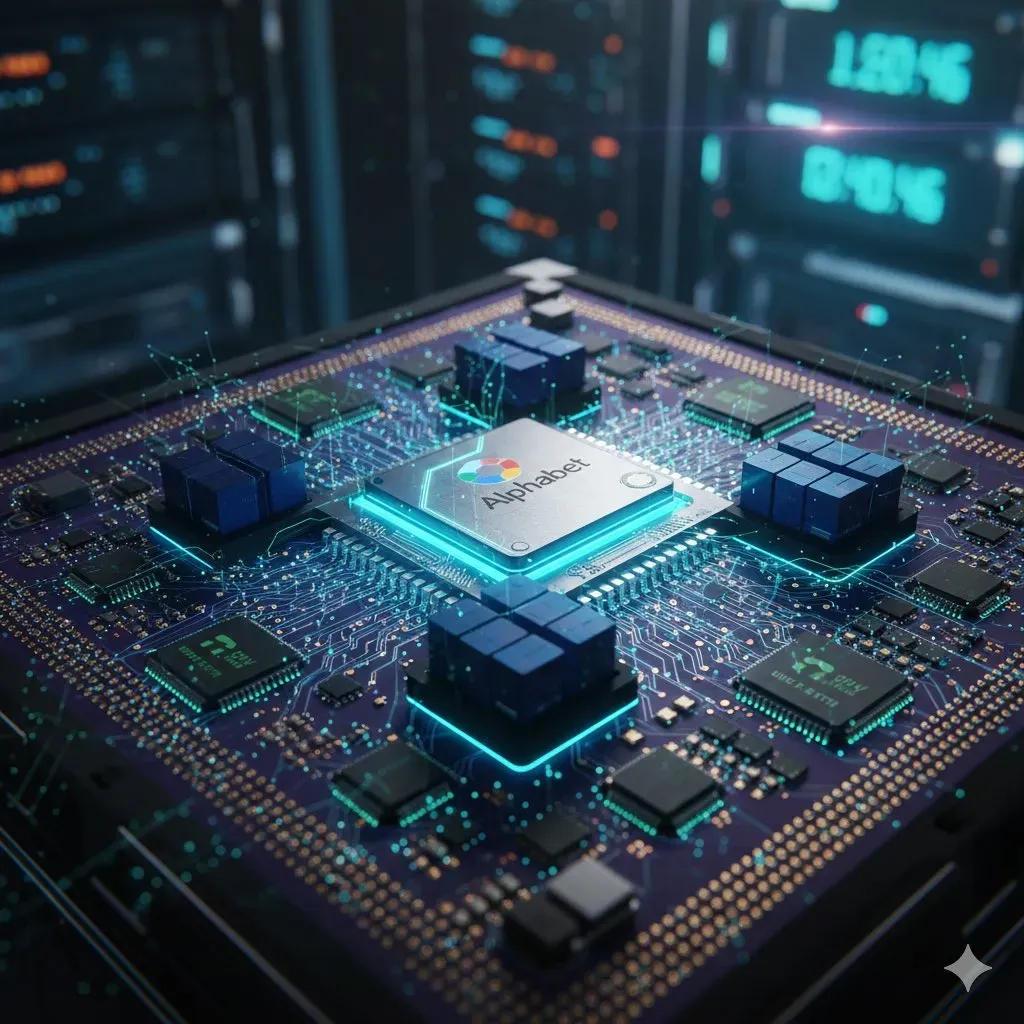
From Classified Project to Nvidia's Biggest Threat
November 25, 2025 - In a stunning turn of events that sent shockwaves through the semiconductor industry this morning, Meta is considering using Google's tensor processing units in its data centers starting in 2027, a move that caused Nvidia shares to fall 4% while Alphabet gained over 4%. This marks a historic inflection point in the AI chip wars - the moment when Google's decade-long secret weapon finally emerged as a genuine threat to Nvidia's seemingly unbreakable monopoly.
The Secret Birth of the TPU (2013-2016)
The Crisis That Changed Everything
In 2013, Google's engineers conducted internal simulations that revealed a looming infrastructure catastrophe. Their projections showed that if every Google user activated voice search for just three minutes daily, the company would need to double its entire global data center GPU fleet simply to handle speech recognition inference. This wasn't a hypothetical scenario - it was an imminent business risk as AI capabilities expanded across Google's product ecosystem.
The numbers were staggering enough to reach the C-suite. Then-CEO Larry Page and Jeff Dean, Google's legendary Senior Fellow, made a decision that would reshape the AI hardware landscape: Google would design and manufacture its own custom silicon. The project was classified at the highest level - even most Google employees remained unaware of its existence for years.
The Architect Behind the Revolution
Norman P. Jouppi, who joined Google in 2013, has been the tech lead for Google's Tensor Processing Units since their inception. Jouppi wasn't a random hire - he was one of the principal architects of the legendary MIPS microprocessor at Stanford University and had spent decades at HP and Compaq's Western Research Laboratory pioneering innovations in computer memory systems and microprocessor design.
Jouppi holds more than 125 U.S. patents and has published over 125 technical papers with several best paper awards. He is a Fellow of the ACM, IEEE, and AAAS, and a member of the National Academy of Engineering. When Jeff Dean recruited him with the pitch, "each time we try deep learning on something new, it works," Jouppi assembled a dream team of chip designers quietly poached from AMD, Broadcom, and Intel.
The team included Cliff Young, Nishant Patil, and Turing Award winner David Patterson (co-creator of RISC architecture). On the software side, Google's XLA compiler team, influenced by Chris Lattner (creator of LLVM and Swift), built the infrastructure to make TPUs programmable and efficient.
TPU v1 (2016): The World's First Production AI ASIC
On May 18, 2016, at Google I/O, the company made a stunning announcement: they had been running a custom AI chip in production for over 18 months. The first-generation TPU was a pure-inference accelerator delivering 92 tera-operations per second at 8-bit integer precision while consuming only 40 watts.
But here's what shocked the industry: Google revealed that the TPU had been used in AlphaGo's matches against Lee Sedol, processed all Google Street View text in under five days, handled over 100 million Google Photos per day on a single TPU, and powered RankBrain for search results. Every Google Search query, every Gmail spam filter decision, every Street View enhancement - all had been running on TPUs while the world thought Google used Nvidia GPUs.
This was the first time any company had shipped a custom AI chip at hyperscale. Nvidia's dominance suddenly looked vulnerable.
The Evolution: From Inference to Training Supercomputers
TPU v2 and v3 (2017-2018): Entering the Training Game
Unlike the first generation, TPU v2 added full training capabilities with bfloat16 support. A single TPU v3 pod delivered over 100 petaflops of aggregate performance in 2018, surpassing every GPU supercomputer on the Top500 list at that time. Google Cloud made these available to external customers in 2018, marking the first public cloud AI supercomputer built on non-Nvidia silicon.
TPU v4 (2021): The Performance Breakthrough
Google released its seventh generation TPU, Ironwood, in November 2025, a decade after making its first custom ASIC for AI in 2015. The v4 generation delivered 275 TFLOPS of bfloat16 compute per chip and 1.1 exaflops in a full pod. Published peer-reviewed papers demonstrated TPU v4 trained ResNet-50 1.6× faster than Nvidia A100 clusters while using 15-30% less power.
TPU v5 and Ironwood (v7): The Current Generation
Ironwood is four times faster than its predecessor and uses 30% less power. It comes with 192 gigabytes of fast-access memory per chip, six times more than the previous generation. Most critically for Google's competitive position, Ironwood pods can connect up to 9,216 units sharing 1.77 petabytes of memory.
Why Meta Is Ditching Nvidia for Google TPUs
The Multibillion-Dollar Deal
The ongoing negotiations involve Meta renting Google Cloud Tensor Processing Units in 2026, before purchasing them outright in 2027, in a deal worth billions to both firms. Google Cloud executives estimate that expanding TPU adoption could help the company capture up to 10% of Nvidia's annual revenue, worth billions of dollars.
This isn't a minor diversification play. Meta currently spends between $70-72 billion annually on AI infrastructure, making it one of Nvidia's largest customers. Even a partial shift to TPUs represents a seismic change in the market dynamics.
The Three Reasons Meta Chose TPUs
1. Price Advantage
Google Cloud's published TPU v5p on-demand pricing is approximately $2.20 per chip-hour versus Nvidia H100 at $3.99-$4.50 as of November 2025. For Meta's scale, this price difference translates to billions in annual savings.
2. Energy Efficiency
The flagship Gemini 3 model trained primarily on TPUs demonstrates Google's processors offer energy efficiency and cost effectiveness advantages over GPUs. TPUs are cheaper to use than Nvidia's offerings, and power costs at data center scale make efficiency a critical competitive factor.
3. Supply Security
Google manufactures its own chips through partnerships with TSMC and Broadcom, meaning customers aren't constrained by Nvidia's allocation queues. In a market where AI chip supply remains severely constrained, guaranteed access is worth paying for.
The Anthropic Validation: One Million TPUs
In October 2025, Google and Anthropic announced what may be the most significant AI infrastructure deal in history. Anthropic will have access to up to one million TPU chips in a deal worth tens of billions of dollars, bringing well over a gigawatt of compute capacity online in 2026.
Anthropic's annual revenue run rate is approaching $7 billion, and Claude powers more than 300,000 businesses - a 300× increase over the past two years. The company's choice of TPUs over Nvidia GPUs wasn't ideological - it was economic. Anthropic chose TPUs due to their price-performance and efficiency, and the company's existing experience in training and serving its models with TPUs.
Industry analysts estimate that one gigawatt of data center capacity costs approximately $50 billion, with roughly $35 billion allocated to chips. This makes the Anthropic-Google deal potentially the largest single AI chip procurement in history.
Apple's Billion-Dollar Dependency on Google AI
While Meta and Anthropic grab headlines for their TPU adoption, Apple has been quietly paying Google for AI technology for years. Apple is planning to pay about $1 billion a year for a 1.2 trillion parameter artificial intelligence model developed by Google to help run its overhaul of the Siri voice assistant.
After testing models from OpenAI, Anthropic, and Google, Apple chose to move forward with Google. What reportedly tipped the scales towards Google wasn't model performance, but rather the price tag.
The technical specifications reveal Apple's desperation: Apple's in-house cloud-based model has 150 billion parameters, while Google's custom model has 1.2 trillion parameters - roughly eight times more complex. Google's Gemini model will handle Siri's summarizer and planner functions, helping the voice assistant synthesize information and execute complex tasks.
This arrangement exposes a critical weakness in Apple's AI strategy: despite spending billions on in-house development, they're a generation behind Google's capabilities and must rent their competitor's technology to remain competitive.
The Technical Edge: Why TPUs Beat GPUs
Purpose-Built vs. General Purpose
TPUs were designed from the ground up to be optimized for machine learning and nothing else, while GPUs carry baggage from multiple application domains including graphics and high-performance computing.
Google uses multidimensional tori which tensor computations map well to, avoiding the cost and power needed for more general-purpose interconnect switch networks. Google's most recent TPU (Ironwood) has a single core per reticle-sized chip versus CPUs with over 100 cores per chip and GPUs with thousands of thread units per chip.
The Software Unlock
The historic barrier to TPU adoption was Google's closed ecosystem. That's changing rapidly. Google has aimed to make its JAX software easier for developers by making TPUs operable via open-source software tied to PyTorch, overhauling error reporting, and introducing extensions for custom code.
JAX + XLA is now open-source and supports PyTorch via torch-xla. Major frameworks are no longer CUDA-only, breaking Nvidia's software moat.
Market Impact: The Numbers Don't Lie
Current Market Share
Nvidia leads the GPU market with approximately 80% share as of 2024, while TPUs account for about 3-4% of deployments. However, TPU installations are expected to reach 5-6% by 2025.
But these overall market share numbers mask the dramatic shifts happening at the high end. Google Cloud grew 34% year-over-year to $15.15 billion in Q3, the fastest growth among major hyperscalers. For large-scale training and inference - the most profitable segment of the AI chip market - TPUs are already claiming double-digit market share.
Production Scale
Google's TPU shipments are projected to reach 2.5 million units for full year 2025, with 1.8 million units shipped through Q3. The TPU V5 series accounts for 1.9 million units (76% of total volume), split between 1.2 million V5E units and 700,000 V5P units.
For 2025, Google TPU's average selling price maintains around $4,500, with V7 series models expected to command pricing near $10,000 for high-specification V7P units.
The Nvidia Response
During Nvidia's recent earnings call, CEO Jensen Huang was asked about custom chip competition. He responded by discussing inference difficulty and touted CUDA software as a selling point due to its common usage. This defensive posture marks a significant shift from Nvidia's previous dismissiveness of custom silicon.
Following reports of the Meta-Google TPU discussions, Nvidia shares slumped more than 4% while AMD fell over 5%. The market clearly views TPUs as a credible competitive threat.
The Broadcom Connection: Who Really Makes TPUs?
Broadcom is a co-developer of TPUs, translating Google's architecture and specifications into manufacturable silicon. It provides proprietary technologies such as SerDes high-speed interfaces, overseeing ASIC design, and managing chip fabrication and packaging through TSMC.
Broadcom, the custom chip specialist who partnered with Google to design TPUs, saw its stock climb about 4% on news of the Meta deal. Google is strengthening its in-house chip platform through a partnership with TSMC affiliate Global Unichip (GUC) on N3 and N5 process-node design services.
This partnership structure gives Google a critical advantage: they can scale TPU production independently of Nvidia's supply constraints while leveraging Broadcom's manufacturing expertise and TSMC's cutting-edge fabrication technology.
Can TPUs Really Kill Nvidia's Dominance?
The Bull Case: TPUs Are Already Winning
Price-Performance: At current cloud pricing, TPUs offer 40-50% lower cost per FLOPS than Nvidia H100s. For large enterprises spending billions on AI infrastructure, this difference is decisive.
Energy Efficiency: Independent measurements show TPUs achieve 2.9× better performance-per-watt than Nvidia Blackwell B200 on LLM inference.
Ecosystem Momentum: Chris Miller, author of "Chip War," told CNBC there's speculation that Google might open up access to TPUs more broadly. TPUs could claim a meaningful share of workloads that suit their architecture.
Major Customer Wins: Meta, Anthropic, and Apple represent three of the world's five largest AI infrastructure spenders. If these customers shift significant workloads to TPUs, Nvidia's growth trajectory faces serious pressure.
The Bear Case: Nvidia's Moat Remains Deep
Software Lock-In: CUDA remains the industry standard, with tens of thousands of developers and applications built around it. Nvidia's entrenched ecosystem, software stack, and huge installed base remain powerful advantages.
Flexibility: GPUs are flexible enough for adoption by many AI companies, while designing a custom ASIC has an upfront cost starting at tens of millions of dollars. Startups and mid-sized companies cannot afford custom silicon.
Market Expansion: The AI chip market is growing so rapidly that both Nvidia and Google can win. The AI accelerator market is projected to reach $83.25 billion by 2024, with a CAGR of 35.1% from 2024 to 2030.
Integration Challenges: Selling TPUs on-premise raises engineering, logistics, and support challenges that differ from cloud rentals, including integration with customers' stacks and validated software toolchains.
The Verdict: Not a Killer, But a Game-Changer
TPUs won't "kill" Nvidia in the sense of driving them out of business. Nvidia's 2024 data center revenue exceeded $90 billion, and demand for their chips remains insatiable. But what TPUs have already accomplished is ending Nvidia's monopoly pricing power and forcing true competition in the AI accelerator market.
Even a small shift in procurement patterns can influence revenue expectations for existing GPU suppliers, potentially leading to reduced pricing power for Nvidia if major customers gain viable alternatives.
The next 18 months will be critical. If Meta's 2027 TPU deployment succeeds, expect a flood of other hyperscalers to demand access. If Apple continues relying on Google AI instead of developing competitive in-house capabilities, it validates Google's technological lead. And if Anthropic's massive TPU infrastructure delivers on its performance and cost promises, the narrative will shift from "Can TPUs compete?" to "Why are you still overpaying for Nvidia?"
What This Means for the Future
For Google
The TPU strategy has evolved from internal optimization to a full-scale assault on Nvidia's dominance. Google Cloud executives estimate that expanding TPU adoption could allow the company to capture up to 10% of Nvidia's annual revenue. With Nvidia's data center revenue at roughly $90 billion annually, that's a $9 billion opportunity - larger than many entire semiconductor companies.
For Nvidia
The luxury of monopoly pricing is ending. Nvidia must now compete on price, efficiency, and supply availability. Their response - accelerating product cycles, deepening CUDA moat, and offering custom solutions - shows they take the threat seriously.
For the Industry
All major hyperscalers are now designing custom ASICs to lessen dependence on Nvidia, including Amazon's Trainium, Microsoft's Maia, and Meta's MTIA chips. The AI chip market is transitioning from Nvidia monopoly to oligopoly competition.
For AI Development
Lower chip costs accelerate AI democratization. If TPUs drive down inference costs by 40-50%, applications that were economically marginal become viable. That expands the AI market far beyond current mega-cap technology companies.
Conclusion: The Secret Is Out
For ten years, Google's TPU project remained largely invisible to the outside world - a secret weapon used only within Google's walls. Now, with the Meta negotiations, Anthropic's billion-dollar commitment, and Apple's dependence on Google AI, the secret is not just out - it's reshaping the entire AI infrastructure landscape.
Norman Jouppi and his team built something remarkable: custom silicon that matches or exceeds Nvidia's best chips while consuming less power and costing significantly less. The question is no longer whether TPUs can compete with GPUs. The question is how fast Nvidia can adapt to a market where it no longer sets prices unilaterally.
From a classified 2013 project to exaflop-scale systems powering the world's largest AI companies, Google's TPU has already changed the game. Whether it becomes the dominant platform or simply one of several competitive options, Nvidia's monopoly era is over.
The AI chip wars have truly begun.