Shell Challenges the EV Rulebook With ‘Triple 10’ Concept Car
Shell unveiled its Triple 10 electric concept car featuring sub-10-minute charging, higher efficiency and a significantly lower carbon footprint.

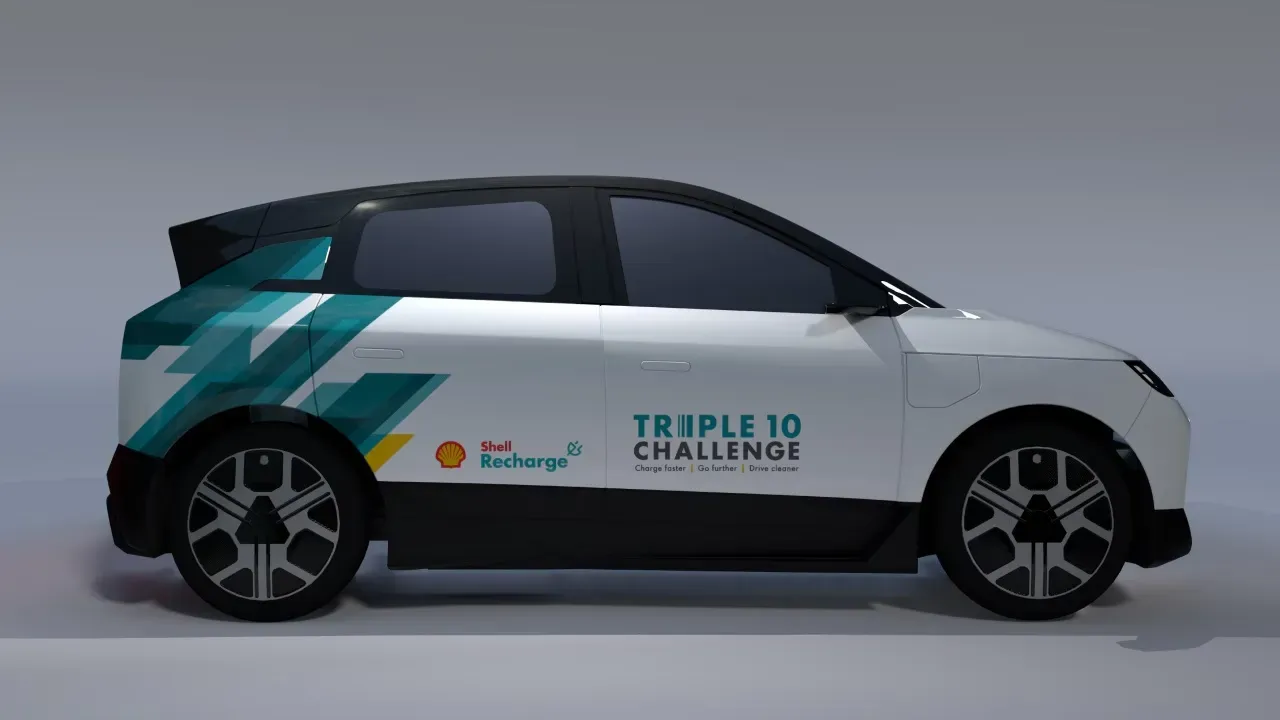
Oil Giant Bets on Smarter Cooling, Smaller Batteries and Faster Charging
London | EcoPulse24
In a move that could reshape assumptions about the future of electric vehicles, Shell has unveiled its Triple 10 Challenge Concept Car, a proof-of-concept battery electric vehicle designed around a simple proposition: the next generation of EVs may not require larger batteries or massive charging infrastructure, but rather smarter thermal engineering.
The concept vehicle pursues three ambitious objectives simultaneously:
-
Charge Faster: Reach 10% to 80% charge in less than 10 minutes.
-
Go Further: Deliver driving efficiency of 10 kilometers per kilowatt-hour.
-
Drive Cleaner: Reduce lifecycle emissions to approximately 10 tonnes of CO₂ equivalent.
The announcement marks one of Shell's most ambitious moves yet beyond traditional oil and gas, positioning the energy giant as an emerging player in the technologies underpinning electric mobility.
Faster Charging Without Ultra-Fast Infrastructure
According to Shell, the vehicle can charge from 10% to 80% in just 9 minutes and 54 seconds using a standard 175-kilowatt charger.
This is significant because many of today's fastest-charging electric vehicles require charging stations exceeding 300 kilowatts, infrastructure that remains relatively scarce and expensive to deploy globally.
Shell said the concept car can add approximately 24 kilometers of driving range per minute of charging, compared with an industry average of around 13 kilometers per minute on similar charging networks.
If proven commercially scalable, the approach could lower one of the largest barriers to mass EV adoption: access to ultra-fast charging infrastructure.
Smaller Batteries, Lower Costs
The Triple 10 Challenge concept seeks to improve efficiency rather than simply increase battery size.
Shell estimates the vehicle can achieve:
-
More than 30% improvement in overall energy efficiency compared with many current-generation EVs;
-
Approximately 25% lower battery pack costs;
-
A smaller and lighter battery system while maintaining practical driving capability.
The company believes future electric vehicles can become more affordable by optimizing system design and energy management instead of relying exclusively on increasingly larger batteries.
Cutting Carbon Across the Entire Vehicle Lifecycle
Shell estimates that the concept vehicle's lifecycle carbon footprint could be approximately 10 tonnes of CO₂ equivalent, representing around a 50% reduction compared with many battery electric vehicles currently sold in Europe.
The lower emissions profile is supported by:
-
Lightweight vehicle design;
-
Optimized battery capacity;
-
Low-carbon and recyclable materials;
-
Charging powered by renewable electricity.
The approach reflects a growing shift in the industry toward evaluating not only tailpipe emissions, but also the carbon footprint associated with manufacturing and operating electric vehicles.
The Technology: Immersive Thermal Management
At the center of the project is Shell's Recharge thermal fluid technology.
Instead of conventional water-glycol cooling systems, the concept uses a dielectric fluid capable of directly cooling battery components while also managing temperatures across motors and power electronics.
The simplified cooling architecture enables:
-
Faster charging capability;
-
Improved thermal stability;
-
Reduced vehicle weight;
-
Fewer components;
-
Lower manufacturing costs.
Shell said the system has successfully demonstrated the ability to manage extreme charging scenarios under real-world operating conditions.
Shell Expands Its EV Ambitions
Alongside the concept car, Shell announced the integration of its electric vehicle offerings under the Shell Recharge brand, combining:
-
Charging infrastructure;
-
Thermal fluids;
-
Battery solutions;
-
EV services.
The company also said it will retire the Shell EV-Plus brand as part of a broader strategy to offer integrated solutions for both consumer and commercial EV customers.
EcoPulse24 Analysis A New Direction for Electric Vehicles?
The significance of Shell's Triple 10 Challenge extends beyond the unveiling of another electric concept car.
For years, the electric vehicle industry has largely pursued a straightforward formula: larger batteries, larger charging stations and greater energy consumption.
Shell is proposing a different path.
The company is effectively arguing that future gains in electric mobility may increasingly come from thermal engineering, system integration and energy efficiency, rather than simply adding more battery capacity.
If the underlying technologies prove commercially viable at scale, the implications could be substantial.
Lower battery costs, reduced charging infrastructure requirements and smaller lifecycle emissions could make electric vehicles more affordable and easier to deploy across both developed and emerging markets.
Perhaps most importantly, the announcement highlights how traditional energy companies are redefining their role in the energy transition.
The future of mobility may not be determined solely by battery manufacturers and automakers. Increasingly, it may also depend on companies capable of optimizing the flow of heat, energy and materials across the entire electric vehicle ecosystem.
Sources & References
Editorial Note
Disclaimer
© 2025 EcoPulse24. All rights reserved.