South Korea's Economy Beats Q2 Growth Estimates as AI Chip Boom Drives Expansion
South Korea's Q2 GDP grew 0.6%, beating forecasts, as AI chip exports surged, raising chances of more interest rate hikes amid rising inflation.

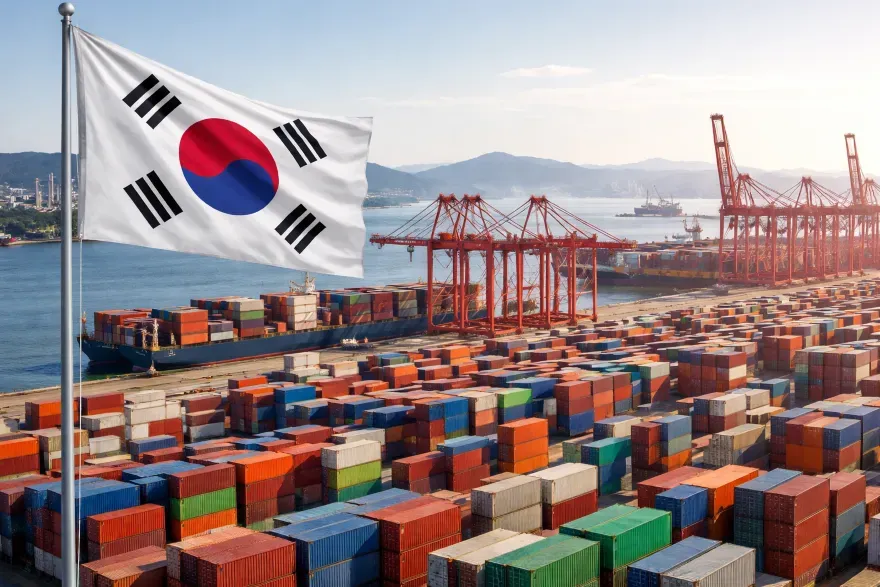
Seoul | EcoPulse24
South Korea's economy expanded faster than expected in the second quarter, supported by an artificial intelligence-driven semiconductor boom that strengthened exports and reinforced expectations that the country's central bank could raise interest rates again in the coming months.
Gross domestic product (GDP) grew 0.6% in the three months ended June compared with the previous quarter, according to preliminary data released Thursday by the Bank of Korea (BOK). The result exceeded the 0.4% median estimate in a Bloomberg survey of economists, following a revised 1.8% expansion in the January-March quarter.
Although growth slowed from the exceptionally strong first quarter, the latest reading extended a series of stronger-than-expected economic data that have prompted repeated upgrades to South Korea's economic outlook by the government, the central bank and the International Monetary Fund (IMF).
AI Chip Demand Continues to Power Growth
The Bank of Korea said exports increased 1.4% during the second quarter, driven primarily by stronger semiconductor shipments.
Imports rose 0.8%, reflecting higher purchases of motor vehicles, machinery and equipment.
The semiconductor industry remained the key engine of economic expansion as global demand for AI infrastructure continued to accelerate.
According to South Korea's trade ministry, semiconductor shipments surged approximately 163% during the first half of 2026 compared with a year earlier, already exceeding the record annual level recorded during all of 2025.
Computer exports also climbed 262%, highlighting continued demand for AI-related hardware.
Authorities said stronger AI-driven chip demand is increasingly spreading across the broader economy through higher corporate earnings, increased business investment, wage growth and stronger tax revenues, helping offset external economic headwinds.
Energy Costs Offset Part of the Gains
Economists had expected slower growth in the second quarter as the conflict involving Iran pushed energy prices higher.
South Korea remains one of the world's most energy import-dependent economies, making it particularly vulnerable to rising oil prices and higher import costs.
Those pressures offset part of the economic benefit generated by booming semiconductor exports.
Following the exceptionally strong first quarter, economists also expected quarterly growth to moderate as chip manufacturers struggled to expand production capacity quickly enough to satisfy rapidly increasing AI-related demand despite strong customer orders.
Stronger Growth Supports Additional Rate Hikes
The stronger-than-expected GDP report is expected to reinforce the case for additional monetary tightening by the Bank of Korea after policymakers raised interest rates on July 16, marking the first increase since 2023.
A recent survey of economists indicated that most expect another rate increase by October, while a minority believe policymakers could act as early as the August 27 policy meeting.
Cho Yong-gu, a fixed-income strategist at Shinyoung Securities, said the upside surprise "likely increases the chances of back-to-back rate hikes."
Following the July rate increase, Bank of Korea Governor Shin Hyun Song said policymakers would maintain a hawkish stance as inflation remains above target, economic growth continues to strengthen and financial stability risks are building.
The central bank has also indicated it will substantially raise its economic growth forecast at next month's policy meeting.
Bloomberg Economics economist Hyosung Kwon said the GDP report has brought an August rate increase into consideration, with the firm's baseline now shifting toward a 25-basis-point increase, although the decision remains a close call.
Domestic Demand Also Improved
Household spending remained resilient during the quarter.
Private consumption increased 0.4% after rising 0.6% in the previous quarter.
Government spending climbed 2.2%.
Facilities investment edged up 0.2%, slowing from a 6.6% increase in the first quarter.
Construction investment slipped 0.2% following 1.4% growth in the previous quarter.
Inflation and External Accounts
Recent economic data have reinforced signs of resilience across the South Korean economy.
Exports continue to benefit from robust semiconductor shipments, while the country's year-to-date current-account surplus has already exceeded last year's full-year record.
Meanwhile, inflation accelerated in June to its fastest pace since late 2023, adding further support for tighter monetary policy.
Cho Yong-gu said the third quarter would likely represent the weakest quarter of the year because of base effects, equity market corrections and higher oil prices, but added that his firm plans to raise its full-year economic growth forecast to around 3.3%.
EcoPulse24 Analysis
South Korea's second-quarter GDP report reinforces the country's position as one of the primary beneficiaries of the global artificial intelligence investment cycle. While higher energy costs linked to geopolitical tensions weighed on the economy, record semiconductor exports and expanding AI-related demand continued to offset those pressures.
The stronger-than-expected growth outcome also increases the likelihood that the Bank of Korea will continue normalizing monetary policy as inflation accelerates and domestic economic activity remains resilient.
Key Highlights
| Indicator | Q2 2026 |
|---|---|
| GDP Growth (QoQ) | +0.6% |
| Bloomberg Consensus | +0.4% |
| Previous Quarter | +1.8% |
| Exports | +1.4% |
| Imports | +0.8% |
| Semiconductor Shipments (H1) | +163% YoY |
| Computer Exports | +262% YoY |
| Private Consumption | +0.4% |
| Government Spending | +2.2% |
| Facilities Investment | +0.2% |
| Construction Investment | -0.2% |
Explore Related Coverage
Sources & References
Editorial Note
Disclaimer
© 2025 EcoPulse24. All rights reserved.