Saudi Arabia Activates 7 Million b/d Pipeline Bypass as Hormuz Disruption Reshapes Global Oil Flows
Saudi Arabia activated its 7M b/d East-West pipeline to bypass Hormuz, sustaining exports amid regional disruption, but global risks remain.

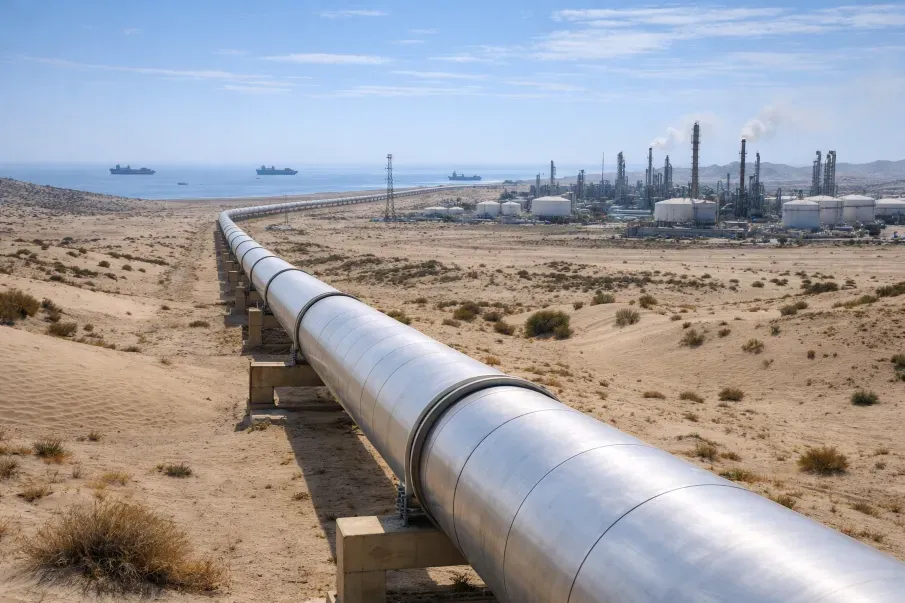
Riyadh | EcoPulse24
Kingdom deploys full-capacity contingency system to sustain exports amid near shutdown of key global chokepoint
Metric | Value
Pipeline Capacity | 7 million b/d
Crude via Yanbu | ~5 million b/d
Refined Products | 700,000 – 900,000 b/d
Domestic Refining | ~2 million b/d
Hormuz Pre-War Flow | ~15 million b/d
Pipeline Length | >1,000 km (620 miles)
Saudi Arabia has activated its East-West crude pipeline at full capacity of 7 million barrels per day, marking a critical operational milestone in its strategy to maintain oil exports as the Strait of Hormuz remains effectively disrupted.
The pipeline, which stretches more than 1,000 kilometers (620 miles) across the Arabian Peninsula from the Kingdom’s eastern oil fields to the Red Sea port of Yanbu, is now operating at maximum throughput, according to a person familiar with the matter.
Yanbu emerges as alternative export hub amid supply disruption
Crude exports routed through Yanbu have reached approximately 5 million barrels per day, while an additional 700,000 to 900,000 barrels per day of refined petroleum products are also being shipped from the Red Sea port. Of the total 7 million barrels per day flowing through the pipeline, roughly 2 million barrels are allocated to domestic refineries.
The rerouting of tankers to Yanbu has become a central element in sustaining Saudi Arabia’s export capacity, providing a crucial outlet as the Kingdom navigates one of the most significant disruptions to global oil transit routes in decades.
Bypass partially offsets Hormuz disruption but global risks remain elevated
Despite the scale of the operation, the Yanbu route only partially compensates for the loss of flows through the Strait of Hormuz, which previously handled around 15 million barrels per day of crude shipments before the conflict.
However, the existence of this alternative corridor is a key reason why oil prices have not yet surged to extreme crisis levels seen in past supply shocks, even as Brent and WTI approach elevated thresholds.
Decades-old contingency plan deployed within hours of conflict escalation
Saudi Arabia’s rapid response reflects long-standing contingency planning rooted in earlier geopolitical disruptions, including tanker attacks during the Iran-Iraq war in the 1980s. The East-West pipeline was designed precisely for such scenarios, enabling the Kingdom to maintain supply continuity even under severe regional stress.
Following the initial US and Israeli strikes on Iran, Saudi authorities moved within hours to activate and scale up east-to-west shipments, reinforcing the Kingdom’s role as a stabilizing force in global oil markets.
Red Sea emerges as potential new risk zone for energy markets
While the pipeline provides a vital alternative route, emerging risks in the Red Sea are now drawing market attention. Yemen’s Houthi group has signaled its entry into the conflict, raising concerns that the Red Sea and the Bab el-Mandeb strait could become new pressure points for global energy shipping.
Although there have been no confirmed attacks on tankers along this route, the group has previously demonstrated the capability to target vessels using drones and missiles, leaving markets sensitive to further escalation.
Saudi Arabia reinforces its role as global supply stabilizer
The deployment of the East-West pipeline underscores Saudi Arabia’s long-standing position as the world’s “supplier of last resort,” capable of mobilizing infrastructure to mitigate shocks to global energy supply.
By maintaining significant export volumes despite the disruption of Hormuz, the Kingdom is helping to cushion the global market from a more severe supply deficit, even as geopolitical uncertainty continues to shape price dynamics.
EcoPulse24 Analysis
What is unfolding is not just a logistical adjustment, but a structural shift in how global oil flows are being rerouted under geopolitical pressure. Saudi Arabia’s ability to activate a 7 million barrel-per-day bypass highlights the strategic importance of infrastructure resilience in today’s energy markets.
However, the partial offset relative to Hormuz’s scale reveals a deeper vulnerability: global supply remains highly dependent on a limited number of chokepoints. As risks begin to extend beyond Hormuz toward the Red Sea, the market is entering a new phase where supply security is shaped not only by production capacity, but by the survivability of transport routes.
In this context, the Saudi pipeline is not just a contingency asset-it is a stabilizing mechanism within an increasingly fragmented and risk-sensitive global oil system.
FAQs
1) What is Yanbu?
Yanbu is a major industrial port city in Saudi Arabia on the Red Sea. It serves as a key export hub for crude oil and refined petroleum products, especially when shipments are rerouted away from the Gulf.
2) Where is Yanbu located?
Yanbu is located on Saudi Arabia’s western coast along the Red Sea. This location allows oil exports to bypass the Strait of Hormuz and reach global markets through alternative shipping routes.
3) What is the East-West pipeline?
The East-West pipeline is a major Saudi oil pipeline that transports crude from the country’s eastern oil fields to Yanbu on the Red Sea. It is over 1,000 kilometers (620 miles) long and can carry up to 7 million barrels per day.
4) Why is this Saudi pipeline important right now?
The pipeline allows Saudi Arabia to continue exporting oil without relying on the Strait of Hormuz, which is currently disrupted. Running at full capacity, it helps stabilize global supply during the crisis.
5) Does this mean the oil crisis is over?
No. The pipeline only partially replaces the volume that used to flow through Hormuz (around 15 million barrels per day). Global markets remain vulnerable to further disruptions.
6) How could this affect fuel prices globally?
The pipeline helps limit extreme price spikes, but it doesn’t remove upward pressure. If tensions escalate or spread to other routes like the Red Sea, fuel prices worldwide could rise further.
Sources & References
Editorial Note
Disclaimer
© 2025 EcoPulse24. All rights reserved.